Multi-channel orders, multi-courier logistics, live tracking and COD & gateway reconciliation — every online sale posted to your real books.
Explore the Ecommerce moduleFrom auto spare parts to optical stores to cloud kitchens — find the configuration made for you.
Browse all industriesFBR, ZATCA, MyInvois & UAE e-invoicing — built into every invoice, not a bolt-on. Sell compliantly from day one.
Compliance hubBook a free 30-minute demo on your own kind of business — no slides, just the product.
Book a demoEloERP is jewellery billing software for the shop counter: weigh the piece in grams, take off the stone weight, price the metal at today's 22K or 18K rate, add making charge, wastage and stone value, record the hallmark number — and the bill shows every step of its working. Old gold exchange, stock by weight and karat, and books that post themselves come with it.
A shirt has a price. A gold bangle does not — it has a weight, a karat, and a rate that changed this morning. Its price is worked out at the moment of sale: net metal at today's rate, plus making, plus wastage, plus whatever stones are set in it.
Ordinary billing software makes the counter do that arithmetic on a calculator and type in the answer. The bill then shows a single number the customer cannot check, and stock is counted in pieces when what you actually hold is grams. Jewellery shop software has to do the working itself, and print it.
Each step a jewellery counter goes through — and where EloERP does it.
Gold and silver move every day. Every unpriced piece has to be billed at today's rate for its karat — not yesterday's, and not a rate someone remembers.
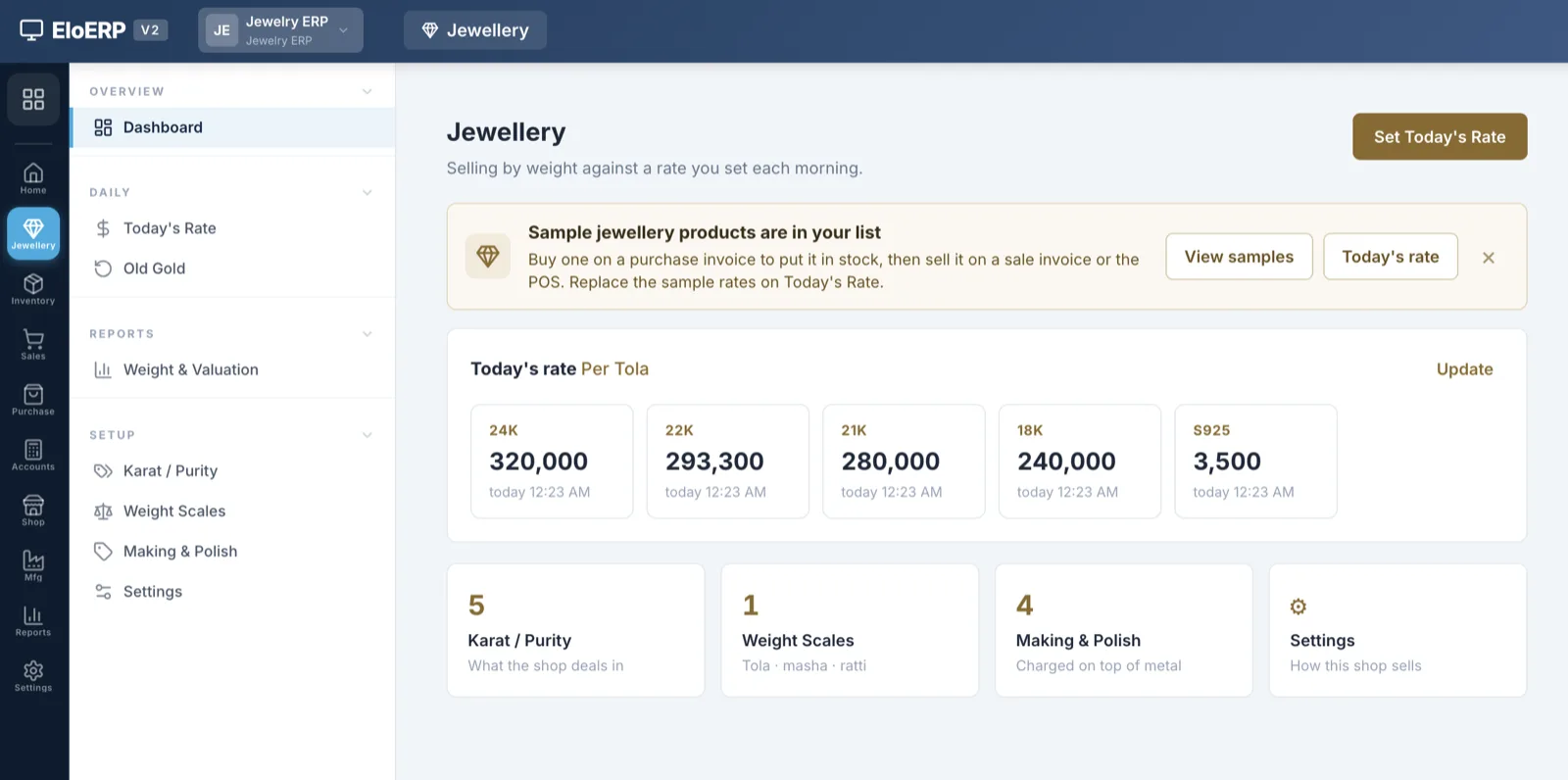
You set Today's Rate each morning for every karat you deal in — 24K, 22K, 21K, 18K and silver such as S925. Every piece without a fixed price prices from that day's rate.
The piece goes on the scale and the gross weight is what the bill starts from.
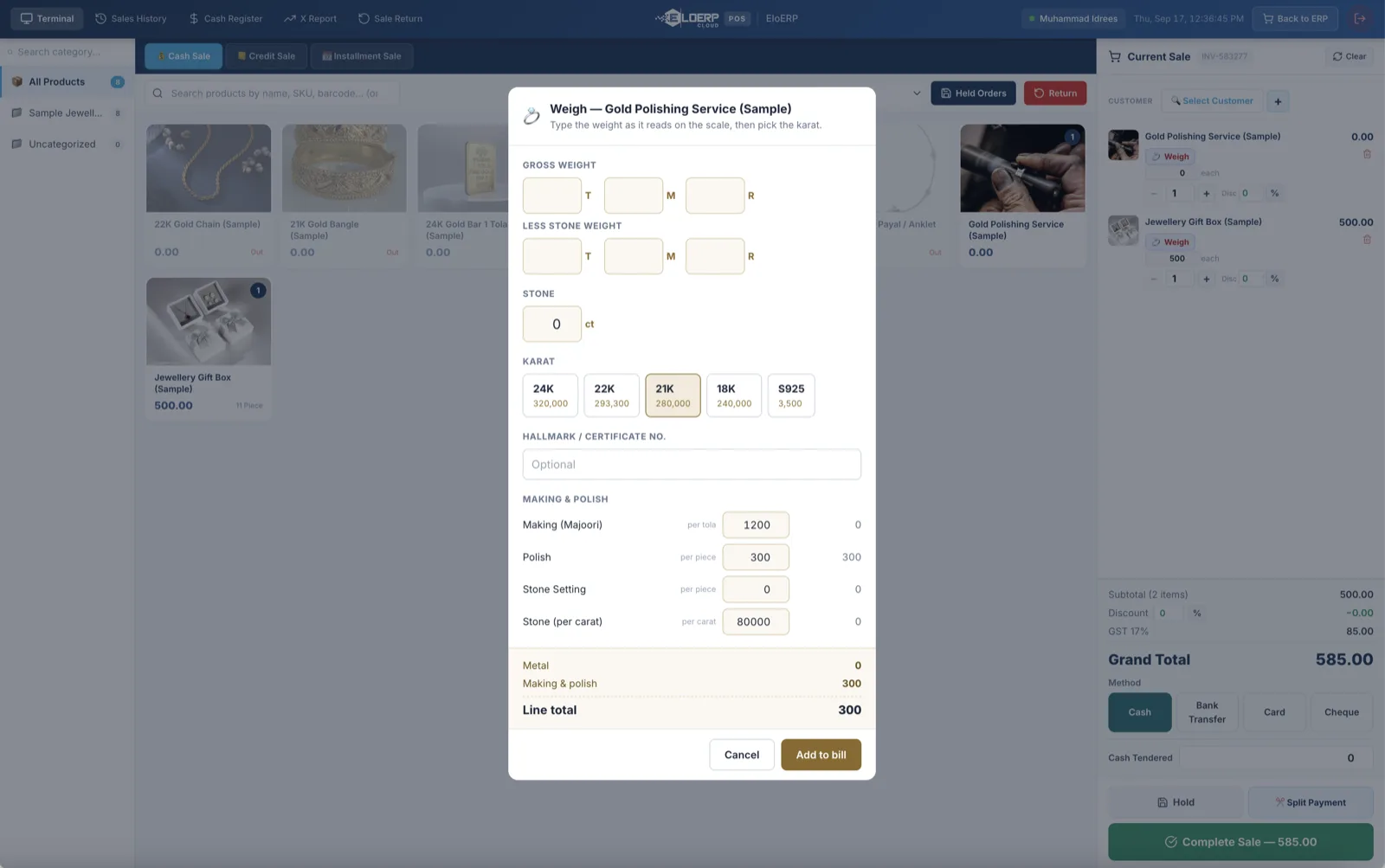
The weigh screen takes the gross weight as it reads on your scale. Weigh in grams — or tola, masha and ratti if that is how your shop works; the units are a setup choice.
A customer does not pay the gold rate on stones. Less-stone weight comes off the gross to give the net metal weight.
Enter the less stone weight and EloERP works out the net metal weight. The stones are entered separately in carats, with a per-carat stone rate.
22K and 18K of the same weight are very different money. The karat chosen decides the rate.
Tap the karat on the weigh screen; each button shows today's rate beneath it. The karats you deal in are set once under Karat / Purity.
Every shop charges making differently — by weight, by piece, or as a percentage — and often differently for different items.
Making charge can be set per weight unit, per piece, or as a % of metal value. Polish and stone setting are charged per piece. All of it is set under Making & Polish and adjustable on the line.
Wastage is charged as a percentage, and the customer will ask how it was arrived at.
Wastage is set as a %, so it is the same calculation on every bill, not whatever the counter typed that day.
The hallmark (HUID) or certificate number belongs to that one piece and should be on that customer's bill.
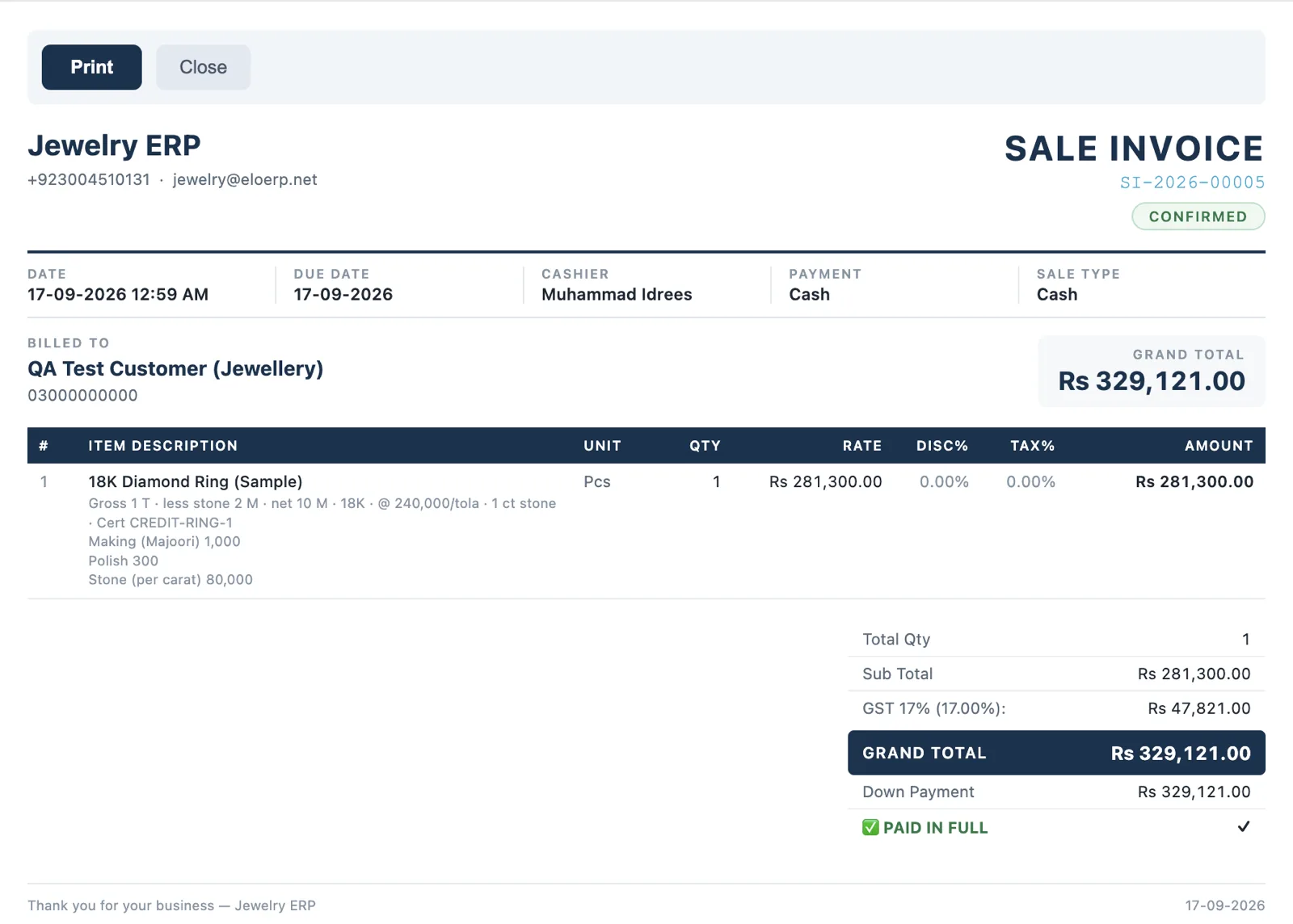
Each line has a Hallmark / Certificate No. field. Record the hallmark (HUID) or certificate number on each piece and it prints on the sale invoice.
Cash today, on account, or in instalments — and often split across more than one method.
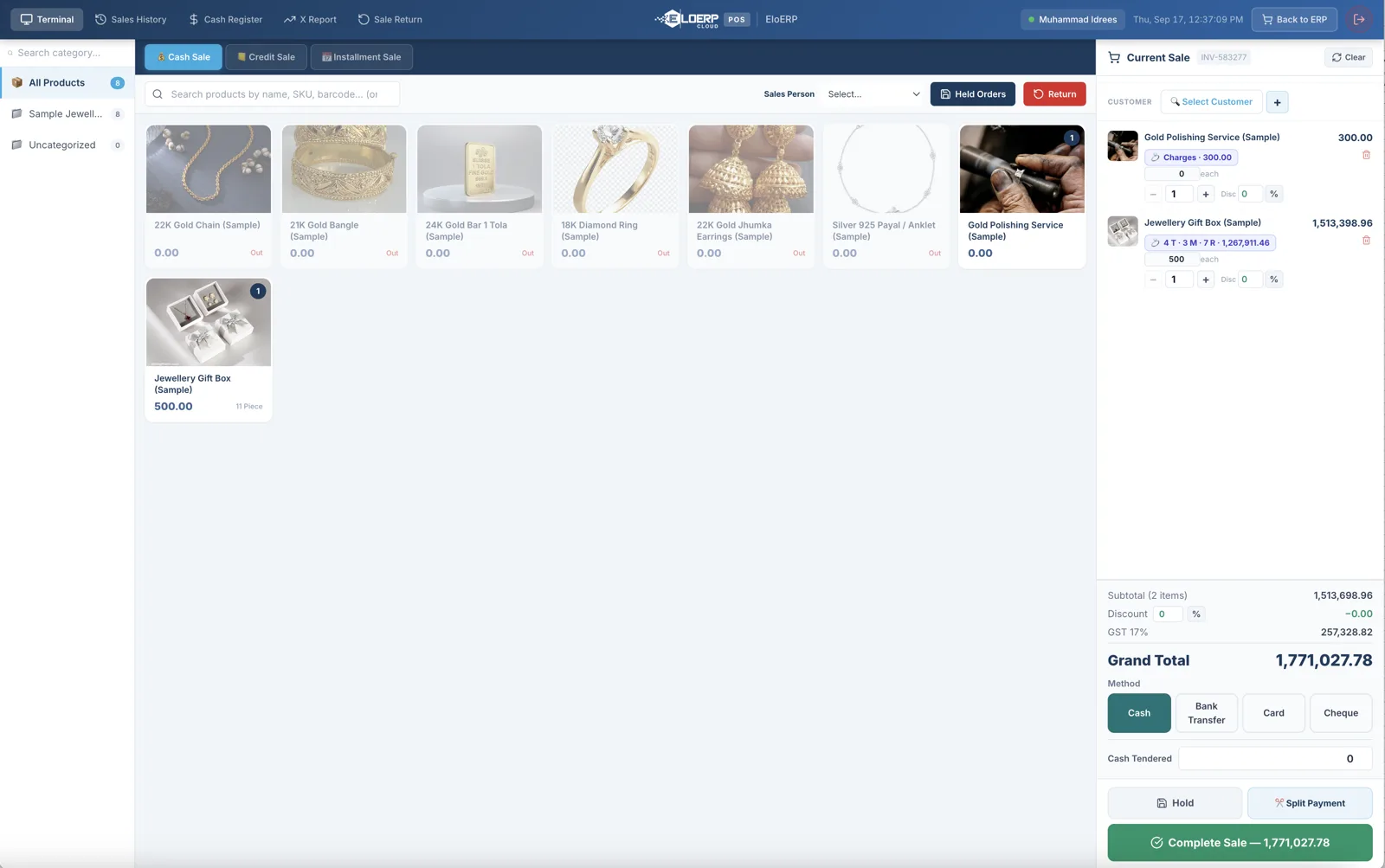
The POS has cash sale, credit sale and instalment sale, split payment across cash, bank transfer, card and cheque, hold orders for a customer who is still deciding, and returns.
An example of the arithmetic EloERP does on the line. The rates and charges below are illustrative figures, not today's market rate and not our price.
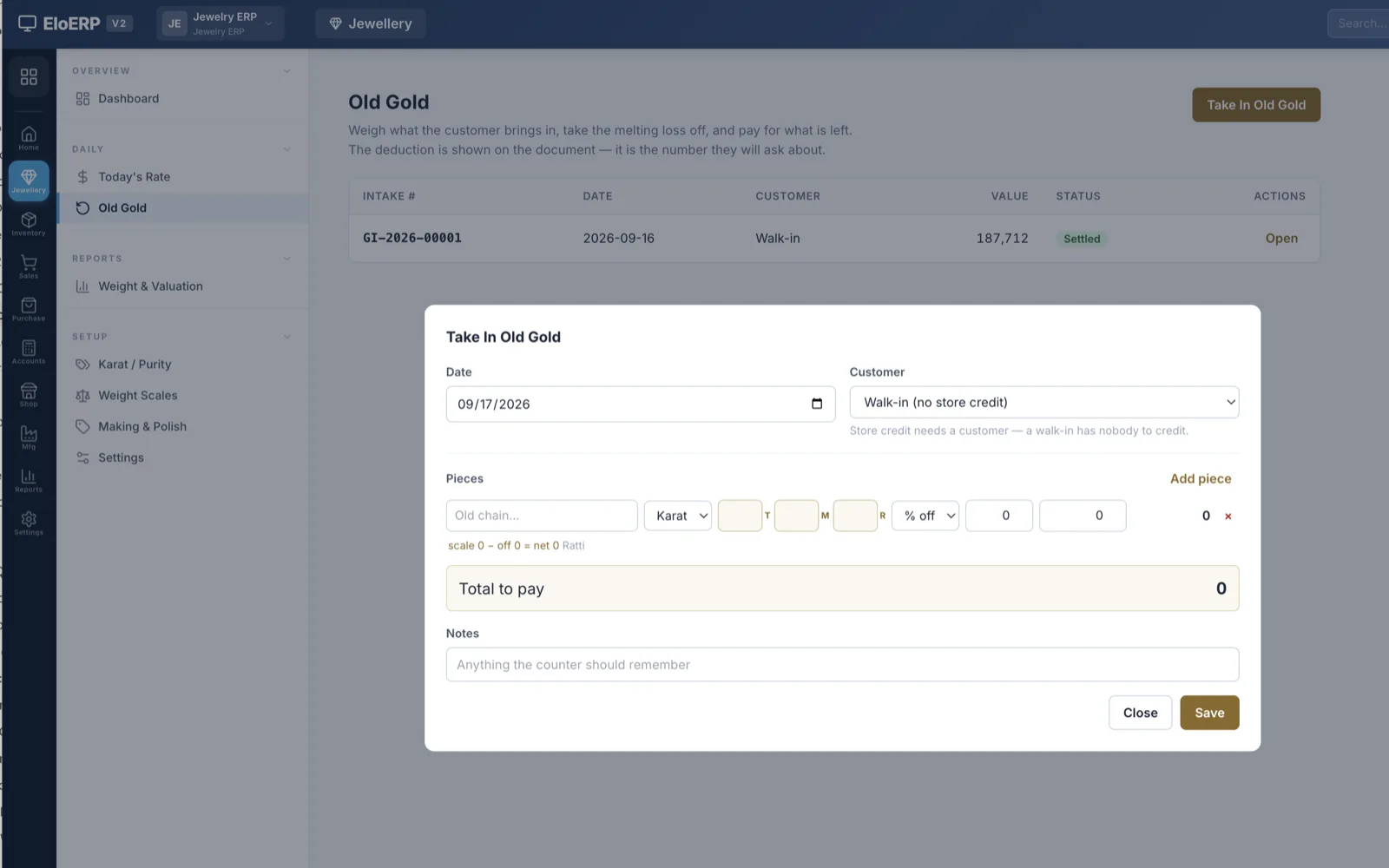
When a customer brings in old jewellery, the number they will question is the deduction. EloERP's Old Gold screen weighs each piece by karat, takes the melting loss off as a %, and shows what is left to pay for.
You then pay out, or give store credit to a named customer — a walk-in has no account to credit, so EloERP will not let you. Every intake is a numbered document that shows the deduction, so the conversation about melting loss happens once, on paper.
A jeweller's stock is grams of 22K, 18K and silver, not a count of pieces. Jewellery inventory software has to keep it that way.
For how to run jewellery stock day to day — counting, reconciling and valuing it — read our jewellery inventory management guide.
The POS keeps billing when the connection drops and pushes every sale to the cloud when it returns. More on offline POS.
Run several showrooms and warehouses in one system, each with its own stock, all in one set of books.
Roles and permissions decide who can do what at the counter and in the back office, with approvals where you want a second pair of eyes.
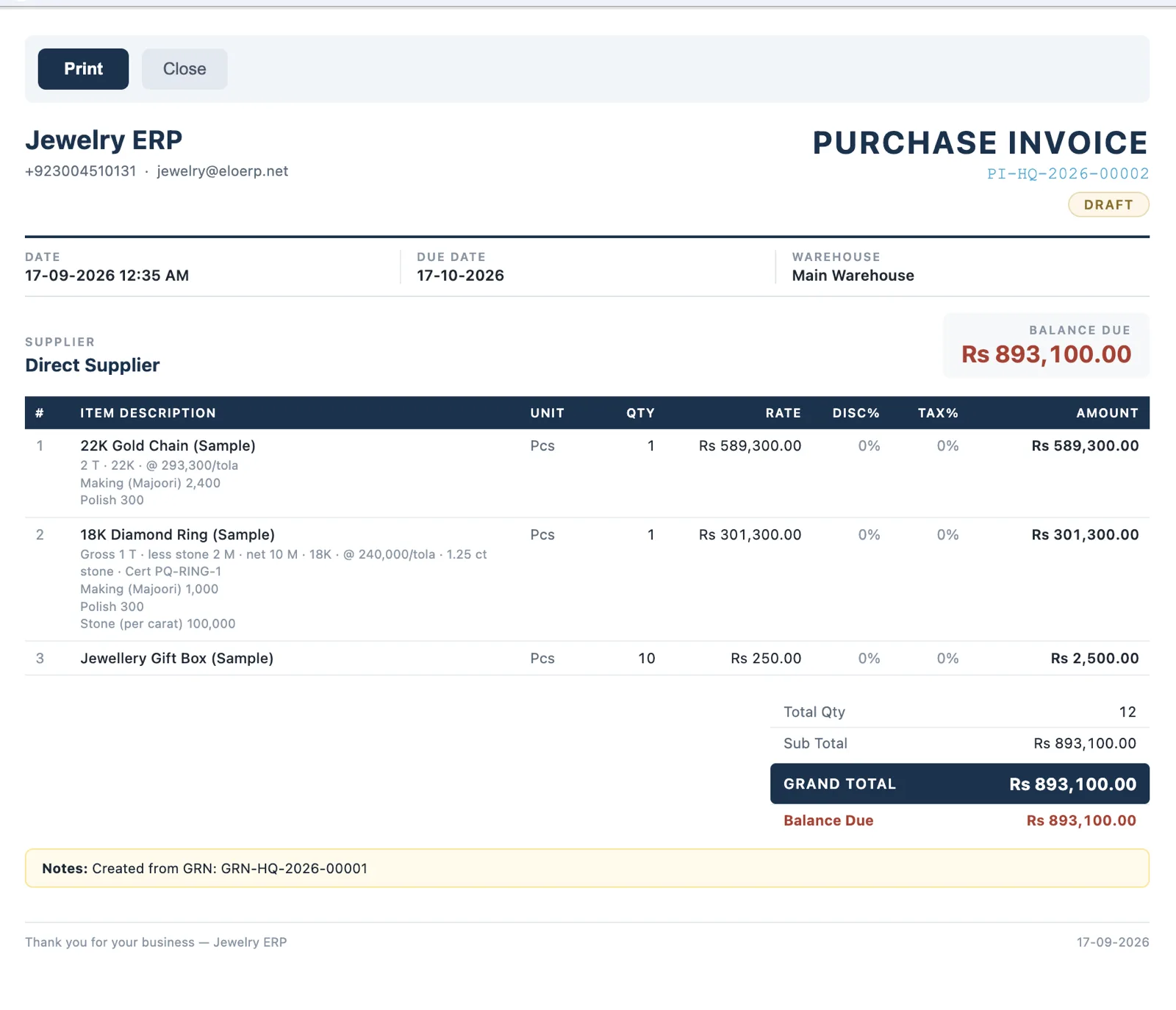
Jewellery management software has to cover more than the bill: what each customer owes, what you owe each supplier, repair jobs, and the accounts behind all of it.
Every sale and purchase posts to double-entry accounting as it happens. Nobody re-keys the day's bills into a separate accounts package.
Credit sales, instalments and old-gold credit sit on the customer's ledger; what you owe each supplier sits on theirs.
Repair jobs tracked to delivery, with the Services module.
The jewellery dashboard opens on today's rate per karat, with dashboards and reports for sales, stock and accounts alongside. HR & Payroll is an add-on, priced separately.
Need the full back office — accounting, purchasing and reporting in depth? See EloERP as jewellery ERP software.
Yes. The weigh screen takes gross weight and less-stone weight in grams, and today's rate is set per gram for each karat. If your shop works in tola, masha and ratti instead, that is a setup choice. Stone weight is entered in carats.
Tax is applied as a line on the invoice at the rate you configure. Indian GST invoices have their own format, so bring yours to the demo and we will show you how it prints from EloERP before you decide.
Making charge (majoori) can be charged per weight unit, per piece, or as a percentage of metal value. Wastage is set as a percentage. Polish and stone setting are charged per piece, and stones are priced per carat. EloERP adds them to the metal value on the line, and the sale invoice shows the making, polish and stone value.
Yes. Every line has a hallmark / certificate number field, and the number prints on the sale invoice. EloERP records the number you enter; it does not connect to any hallmarking portal or verify the number.
On the Old Gold screen you weigh each piece by karat and take off the melting loss as a percentage. The document shows the deduction and the value left. You then pay the customer out, or give store credit to a named customer. Walk-in customers can be paid out but cannot be given store credit, because there is no account to credit.
No. The POS keeps billing without an internet connection and sends the sales to the cloud when the connection returns, so the counter does not stop.
Yes. The POS has cash sale, credit sale and instalment sale, and a payment can be split across cash, bank transfer, card and cheque. Credit and instalment dues sit on the customer's ledger.
Pricing is on request. It is billed yearly, or monthly on request. You can try EloERP free for 15 days with no credit card.
Set today's rate, weigh in grams, add making and wastage, record the HUID — and let the bill show its working. Try it free for 15 days, or see it on your own bills in a demo.
No credit card for the trial. Pricing on request — get a quote.