Multi-channel orders, multi-courier logistics, live tracking and COD & gateway reconciliation — every online sale posted to your real books.
Explore the Ecommerce moduleFrom auto spare parts to optical stores to cloud kitchens — find the configuration made for you.
Browse all industriesFBR, ZATCA, MyInvois & UAE e-invoicing — built into every invoice, not a bolt-on. Sell compliantly from day one.
Compliance hubBook a free 30-minute demo on your own kind of business — no slides, just the product.
Book a demoEloERP buys your stock by weight and karat, holds it in every branch and warehouse, takes in old gold with the melting loss shown on the document, and posts every sale and purchase to your accounts. The counter, the stock and the books stop being three separate registers.
An ERP (enterprise resource planning) system is one set of records for the whole business instead of a separate register for each job. For a jewellery business — whether you search it as jewellery ERP or jewelry ERP — that comes down to the questions you already answer every day from the stock register, the rate board and the khata.
A spreadsheet or a billing program answers one or two of these. A jewellery ERP answers all six from the same records. The rest of this page shows how EloERP does each one.
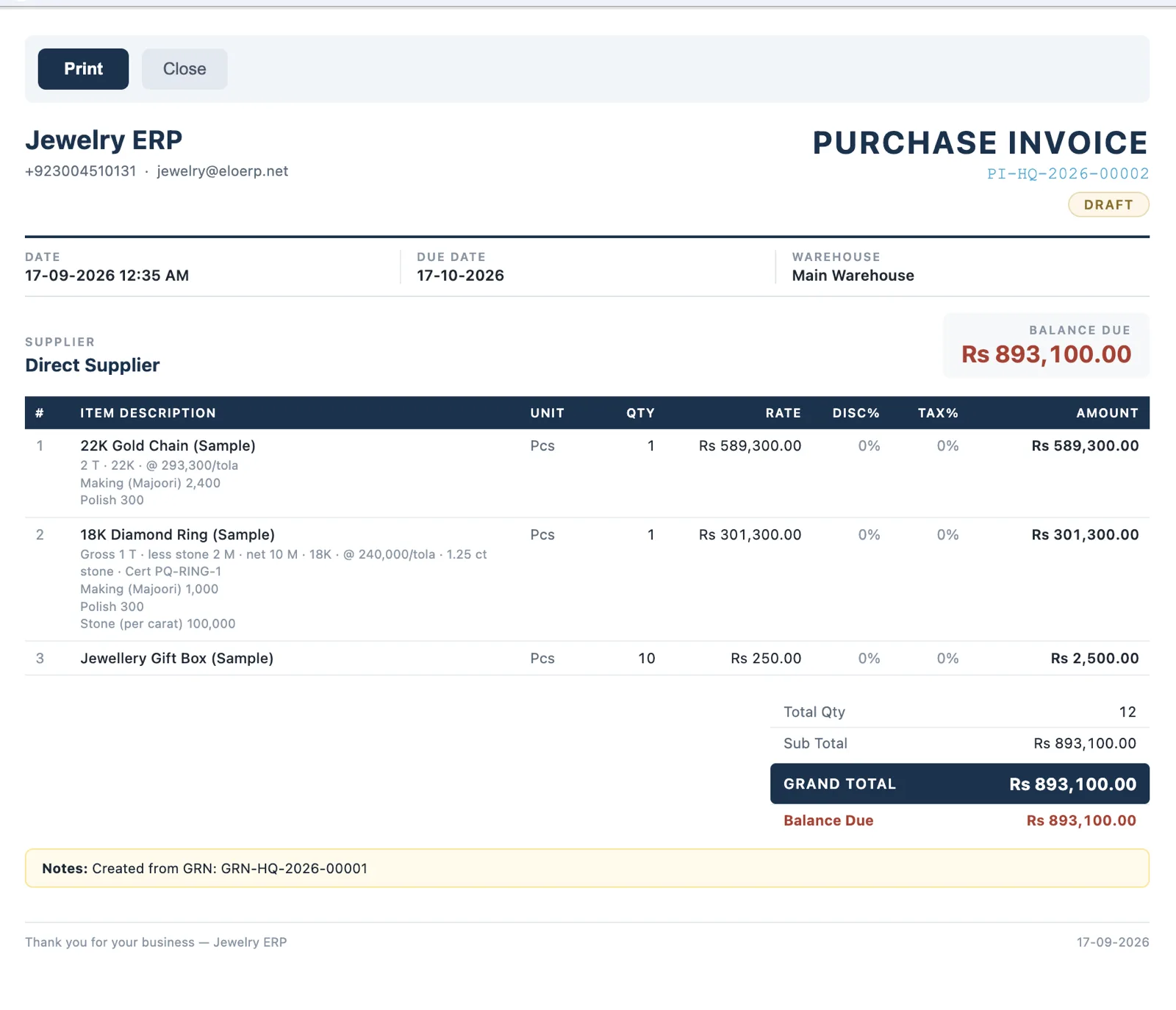
Gold does not arrive as "1 chain at a price". It arrives as a weight, a purity and a rate, with making on top. EloERP's purchase invoice is built that way: every line carries the weight, karat, rate and making, and stone pieces carry gross weight, less stone weight, net weight and the stone in carats at a per-carat rate.
For purchasing outside the jewellery screens — orders, returns to supplier, supplier payments — see Purchasing.
The weight, karat and making you recorded on the purchase stay with the piece. Stock is held per warehouse, every warehouse belongs to a branch, and the Weight & Valuation report shows what you hold by weight and what it is worth — the figure an owner actually wants, rather than a count of pieces.
The general stock tools — stock ledger, counts, transfers, valuation by warehouse — are described on Inventory; for a weekly counting routine by weight, see the jewellery inventory management guide.
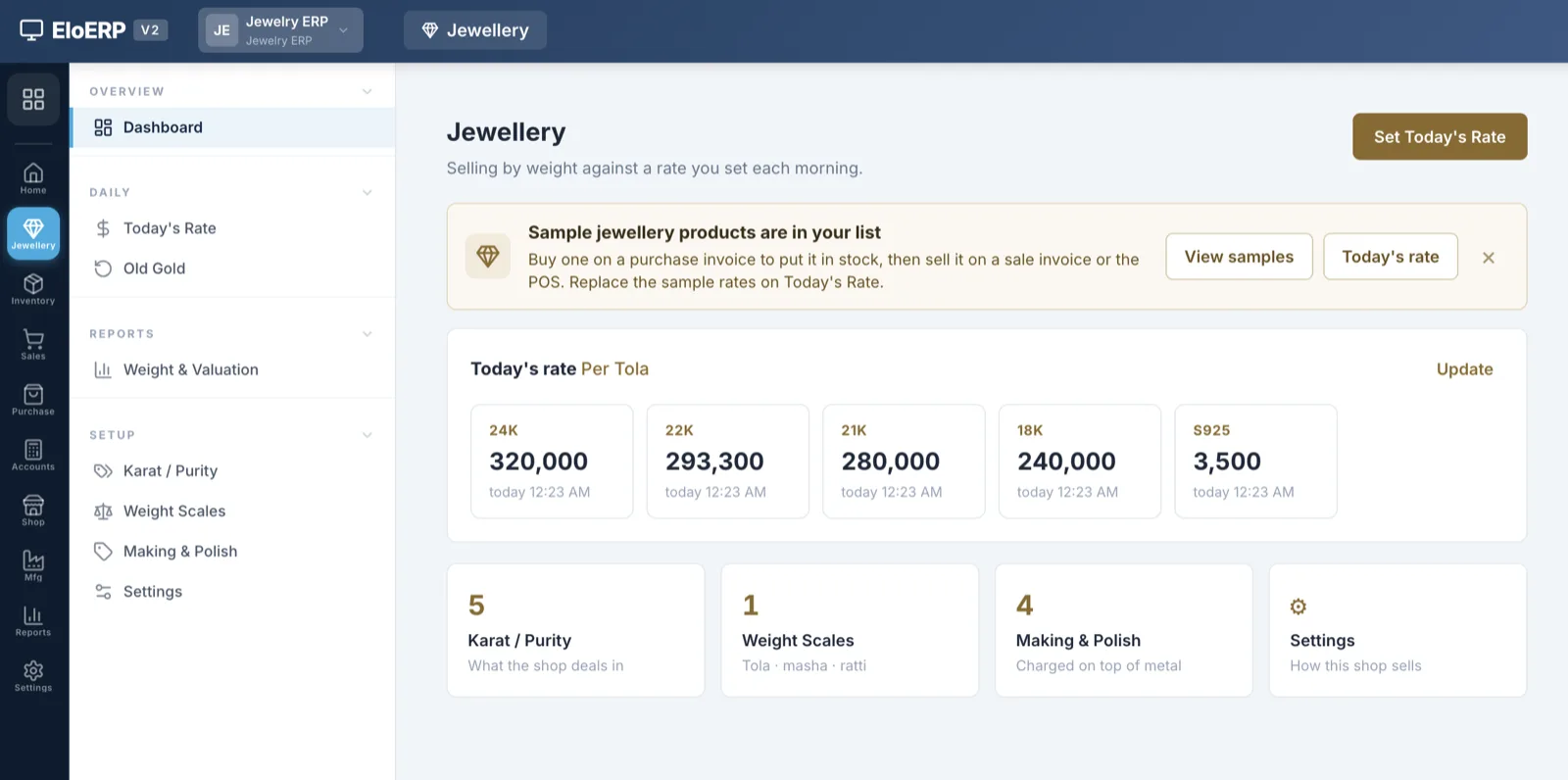
Gold and silver move every day, so a jewellery ERP cannot keep a fixed price on a piece. In EloERP you set today's rate per karat each morning, and every piece without a fixed price is priced from that day's rate by its net weight.
The jewellery dashboard shows each rate with the time it was set, next to the setup the rate works with: Karat / Purity, the weight units, and Making & Polish — the charges added on top of metal value.
Change the rate once and the next sale uses it. Nobody re-types prices across the showroom.
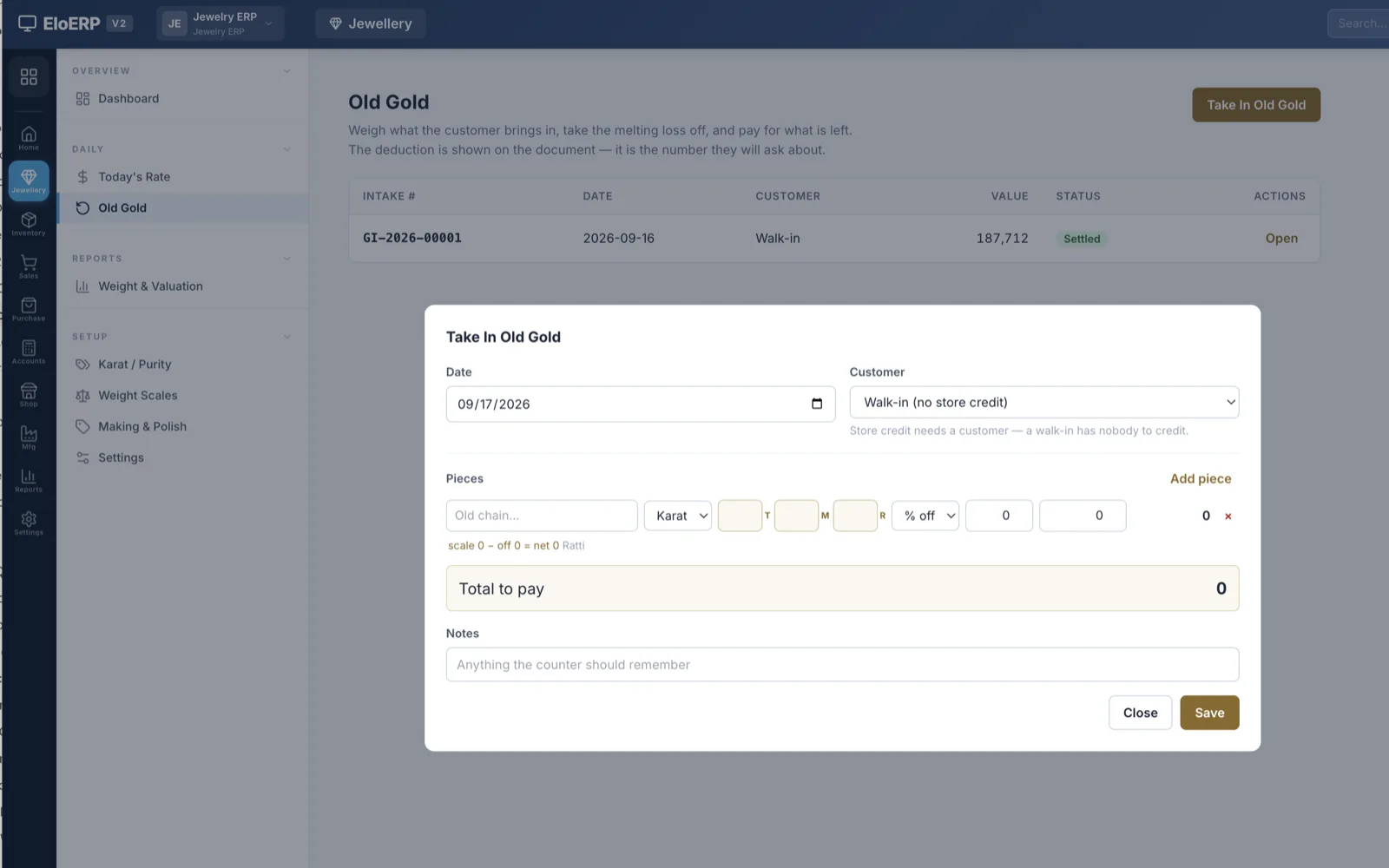
When a customer brings in old jewellery, the argument is always about the deduction. EloERP takes it in as a numbered intake document: each piece is weighed and given its karat, the melting loss is taken off as a percentage, and the document shows the deduction — because that is the number the customer will ask about.
In most jewellery shops the bills are written in one place and the accounts are typed again somewhere else. In EloERP the accounts are double-entry and posted from the documents themselves: confirm a sale or a purchase and it is posted to the right ledgers, with the stock moving at the same time.
The supplier is owed and the stock is up. The purchase posts to the books and the balance due sits on the supplier's ledger until you pay it.
The sale and its cost are both posted. Cash, card, bank transfer or cheque, or a balance left on the customer's ledger for a credit or instalment sale.
Returns reverse what the sale did — the stock comes back and the customer's side is corrected.
Nothing is quietly deleted. Cancelling a confirmed invoice reverses its entries, so the history stays readable.
Trial balance, profit and loss and balance sheet come from the same entries. See Accounting for the general ledger.
Every customer you sell to on credit has a ledger, a credit limit and a running balance. A sale can be cash, credit or instalment; an instalment sale carries a down payment and a schedule — monthly, fortnightly or weekly — and each instalment received is posted against it.
Each purchase invoice lands on the supplier's account with its due date and balance due. Payments are recorded against the invoice, and payables are aged so you can see what falls due first.
The counter is part of the same system, so a sale there is the same sale the ledgers and stock see. Cash, credit and instalment sales, held orders, returns and split payments are all at the till. EloERP's offline POS keeps selling with no internet and pushes each sale to the cloud when the connection returns — see how offline POS works.
If what you need first is the billing counter itself — weighing a piece, karat, making, stone and certificate on the bill — that is covered on jewellery software for the billing counter.
Repair jobs tracked to delivery, with the Services module.
Staff records and payroll can run in the same system as the shop. It is an add-on priced separately, so you only take it if you want it. See HR & Payroll.
Jewellery ERP software is one system for the whole jewellery business rather than a separate register for each job. It records purchases by weight and karat, holds stock by branch and warehouse, prices from the day's gold rate, takes in old gold, keeps customer and supplier ledgers, and posts every sale and purchase to double-entry accounts. EloERP does all of these in one cloud system with a POS at the counter.
Billing software produces the bill at the counter. An ERP also covers what happens before and after it: buying stock from suppliers by weight and karat, holding it across branches and warehouses, old gold intake, customer and supplier ledgers, and the accounts. In EloERP the counter and the back office are the same system, so a sale updates stock and the books at once.
Yes. Each line on a purchase invoice carries the weight, karat, rate and making charge, and stone pieces carry gross weight, less stone weight, net weight and the stone in carats at a per-carat rate. The purchase invoice can be created from the GRN (goods received note) for the delivery, and it records the warehouse the stock went into.
Both. You can weigh in grams, or in tola, masha and ratti. Today's rate is set per karat, for 24K, 22K, 21K and 18K gold and for silver such as S925.
Tax is applied as a line on the invoice at the rate you configure. Bring your GST invoice format to the demo and we will show you how it prints.
Each piece is weighed and given its karat, the melting loss is deducted as a percentage, and the intake is saved as a numbered document that shows the deduction. You can pay the customer out, or give store credit to a named customer. A walk-in customer is paid out, because store credit needs a named customer to hold it.
The counter does. EloERP's offline POS keeps selling with no internet connection and pushes each sale to the cloud when the connection returns, so the stock and the books catch up without anything being typed twice.
Pricing is on request. It is billed yearly, with monthly billing on request. HR and Payroll is an add-on priced separately. You can try EloERP free for 15 days with no credit card, or book a demo and ask for a quote.
Purchases by weight and karat, stock across branches, old gold and the books — try it free for 15 days with no credit card, or book a demo and bring your own invoice formats. Pricing is on request — get a quote.