
Jewelry Inventory Management: Track Stock by Weight and Karat

Jewelry inventory management is the job of knowing, at any moment, exactly which pieces you hold, how much metal is in them, at what purity, and what that metal is worth at today's rate. A shoe shop counts pairs. A jewelry store has to count pieces and grams, and the value of those grams moves every morning even when nothing is bought or sold.
This guide covers what a jeweller actually has to track, how to hold stock by net weight and karat, how to value it at today's rate (with a worked example), how old gold comes back in, why every piece needs its hallmark or certificate number against it, and how to count stock by weight so a missing gram shows up the same day.
Why jewelry inventory management is different
General retail inventory systems are built around a product code and a quantity. Jewelry breaks that model in three ways:
- Pieces are not interchangeable. Two rings that look identical can differ in karat, stone weight and cost. Selling "one ring" from stock is not enough; you need to know which ring left.
- Value sits in the weight, not the price tag. A 22K bangle is worth its net metal weight times today's 22K rate. A fixed price written on a tag last month is already wrong.
- Metal comes back in. Customers sell or exchange old gold at the counter. That metal arrives in irregular weights and purities, minus a melting loss, and it has to be accounted for like any other stock.
That is why a spreadsheet of SKUs and quantities stops working for a jewellery shop long before it stops working for most other retailers.
What a jewelry inventory management system has to record for each piece
Before you choose a method or a system, agree what one stock record means. For each piece, a jeweller needs:
| Field | Why it matters |
|---|---|
| Karat / purity | Decides which of today's rates the metal is valued at (24K, 22K, 21K, 18K, silver 925 and so on). |
| Gross weight | What the piece weighs on the scale, stones included. |
| Less stone weight | The weight of stones and other non-metal parts, taken off the gross. |
| Net metal weight | Gross minus less stone. This is the only weight the metal rate applies to. |
| Stone weight (carats) | Priced separately, at a per-carat stone rate. |
| Making charge and wastage | How labour is charged on top of the metal: per gram, per piece or as a % of metal value, plus wastage as a %. |
| Hallmark or certificate number | Identifies this exact piece to the customer, the insurer and your own audit. |
| Purchase weight, karat and rate | What you actually paid for the metal, so margin is real rather than guessed. |
If any of these lives only in a notebook or on a paper tag, your stock valuation and your counts will drift apart.
Tracking jewellery stock by weight and karat
Jewellers who weigh in grams (and, in parts of South Asia, in tola, masha and ratti) already think this way at the counter. The inventory has to think the same way: stock is held as net metal weight per karat, and it is valued at today's rate, not at a stored price.
Gross, less stone, net
Every piece goes on the scale for its gross weight. Stones and other non-metal parts are weighed or taken from the supplier's note as "less stone", and what remains is net metal. Stone weight in carats is kept separately, because stones are valued at their own per-carat rate. One carat is 0.2 grams, so a ring carrying 0.90 ct of stones has 0.18 g that must not be valued as gold.
Worked example: valuing stock at today's rate
The figures below are an illustration of the arithmetic only. They are not a market rate and not anyone's price. Swap in your own currency per gram and the method is identical.
Say this morning's rates are 22K ₹9,000/g, 18K ₹7,400/g and silver 925 ₹95/g, and the safe holds:
| Stock line | Gross (g) | Less stone (g) | Net (g) | Metal value |
|---|---|---|---|---|
| 22K plain bangles, 6 pcs | 92.400 | 0 | 92.400 | ₹831,600 |
| 18K diamond rings, 10 pcs (9.00 ct stones) | 38.000 | 1.800 | 36.200 | ₹267,880 |
| 925 silver chains, 25 pcs | 1,250.000 | 0 | 1,250.000 | ₹118,750 |
| Metal value at today's rate | ₹1,218,230 |
The stones in the rings (9.00 ct) are valued separately at their per-carat rate. Two things this example shows:
- Valuing gross weight overstates stock. Had the rings been valued at 38.000 g instead of 36.200 g, the books would carry 1.8 g of stone as gold: ₹13,320 of value that does not exist, on just ten rings.
- Stock value moves with the rate. If 22K goes up ₹120/g tomorrow, the six bangles are worth ₹11,088 more without a single sale. A system that stores a fixed price per piece cannot show you that; one that holds net weight per karat can, the moment the new rate is entered.
Pricing a piece at the counter from the same records
Because the stock record already holds net weight, karat and stone carats, an unpriced piece can be priced at the moment of sale: net weight × today's rate for that karat, plus wastage %, plus making charge (per gram, per piece or % of metal value), plus stone value (carats × per-carat rate), plus polish or setting, plus tax at the rate you set. Doing that arithmetic by hand, for every piece, every day the rate changes, is where errors and arguments at the counter come from.
Old gold coming back into stock
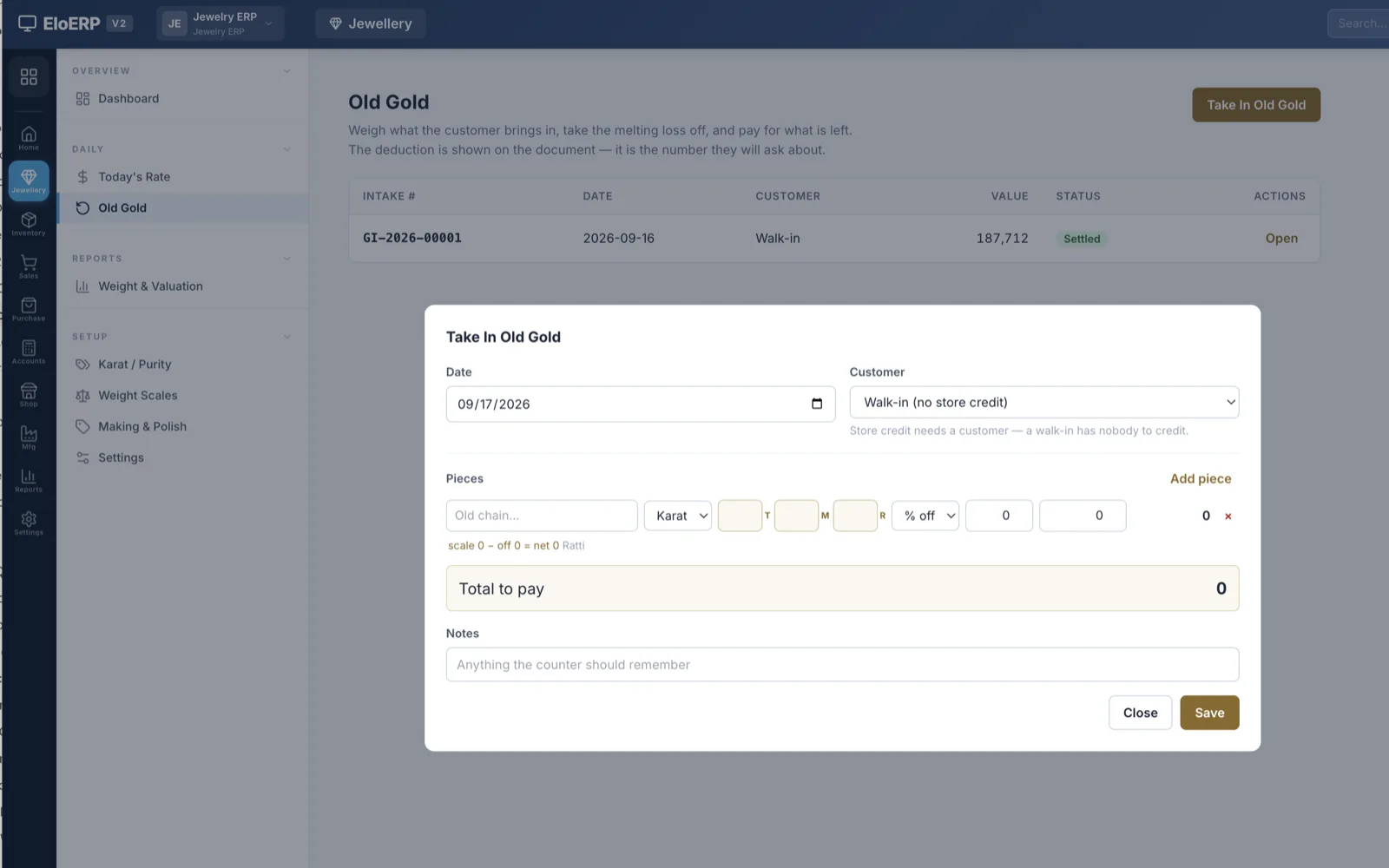
Old gold bought or exchanged at the counter is stock arriving through the front door instead of from a supplier, and it needs the same discipline:
- Weigh each piece and record its karat. A customer's "22K chain" is weighed and assessed as what it is, not as what it is described as.
- Deduct melting loss as a stated percentage. If the 22K chain weighs 20.000 g and your melting loss is 4%, 0.800 g comes off and 19.200 g is what you pay for. At ₹9,000/g, that is ₹172,800 (again, an illustration of the arithmetic).
- Put the deduction on a numbered document. The melting-loss line is the number the customer will ask about. A printed, numbered intake record answers the question once and leaves an audit trail.
- Settle it properly. Either pay out, or give store credit against a named customer so it can be used on a later purchase. A walk-in with no customer record has nobody to credit.
- Account for the metal. The net weight taken in, by karat, is metal you now own. If it is not recorded by weight and karat, your next stock count by weight will not balance.
Hallmark and certificate numbers on every piece
For a jewelry store, the identifier that matters is usually the one already stamped or issued with the piece: the hallmark number (the HUID on hallmarked gold in India) or a diamond grading certificate number. Recording it against each piece in stock does three jobs:
- it tells you which ring was sold, not just that a ring was;
- it lets the customer see on the invoice that the piece they paid for is the piece they were shown;
- it gives your counts, insurance claims and loss investigations something exact to check against.
The rule is simple: no piece goes into the showcase until its weight, karat and hallmark or certificate number are in the system.
Counting and reconciling jewelry stock by weight
A jewelry count that only checks piece numbers misses the expensive problem: a piece swapped for a lighter one, or a chain shortened. Counting by weight catches it. A workable routine:
- Count by tray and by karat. Keep each tray to one karat so its weight can be compared with one book figure.
- Check the piece count first, then put the tray on the same calibrated scale you use at the counter and compare its gross weight with the book gross weight for that tray.
- Allow only the scale's tolerance. If your scale reads to 0.01 g, a 40-piece tray can honestly differ by a few hundredths of a gram. Anything beyond that is a discrepancy to investigate today, piece by piece, using the weights and hallmark numbers on record.
- Total by karat. At the end of the count, net weight per karat on hand should equal the book weight per karat, plus old gold taken in, less what was sold and sent out.
- Record every adjustment with a reason. Never overwrite a weight to make a count balance. A posted adjustment with a reason is evidence; a silent edit is a hole.
- Set a rhythm. High-value trays daily at opening and closing, each karat weekly, the whole shop monthly, and an extra count after any large old-gold intake.
This only works if the book weight per karat is current to the last sale. Reconciling against a paper register updated at night means investigating yesterday's gap tomorrow.
Receiving stock from suppliers by weight
Most jewelry inventory errors start at receipt. When a supplier delivers, check what arrived against what was ordered, then enter each line with its weight, karat, rate and making charge as invoiced. Booking a parcel as "12 rings" instead of "12 rings, 18K, 46.300 g net" means the stock record is wrong from the first day and no later count can fix it.
Jewelry store inventory best practices
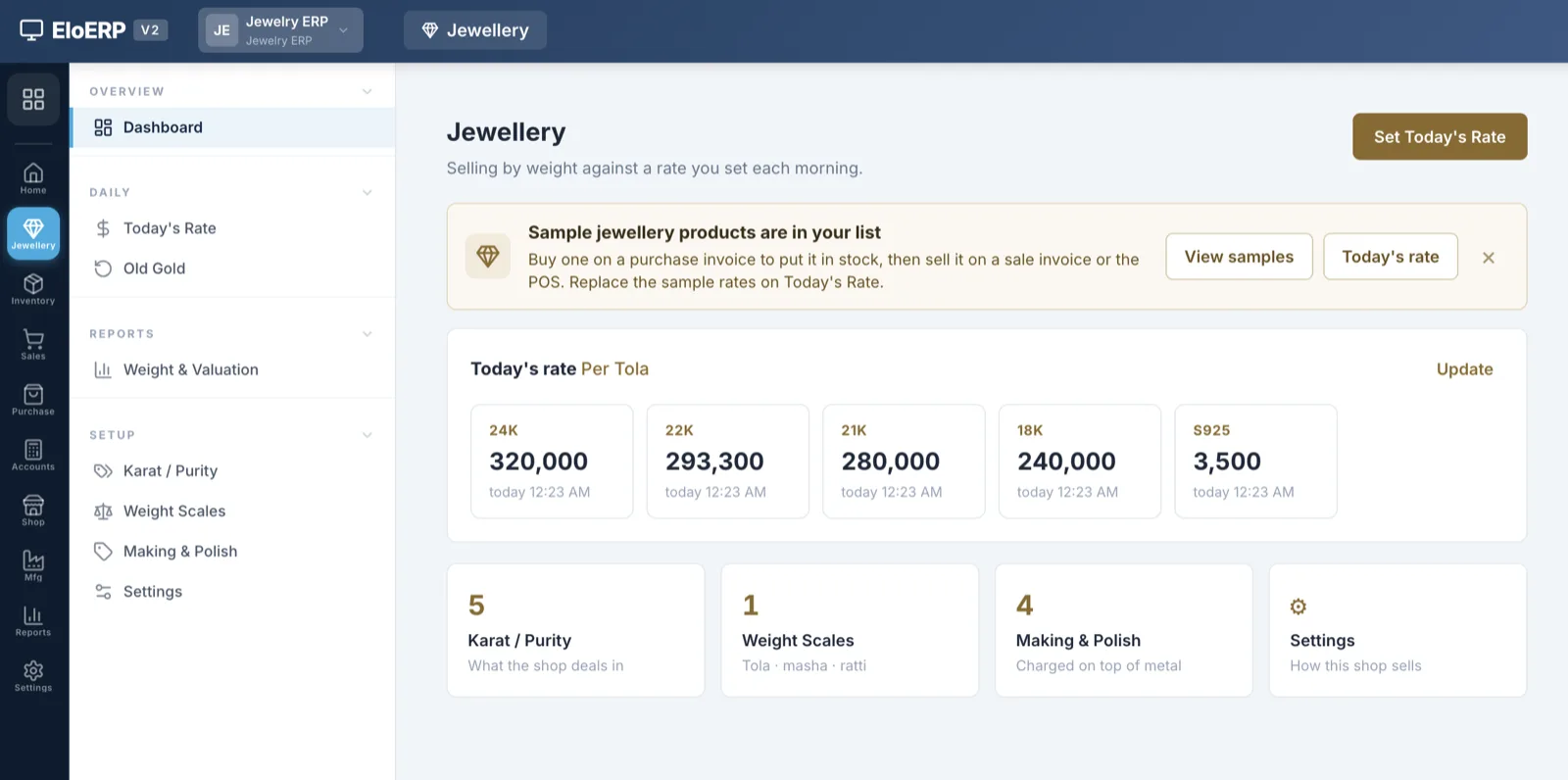
- One person sets today's rate, once, before the shop opens. Every valuation and every unpriced sale that day depends on it.
- Separate the safe from the showcase. Hold display stock and reserve stock as separate locations so you always know what is on the counter and what is locked away, and record every move between them.
- Record every piece on receipt, with weight, karat and hallmark or certificate number, before it goes on display.
- Review slow-moving pieces monthly. Jewelry ties up capital, insurance and display space. Anything unsold for 90 days needs a decision: re-display, re-price or return.
- Keep old gold and new stock apart in your counts until the old metal has been dealt with, so each reconciles to its own record.
What to look for in a jewelry inventory management system
If you are choosing software, test it against the job rather than a feature list. Ask to see it:
- set a rate per karat in the morning and revalue stock from it;
- record gross, less stone and net weight, plus stone carats, on a single piece;
- price an unpriced piece at the counter from net weight, karat, making, wastage and stones, with the working shown on the invoice;
- take in old gold by karat with melting loss deducted on a numbered document, paid out or credited to a named customer;
- carry the hallmark or certificate number on the piece and print it on the sale invoice;
- report stock by weight and value, so a count by weight has a book figure to check against;
- post every sale and purchase to the accounts without re-keying.
A system that cannot do the first three is a general retail system with a jewelry label on it.
How to do this in EloERP
EloERP is a cloud ERP and POS with a jewellery module built around selling by weight against a rate you set each morning. Here is how the routine above maps onto it:
- Today's rate: set the rate per karat each morning (24K, 22K, 21K, 18K and silver such as S925). Every unpriced piece prices from that day's rate.
- Weight and karat on every line: weigh in grams, or in tola, masha and ratti. Gross weight less stone weight gives net metal weight; stone weight is in carats with a per-carat stone rate. Karat / Purity and Making & Polish are set up once.
- Making and wastage: making charge per weight unit, per piece or as a % of metal value; wastage as a %; polish and stone setting per piece.
- Purchases: purchase invoices carry weight, karat, rate and making per line, created from a goods received note, into the warehouse you choose.
- Old gold: weigh each piece by karat, take melting loss off as a %, then pay out or give store credit to a named customer. Intake documents are numbered and show the deduction.
- Hallmark and certificates: record the hallmark (HUID) or certificate number on each piece; it prints on the sale invoice alongside gross, less stone, net, karat, rate, stone carats, making, polish and stone value.
- Counts: the Weight & Valuation report gives you the book figure to weigh against, and physical stock counts record counted against system quantities with a reason for each difference before adjustments are posted.
- Selling: the POS handles cash, credit and installment sales, held orders, returns and split payments (cash, bank transfer, card, cheque), and keeps selling offline when the internet drops, syncing when it returns.
- Behind the counter: multi-branch and multi-warehouse stock, double-entry accounting posted from every sale and purchase, customer and supplier ledgers, and roles and permissions to control who can do what. Repair jobs can be tracked to delivery with the Services module.
Which page to read next depends on where you sell:
- Jewellers in India billing at the counter by weight: EloERP jewellery software.
- Jewelry stores in the US looking for a point of sale that prices by weight and karat: EloERP jewelry store POS software.
- If your connection is unreliable: how the offline POS keeps selling.
Pricing is on request and billed yearly. Get a quote and a demo with your own karats, rates and a few real pieces, or start a 15-day free trial with no credit card.