
EloERP Cloud
The compliance differentiator

FBR, ZATCA, MyInvois & UAE e-invoicing — built into every invoice, not a bolt-on. Sell compliantly from day one.

Compliance hub
Guide

UBS vs EloERP: Which Accounting Software Is Right for Malaysian Businesses in 2026?
EEloERP Team··5 min read
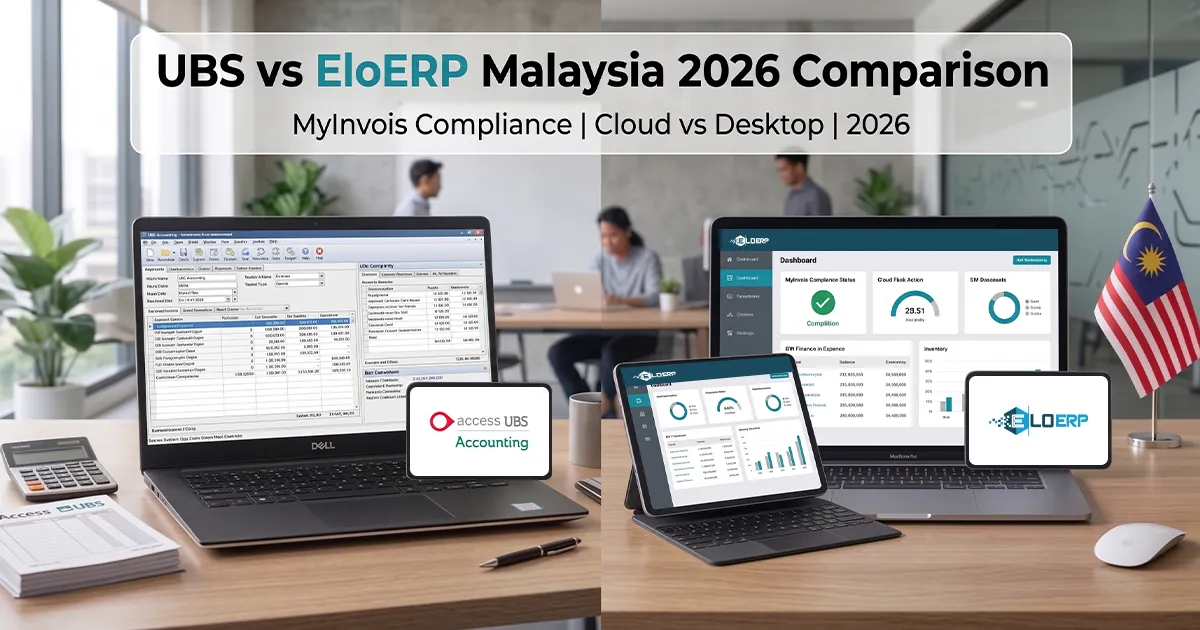
UBS vs EloERP: Which Accounting Software Is Right for Malaysian Businesses in 2026?

UBS Accounting is a desktop Windows software with optional cloud hosting and MyInvois compliance via add-on module, ideal for single-location accounting needs. EloERP is cloud-native ERP with built-in MyInvois, multi-mode POS, and real-time multi-branch sync — better for multi-location businesses needing all-in-one POS + accounting. Pricing: UBS = per-user licensing (RM995-1,585/year for accounting, additional costs for cloud/modules); EloERP = flat-rate SaaS with unlimited users. Choose based on deployment preference (desktop vs cloud) and feature scope (accounting-only vs full ERP).

Malaysia's MyInvois e-invoicing mandate is prompting SMEs to re-evaluate their accounting software choices. UBS (formerly Sage UBS, now Access UBS) is an established Malaysian accounting brand with 30+ years in the market and 31,000+ users — a desktop-first solution with optional cloud hosting. EloERP is a cloud-native ERP with built-in MyInvois compliance, multi-mode POS, and real-time multi-branch synchronization. This comparison covers features, MyInvois compliance architecture, deployment models, pricing, and ideal fit scenarios to help you decide which solution matches your business needs in 2026.

Quick Comparison Summary

Feature UBS Accounting EloERP Cloud
Deployment Desktop (Windows) + optional cloud hosting (RM600/year) Cloud SaaS (browser-based)
MyInvois Compliance Via e-invoicing module/integration (separate setup) Built-in (native LHDN integration, company-level toggle)
Multi-branch Support Desktop per location OR cloud hosting (yearly fee) Real-time cloud sync (all branches)
User Access 1-3 concurrent users (RM995-1,585/year for accounting) Unlimited users (role-based permissions)
POS Integration UBS POS module available (separate license) Built-in multi-mode POS (retail/restaurant/pharmacy)
Mobile Access Via Connect UBS Online (RM600/year) Native (iOS/Android/browser)
Backup & Security Manual (desktop) OR cloud service (if hosted) Automated daily cloud backup (encrypted)
Pricing Model Per-user license + modules + cloud add-ons Flat-rate SaaS subscription (see pricing)
Best For Single-location desktop users, established UBS base, accounting-only needs Multi-location cloud-first businesses, all-in-one POS+ERP, compliance urgency

About UBS Accounting Software

Access UBS (formerly Sage UBS) is an established Malaysian accounting software with over 30 years of product development and 31,000+ users. It's a desktop Windows application with an optional cloud connectivity service called "Connect UBS Accounting Online."

Core Features:

Available Modules:

Deployment Options: The core product is a desktop Windows installation for on-premise use. Cloud access is available via "Connect UBS Accounting Online" at RM600/year, enabling remote access to the desktop application. Traditional desktop licensing remains the primary deployment model, with cloud connectivity as an add-on service.

Strengths:

Limitations (per third-party reviews and reseller documentation):

Target Market: Malaysian SMEs, non-profits, single-location businesses needing accounting-focused functionality with optional inventory, payroll, and POS modules.

Sources: Access UBS Official Site | Rockbell UBS Overview | IT Simple Access UBS

About EloERP Cloud

EloERP is an all-in-one cloud ERP and POS system built by IT Vision Pvt. Ltd. specifically for multi-location businesses requiring integrated point-of-sale, inventory, accounting, and compliance in a single platform. Unlike accounting-only software, EloERP combines 19 modules covering the complete business lifecycle from sales floor to financial statements.

Core Capabilities:

Deployment Architecture: Cloud SaaS (browser-based and mobile apps for iOS/Android). Zero installation required — access via URL from any device with internet. Offline POS functionality available (queues sales during outages, syncs when reconnected).

MyInvois Compliance: Built-in native MyInvois integration with LHDN API. Company-level toggle activates e-invoicing without add-on modules or separate integrations. Automatic e-invoice generation, LHDN submission, and compliance validation included in all plans.

Strengths:

Target Market: Multi-branch retail chains, restaurant groups, pharmacies, wholesalers, manufacturers, and distributors requiring integrated POS + accounting + inventory in cloud architecture.

Sources: EloERP Official Site | EloERP Pricing | Product specifications per IT Vision documentation

MyInvois E-Invoicing Compliance: How UBS and EloERP Compare

Malaysia's LHDN MyInvois e-invoicing mandate requires businesses above RM 1 million annual turnover to submit validated invoices to the MyInvois platform. The phased rollout is already enforced for businesses with turnover >RM 5 million (as of July 1, 2025), with Phase 4 (RM 1-5M businesses) enforcement beginning January 1, 2028 after a relaxation period through December 31, 2027.

How UBS Handles MyInvois: Access UBS supports "LHDN Compliant eInvoicing" through integration with their e-invoicing module. The official Access UBS e-Invoicing page describes the system as enabling "seamless system integration" where "your data seamlessly integrates into your accounting software with just a click."

However, specific implementation details indicate this is a separate integration setup rather than core product functionality:

Implication: UBS MyInvois compliance involves additional setup, potential licensing costs, and dealer coordination. Updates to compliance requirements would require module updates through the dealer/reseller channel.

How EloERP Handles MyInvois: EloERP includes native MyInvois integration built into the core product. Per IT Vision documentation, MyInvois compliance is activated via company-level toggle (no add-on module purchase required). The system:

Implication: EloERP MyInvois compliance is included in the base subscription with no additional licensing fees. Compliance updates are automatic as the platform is cloud-based SaaS.

Side-by-Side Comparison:

Compliance Aspect UBS Accounting EloERP Cloud
Integration Type E-invoicing module/integration (separate from core accounting) Native built-in (core product)
Setup Process Requires integration setup, dealer-assisted Self-serve (company-level toggle in settings)
Additional Cost Not publicly disclosed (contact dealer) Included in subscription (no add-on fee)
API Integration Via e-invoicing module Direct LHDN API integration
Update Mechanism Module updates through dealer/reseller Automatic (SaaS platform updates)
Training Required Yes (3-hour or 1-day training offered) In-app guidance (self-serve)

Compliance Wedge: EloERP's native MyInvois architecture means compliance updates are automatic and included in the subscription. UBS requires separate e-invoicing module setup and dealer coordination for compliance, with update cadence dependent on module releases.

Sources: Access UBS e-Invoicing | MyInvois Implementation Guide | EloERP product documentation

Deployment & Access: Desktop vs. Cloud Architecture

The fundamental difference between UBS and EloERP is deployment architecture: desktop application with optional cloud access (UBS) versus cloud-native SaaS (EloERP). This choice impacts multi-location operations, remote work, backup, and total cost of ownership.

UBS Deployment Model:

Primary: Desktop Windows installation (on-premise). The software installs locally on each workstation, with data stored on the local machine or networked server.

Licensing: Single-user license (RM995/year for UBS Accounting) or concurrent multi-user licenses (RM1,585/year for 3 concurrent users). Each concurrent user requires separate licensing.

Cloud Access: Available via "Connect UBS Accounting Online" at RM600/year. This add-on service enables remote access to the desktop application but does not convert it to cloud architecture.

Backup: Desktop installations require manual backup processes unless using cloud hosting service. Data backup responsibility falls on the business owner for on-premise deployments.

Multi-Location Scenario: A 3-branch retail chain using UBS has two options:

Remote Work: Requires Connect UBS Online (RM600/year additional) for browser-based access to the desktop application.

EloERP Deployment Model:

Primary: Cloud SaaS (browser-based, mobile apps for iOS/Android). Zero installation — access via URL (e.eloerp.net) from any device with internet connection.

Licensing: Flat-rate subscription with unlimited concurrent users. Role-based permissions control who can access which modules and data, but no per-user fees apply.

Backup: Automated daily cloud backup (encrypted) with no manual intervention required. Backup infrastructure managed by IT Vision hosting.

Multi-Location Scenario: A 3-branch retail chain using EloERP gets:

Remote Work: Works from any browser or mobile device by default (no add-on required). Owner can check dashboard from home, branch managers can access reports on mobile, accountant can work remotely without additional licensing.

Offline Capability: EloERP POS works offline (queues sales during internet outages, syncs when reconnected) — addresses the common concern that "cloud = must be online."

Multi-Location Cost Comparison Example:

Scenario UBS Estimated Annual Cost EloERP Annual Cost
3-branch retail, 5 users, accounting + inventory RM995 (accounting) + RM600 (cloud access) + concurrent user fees for 5 users + inventory module = Contact dealer for quote (est. RM3,000-5,000+) See pricing (single flat-rate subscription, all modules, unlimited users)

Deployment Wedge: EloERP's cloud-native architecture eliminates per-location and per-user licensing complexity. UBS's desktop-first model with cloud add-ons works well for single-location businesses but scales cost and complexity for multi-branch operations.

Sources: Access UBS Pricing | EloERP Pricing

Feature Comparison: Accounting-Only vs. All-in-One ERP

UBS Accounting is an accounting-focused software with optional modules for inventory, payroll, and POS. EloERP is an all-in-one ERP combining POS, inventory, accounting, HR, CRM, manufacturing, and e-commerce in a single platform. If you only need accounting, UBS may suffice. If you need POS + inventory + accounting integrated, EloERP eliminates multiple-software juggling.

Core Accounting Features (Where Both Overlap):

Where EloERP Extends Beyond UBS:

1. Point-of-Sale Integration

2. Inventory Management Depth

3. Purchasing & Procurement

4. HR & Payroll

5. CRM & Sales Pipeline

6. Manufacturing

7. E-commerce Integration

8. Approvals Workflow

Fair Comparison Note: UBS is accounting software with optional modules for inventory, payroll, and POS. It excels at accounting depth for businesses that need primarily accounting with bolt-on modules. EloERP is all-in-one ERP designed for businesses needing POS, inventory, accounting, HR, and compliance integrated from day one. If you only need accounting and already have separate POS/inventory systems you're happy with, UBS's focused accounting approach may be simpler. If you're juggling multiple disconnected systems (one for POS, one for inventory, one for accounting), EloERP unifies everything.

Sources: Access UBS Modules | EloERP Product Overview

Pricing & Total Cost of Ownership

IMPORTANT: UBS pricing is dealer-quoted and not publicly listed on the official website. Pricing varies by configuration (user count, modules, cloud hosting). The costs below are based on publicly available annual subscription rates from the official Access UBS site for specific modules.

UBS Cost Structure (Typical Components):

Base Licenses (Annual Subscription):

Additional Costs to Consider:

EloERP Pricing (Publicly Listed):

Flat-Rate SaaS Subscription: EloERP offers three yearly subscription tiers with pricing available at eloerp.net/pricing. Pricing varies by region (Pakistan, International USD, Saudi Arabia). Contact EloERP for Malaysia-specific pricing or see current rates on the pricing page.

Included in All Plans:

Add-Ons (Optional):

3-Scenario Total Cost of Ownership Comparison (1 Year):

Scenario UBS Estimated Annual Cost EloERP Annual Cost
Single-location, 2 users, accounting-only RM995 (single user accounting) + RM600 (cloud access if remote work needed) = RM1,595 See pricing (Cloud Suite) — includes POS, inventory, accounting, unlimited users
Single-location, 3 users, accounting + inventory + payroll RM1,585 (3 concurrent accounting) + UBS Inventory module (est. RM1,000-2,000) + UBS Payroll RM300-3,640 + RM600 (cloud access) = est. RM3,500-8,000+ (contact dealer) See pricing (Cloud Suite or Cloud Suite Pro) — includes all modules, unlimited users
Multi-location (3 branches), 10 users, full ERP (POS/inventory/accounting/HR) RM1,585 (3 concurrent accounting) + additional concurrent user fees for 10 users (est. RM5,000+) + cloud hosting RM600 + UBS POS module (est. RM2,000+) + UBS Inventory module (est. RM2,000+) + UBS Payroll (RM300-3,640) = est. RM10,000-15,000+ OR multiple-software stack (POS + accounting + inventory from different vendors = even higher cost + integration headaches) See pricing (Cloud Suite Pro or Plus) — single flat-rate, all modules, unlimited users, all branches synced

TCO Wedge: EloERP's flat-rate model scales without per-user or per-location penalties. For accounting-only single-location needs with minimal user count, UBS is cost-competitive (RM1,595/year vs EloERP's flat-rate subscription). For multi-location or all-in-one ERP needs (POS + inventory + accounting + HR), EloERP's flat-rate typically offers better TCO and eliminates multiple-software integration complexity. See current EloERP pricing at eloerp.net/pricing.

Pricing Transparency:

Sources: Access UBS Pricing | EloERP Pricing

When UBS Wins

UBS genuinely wins for specific business scenarios. This is not a token gesture — there are legitimate reasons to choose UBS over EloERP:

1. Established Malaysian Accounting Practice If your accountant or bookkeeper has 10+ years of UBS experience and has mastered the desktop workflow, UBS continuity may outweigh cloud benefits. Switching software means retraining staff, and if your current accounting team is highly productive with UBS, migration cost (time + training disruption) may not justify cloud ERP benefits.

2. Accounting-Only Needs (No POS/Inventory/HR Required) If you genuinely need ONLY accounting functionality and already have separate POS and inventory systems you're happy with, UBS's focused accounting feature set may be preferable to learning a full ERP. Some businesses prefer specialized best-of-breed tools over all-in-one platforms.

3. Desktop-First Preference Some business owners prefer desktop software for perceived control and offline access. While EloERP POS also works offline, UBS's desktop architecture means accounting functions work entirely offline (no internet dependency except for cloud access add-on).

4. Existing UBS Investment If you have years of UBS data, customizations, and workflows deeply embedded in your operations, the migration cost (time, data export/import, retraining, parallel run) may outweigh the benefits of cloud ERP. Switching costs are real — for businesses satisfied with UBS, staying put is a valid choice.

5. Local Dealer Support Network UBS has an established reseller network across Malaysia (Rockbell, IT Simple, PC Mart, and many others) offering in-person support, training, and implementation assistance. For businesses that value face-to-face support over online/email support, UBS's dealer network is a tangible advantage.

6. Lower Entry Cost for Simple Needs For single-location, single-user, accounting-only businesses not needing POS or multi-branch features, UBS Accounting at RM995/year (or RM1,585/year for 3 concurrent users) offers a lower entry cost compared to EloERP's flat-rate subscription. See current EloERP pricing at eloerp.net/pricing.

Key Caveat: These advantages assume MyInvois compliance is handled via Access UBS e-Invoicing integration without significant additional cost or complexity. If MyInvois compliance urgency is your primary driver (e.g., Phase 4 deadline approaching), UBS's add-on e-invoicing module approach vs. EloERP's built-in native integration becomes a critical decision factor. Verify e-invoicing module pricing and setup timeline with your UBS dealer before committing.

When EloERP Wins

EloERP is the ideal fit for businesses prioritizing cloud access, multi-location sync, all-in-one POS + accounting consolidation, or MyInvois compliance urgency:

1. MyInvois Compliance Urgency If LHDN MyInvois deadline is approaching (Phase 3 already enforced for >RM5M businesses; Phase 4 enforcement begins January 1, 2028 for RM1-5M businesses) and you want built-in compliance with no add-on module complexity, EloERP's native MyInvois integration eliminates setup risk and dealer dependency. Compliance is included in the subscription with automatic updates.

2. Multi-Location Operations Retail chains, F&B groups, multi-branch wholesalers, or any business operating 2+ locations benefit from EloERP's real-time cloud sync. All branches access the same live data instantly (inventory updates, sales, customer ledgers), with branch-level reporting built-in. UBS requires either desktop-per-location with manual consolidation OR cloud hosting (RM600/year) + concurrent user licensing, both of which add complexity and cost.

3. All-in-One Consolidation If you're currently juggling separate software for POS, accounting, inventory, payroll, or e-commerce, EloERP unifies everything in a single platform. This eliminates:

4. Unlimited User Growth Businesses planning to scale team size (adding branch managers, accountants, warehouse staff, sales reps who need system access) benefit from EloERP's unlimited user model. No per-user licensing fees means you can give appropriate access to everyone who needs it without cost penalties. UBS charges per concurrent user (RM1,585/year for 3 concurrent users, higher for more).

5. Remote/Mobile Access Priority Cloud-native access from anywhere (browser/mobile) without add-on fees. Owner checks sales dashboard from home on mobile, branch managers access inventory reports on iPad, accountant works remotely during monsoon season — all included. UBS requires Connect UBS Online (RM600/year) for remote access.

6. Vertical-Specific Needs EloERP has industry-specific modes:

UBS is horizontal accounting software without vertical-specific workflows.

7. E-commerce Integration If you sell on Shopify, WooCommerce, or Daraz, EloERP native integrations sync inventory and orders automatically. A Shopify sale updates EloERP inventory in real-time, preventing overselling. UBS has no native e-commerce integration (would require third-party middleware or manual data entry).

8. Approval Workflows (Financial Control) Multi-user environments benefit from EloERP's maker-checker approvals: one user creates a transaction (e.g., purchase order), another approves before posting to ledger. This prevents unauthorized spending and embezzlement risk. UBS does not have advanced approval workflows.

Migration Considerations

Switching from UBS to EloERP:

Data Export from UBS: UBS allows data export (verify format with your dealer — typically CSV or Excel). Common export data includes:

EloERP Import Tools: EloERP provides data import functionality for common formats (CSV, Excel). IT Vision migration assistance helps with data mapping.

Historical Data Decision: Decide how much history to migrate:

Most businesses choose opening balances only (reduces migration complexity) and keep old UBS data archived for historical reference.

Training & Learning Curve: Cloud ERP learning curve exists, but EloERP UI is designed for simplicity (per competitive research, UBS is noted for "steep learning curve" by multiple reviewers — EloERP aims for intuitive design). IT Vision offers:

Migration Timeline: Typical migration takes 2-4 weeks depending on data complexity:

Migration Support: EloERP offers migration assistance. Book a free migration consultation at /schedule-demo to discuss your specific data transfer needs, timeline, and training requirements.

Migration Wedge: Many Malaysian businesses have successfully switched from desktop accounting software (UBS, SQL Account, AutoCount) to EloERP cloud. The key is proper planning: decide what historical data to migrate, allocate time for parallel run testing, and train staff before cutover. Migration complexity is manageable with IT Vision's assistance.

Ready to Choose?

Try EloERP for Free: See how EloERP's cloud ERP + built-in MyInvois compliance works for Malaysian businesses. Start your 14-day free trial — no credit card required.

Need Migration Help? Considering switching from UBS to EloERP? Book a free migration consultation to discuss your data transfer, training needs, and timeline.

Compare Pricing: See detailed EloERP pricing plans for Malaysia at eloerp.net/pricing. For UBS pricing, contact authorized dealers (Rockbell, IT Simple, PC Mart) or sales@pcmart.com.my.


Related Comparisons Section: (Placeholder — will populate when Malaysia comparison cluster expands with SQL Account vs EloERP, AutoCount vs EloERP, and other Malaysia-specific competitor comparisons)


Sources

  1. Access UBS Official Site — Product features, modules, compliance
  2. Access UBS e-Invoicing — MyInvois integration details
  3. Rockbell UBS Accounting — Deployment model, target market
  4. IT Simple Access UBS — SST compliance, SME focus
  5. EloERP Official Site — Product specifications, features
  6. EloERP Pricing — Flat-rate subscription plans (regional pricing available)
  7. MyInvois Implementation Guide — LHDN phases, deadlines, penalties
  8. IT Vision Pvt. Ltd. product documentation (site-facts.md) — CEO-confirmed features
TagsUBS vs EloERP MalaysiaAccess UBS vs EloERPMalaysia accounting softwareMalaysia ERP softwareMyInvois e-invoicing softwareMyInvois compliant ERP

Frequently asked questions

1. Is UBS accounting software cloud-based?
No, UBS is primarily a Windows desktop application with on-premise installation. Cloud access is available via an optional service called "Connect UBS Accounting Online" (RM600/year), which enables browser-based remote access to the desktop application. This is a cloud connectivity add-on, not cloud-native architecture. EloERP is cloud-native SaaS (browser + mobile apps, no installation required).
2. Does UBS support MyInvois e-invoicing in Malaysia?
Yes, UBS supports MyInvois via an e-invoicing module/integration (Access UBS e-Invoicing). This is a separate setup from the core accounting product, requiring integration configuration and potentially additional licensing (pricing not publicly disclosed — contact sales@pcmart.com.my or authorized dealers). EloERP includes MyInvois compliance built-in with no add-on module required (company-level toggle activates e-invoicing).
3. Can I access UBS accounting software from multiple locations?
Yes, but it requires either (A) separate desktop licenses per location with manual data consolidation for company-wide reporting, OR (B) Connect UBS Online (RM600/year cloud access) + concurrent user licensing for centralized access. EloERP provides multi-location real-time sync by default with no additional per-location fees (single subscription covers all branches).
4. Which is cheaper: UBS or EloERP?
It depends on your scenario: Single-location, accounting-only, 1-3 users: UBS is cheaper (RM995-1,585/year for accounting vs. EloERP's flat-rate subscription) Multi-location or all-in-one ERP needs (POS + inventory + accounting + HR): EloERP's flat-rate model typically offers better TCO than UBS per-user licensing + module fees + cloud hosting UBS module pricing (Inventory, POS, Payroll, e-Invoicing) is dealer-quoted (not publicly listed). EloERP pricing is publicly listed at eloerp.net/pricing with 14-day free trial.
5. Does EloERP have POS features that UBS lacks?
Yes. UBS offers UBS POS as a separate module requiring additional licensing. EloERP includes multi-mode POS (retail/restaurant/pharmacy/gaming) built-in and integrated with accounting and inventory. A sale at EloERP POS counter instantly updates stock and ledgers in real-time — no end-of-day import/export. If you need POS + accounting in one unified system, EloERP eliminates the need for separate POS software and module integration complexity.
6. Can I migrate my UBS data to EloERP?
Yes. UBS allows data export (CSV/Excel format), and EloERP provides data import tools + migration assistance. You can choose to migrate full historical transactions OR opening balances only (chart of accounts, customer/supplier balances, inventory opening stock). Typical migration takes 2-4 weeks depending on data complexity. Book a free migration consultation at /schedule-demo to discuss your specific data transfer needs.
7. Is UBS or EloERP better for small businesses in Malaysia?
Depends on your needs: UBS is ideal for: Single-location, accounting-only businesses with desktop preference, existing UBS expertise, or budget constraints (RM995-1,585/year is cheaper for basic accounting needs) EloERP is better for: Multi-location businesses, businesses needing POS integration, businesses wanting all-in-one cloud ERP, or businesses prioritizing MyInvois compliance urgency (built-in vs. add-on module) Both support small businesses, but deployment model (desktop vs. cloud) and feature scope (accounting-only vs. all-in-one ERP) differ significantly.
8. Does UBS work offline like EloERP?
UBS desktop version works entirely offline (desktop-installed, data stored locally). EloERP POS also works offline (queues sales during internet outages, syncs when reconnected) — this addresses the common concern that "cloud = must be online." EloERP accounting module requires internet connection, but POS handles offline scenarios common in Malaysian retail (unstable internet, power outages).
Back to all articles

Run your business on one system

See how EloERP unifies sales, stock and accounts. Start free, or book a quick demo.

Start 14-Day Free TrialBook a demo