
ERP vs Accounting Software: When Do You Need an Upgrade? (2026 Guide)
ERP vs Accounting Software: The Quick Answer
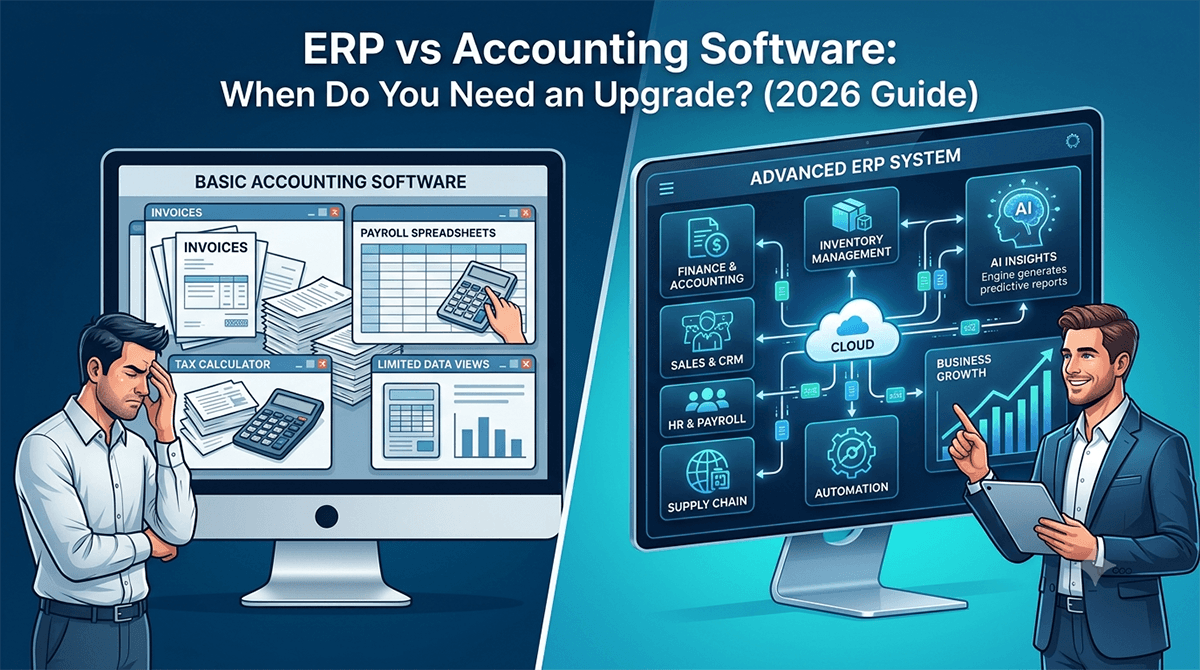
Accounting software handles your financials — invoicing, bookkeeping, bank reconciliation, and tax reporting. ERP software does all of that and connects it to inventory, purchasing, point of sale, payroll, HR, and operations in a single integrated system. If you are managing finances in isolation while running operations in spreadsheets or separate tools, you have outgrown accounting software and need an ERP.
This guide covers the key differences, the warning signs that it is time to upgrade, and how to choose the right solution for your business size and industry.
What is Accounting Software?
Accounting software focuses on financial record-keeping and reporting. Core capabilities include:
- General ledger: double-entry bookkeeping and chart of accounts
- Invoicing and billing: create, send, and track customer invoices
- Accounts receivable and payable: manage money owed to and by the business
- Bank reconciliation: match bank statements to internal records
- Tax reporting: GST, VAT, income tax summaries
- Basic financial reports: profit & loss, balance sheet, cash flow
Popular accounting software options include QuickBooks, Xero, Sage 50, Zoho Books, and FreshBooks. These tools are well suited to freelancers, service businesses, and small companies with simple operations. They are typically fast to set up and low cost.
The limitation: accounting software is a financial lens only. It records what happened financially but does not manage how your business operations create those financial outcomes.
What is ERP Software?
Enterprise Resource Planning (ERP) software integrates all core business processes — accounting, inventory, purchasing, sales, payroll, HR, and point of sale — into a single connected system. Every transaction updates all relevant modules simultaneously: a sales invoice updates inventory, triggers accounts receivable, and feeds into the general ledger automatically.
ERP systems eliminate the manual data entry, reconciliation, and reporting gaps that occur when accounting and operations live in separate tools. For businesses with physical inventory, multiple locations, or industry-specific compliance requirements, ERP provides visibility and control that standalone accounting software cannot.
Modern cloud ERP systems like EloERP Cloud are purpose-built for specific industries — pharmacy, retail, restaurant, grocery, jewelry, garment, and more — with workflows that match how those businesses actually operate.
ERP vs Accounting Software: Side-by-Side Comparison
| Feature | Accounting Software | ERP Software |
|---|---|---|
| General ledger & bookkeeping | ✓ | ✓ |
| Invoicing & billing | ✓ | ✓ |
| Tax reporting (GST/VAT) | ✓ | ✓ |
| Inventory management | Basic or none | ✓ Full (multi-location) |
| Point of sale (POS) | No | ✓ Integrated |
| Purchase orders & supplier management | Basic | ✓ Full module |
| Payroll processing | Limited / add-on | ✓ Built-in |
| HR & employee management | No | ✓ Built-in |
| Multi-location operations | No | ✓ Real-time stock sync |
| Industry-specific workflows | No | ✓ (in purpose-built ERP) |
| Real-time operational reporting | Financial only | ✓ Across all departments |
| Barcode scanning & POS hardware | No | ✓ |
| Batch/expiry tracking (pharmacy) | No | ✓ (industry-specific ERP) |
| KOT & table management (restaurant) | No | ✓ (industry-specific ERP) |
7 Signs You Have Outgrown Accounting Software
1. You Are Managing Inventory in Spreadsheets
If stock levels, purchase orders, and supplier records live in Excel while your financials live in QuickBooks, you have a gap. Every time you sell something, someone has to manually update both systems. Errors compound. Stockouts happen without warning. An ERP connects your inventory directly to your accounts so every movement updates automatically.
2. You Have a Physical Shop or Checkout Counter
Accounting software does not include a point-of-sale system. If you are using a separate POS (or a cash register) and then re-entering sales data into your accounting software, you are doing double the work and accepting reconciliation errors as a permanent cost of doing business. An integrated ERP-POS eliminates that entirely.
3. You Operate More Than One Location
Multi-location businesses need real-time visibility into stock across all branches, centralised purchasing, and consolidated financial reporting. Accounting software provides consolidated reports but cannot manage the operational complexity of inter-branch stock transfers, location-level P&L, or distributed POS billing.
4. Your Month-End Close Takes Days
If closing the books each month requires reconciling data from your POS, inventory tool, payroll system, and accounting software, you are spending time on data assembly rather than analysis. An ERP where every transaction flows into the ledger automatically can reduce month-end close from days to hours.
5. You Process More Than 100 Transactions per Day
High transaction volumes amplify every manual step. At 100+ daily transactions, the time spent on data entry and reconciliation between disconnected systems becomes a significant operational cost. ERP systems handle high transaction volumes natively — every sale, receipt, and payment posts to the ledger in real time.
6. You Have Compliance or Traceability Requirements
Industries like pharmacy, food distribution, and electronics require batch number tracking, expiry date management, and product traceability from supplier to customer. Accounting software has no concept of batch numbers or expiry tracking. Industry-specific ERP platforms handle this natively.
7. Your Accountant Spends Time Cleaning Up Data
When your accountant’s first task each month is reconciling inconsistencies between your POS, inventory records, and accounting system, you are paying professional-rate fees for data cleanup. An ERP that keeps all data consistent in real time makes your accountant’s work faster and more valuable.
When Accounting Software is Still the Right Choice
Not every business needs ERP. Accounting software remains the better choice when:
- You are a service business with no physical inventory (consulting, freelancing, agency work)
- You have fewer than 5 employees and straightforward financial transactions
- Your operations are entirely digital or project-based with no retail, POS, or physical goods
- You are in the early startup stage and not yet generating significant transaction volume
- Your primary need is tax compliance and basic financial reporting rather than operational management
QuickBooks, Xero, or Zoho Books are excellent for these profiles. They are fast to set up, affordable, and well-supported by accountants worldwide.
When ERP is the Right Choice
ERP makes sense when:
- You sell physical products with stock that needs to be tracked in real time
- You operate a retail shop, pharmacy, restaurant, grocery, or any business with a checkout counter
- You have more than one location and need centralised visibility
- You have 10+ employees with payroll, attendance, and HR requirements
- Your industry has compliance requirements (batch tracking, expiry dates, controlled substances)
- You are growing rapidly and your current tools are already showing strain
How EloERP Cloud Combines Accounting and ERP
EloERP Cloud is an all-in-one cloud ERP and POS platform designed for 35+ industry verticals. It includes a full accounting module alongside inventory, purchasing, POS, payroll, and HR — so there is no separate accounting software to reconcile.
Accounting Features in EloERP Cloud
- Double-entry general ledger with full chart of accounts
- Accounts receivable and payable management
- Bank reconciliation and multi-bank account support
- GST/VAT tax reporting for Pakistani and regional compliance
- Profit & loss, balance sheet, and cash flow reports in real time
- Automated journal entries from every POS sale, purchase, and payroll run
What Goes Beyond Accounting
- Point of sale: industry-specific POS for pharmacy, restaurant, retail, grocery, and more — every sale posts to accounting automatically
- Inventory: real-time stock across all locations, automatic reorder alerts, batch and expiry tracking for pharmacy and food businesses
- Purchasing: supplier management, purchase orders, GRN, and three-way matching with accounting entries
- Payroll: employee salary processing, attendance, leave, and compliance — payroll entries post to the ledger automatically
- HR: employee records, department management, and appraisals in the same system
For a retail, pharmacy, or restaurant business, this means one login, one dataset, and one source of truth for operations and finance. Visit our features page for a full breakdown, or view current pricing to see how EloERP Cloud compares to maintaining separate accounting and operational tools.
Accounting Software + ERP: The Hidden Cost of Running Both
Many growing businesses try to extend the life of their accounting software by adding integrations — connecting QuickBooks to a POS via API, syncing inventory data via a middleware tool, and running payroll in a third system. The result is a fragile integration architecture with a high total cost:
- Subscription cost: accounting software + POS + inventory tool + payroll = 3–4 separate monthly fees
- Integration maintenance: API connections break with software updates; someone has to fix them
- Reconciliation time: data inconsistencies between systems require manual review and correction
- Training overhead: staff must learn and switch between multiple interfaces
- Reporting gaps: consolidated reporting across disconnected systems is difficult and often incomplete
A single ERP platform eliminates all of these costs. The upfront investment in switching is typically recovered within 6–12 months through reduced reconciliation time, fewer data errors, and eliminated duplicate subscriptions.
Making the Switch: What to Expect
Migrating from accounting software to ERP does not have to be disruptive. For businesses moving to EloERP Cloud:
- Data migration: customer records, supplier records, opening balances, and inventory data can be imported via spreadsheet upload
- Go-live timeline: most retail and pharmacy businesses are fully live within 1–3 weeks
- Parallel running: it is common to run both systems side-by-side for one accounting period to validate data before cutting over
- Training: staff typically require 1–3 days of training for the POS; accounting staff require a few days to learn the ERP accounting module
The key is choosing an ERP that is pre-configured for your industry rather than a generic system requiring months of configuration. Book a free EloERP Cloud demo to see your specific industry workflows in action before committing.
Schedule a Free EloERP Cloud Demo → See how EloERP Cloud handles accounting, inventory, and POS for your specific industry in a live session.
View EloERP Cloud Pricing → Compare the cost of EloERP Cloud against maintaining separate tools.
Related Reading:
- What is Cloud ERP? The Complete 2026 Guide
- 10 Best ERP Software for Small Business in 2026
- EloERP vs Odoo vs ERPNext: Which Cloud ERP is Right for Your Business?