
POS Software with Payroll: Manage Staff and Sales in One System
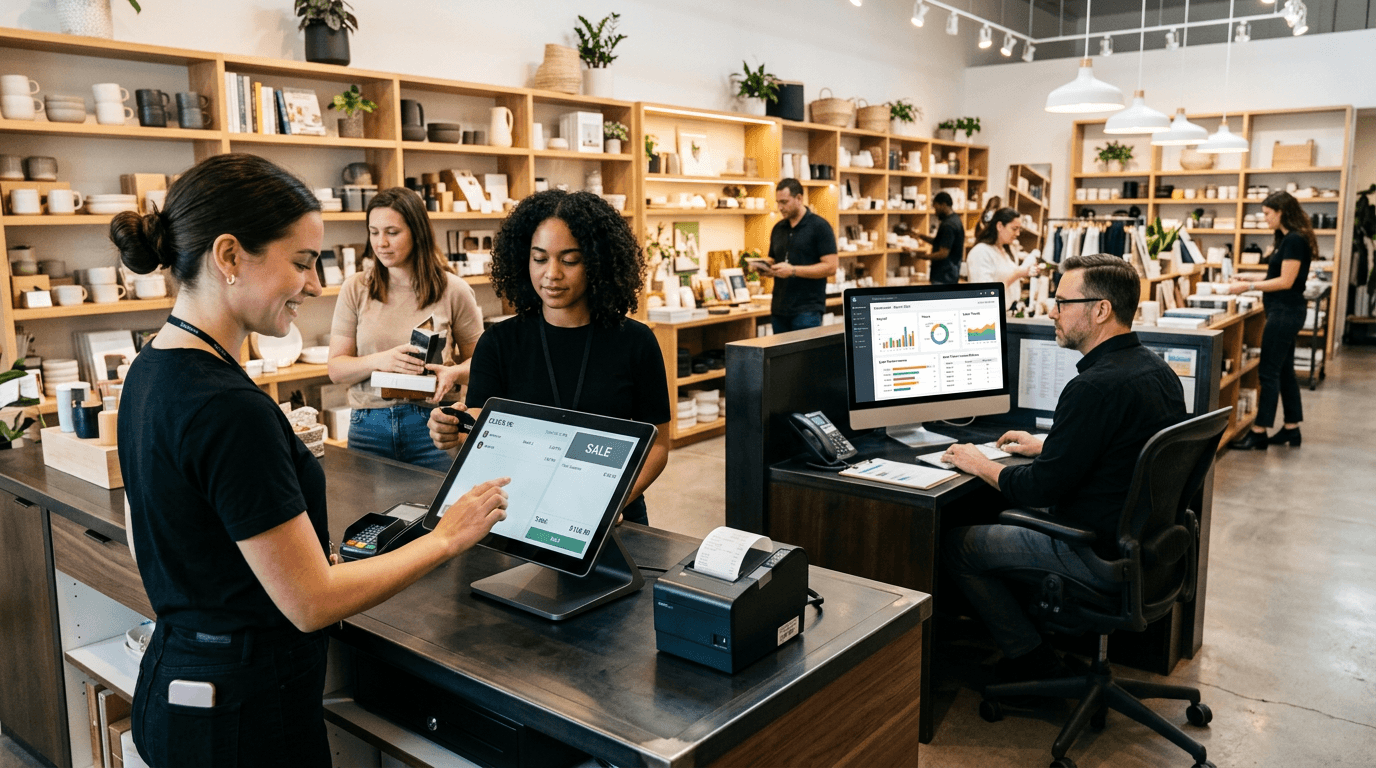
Most retail and restaurant businesses run their POS system and payroll completely separately. Sales data lives in one system. Employee hours, commissions, and pay calculations live in another — or worse, in spreadsheets. Every pay cycle requires manual data transfer, creating hours of work and a high risk of errors. POS software with integrated payroll solves this by connecting sales data to compensation in real time.
The Hidden Cost of Disconnected POS and Payroll
When your POS and payroll don't talk to each other, you pay in three ways:
- Time: Someone manually exports sales data, matches it to employee timesheets, calculates commissions, and enters everything into payroll software — every pay cycle.
- Errors: Manual transfer of data between systems introduces mistakes. Wrong commission calculations, missed overtime, incorrect deductions — all costly to fix and damaging to employee trust.
- Missed insights: Without connecting sales to labor, you cannot see your labor cost as a percentage of sales per shift, per employee, or per day of week — the data you need to optimize staffing.
What POS Software with Payroll Should Do
1. Integrated Time and Attendance
Employees clock in and out via the POS terminal. The system automatically calculates hours worked per shift, total weekly hours, and overtime. No separate time tracking app needed.
2. Sales-Based Commission Calculation
Set commission rules by employee role, product category, or sales threshold. When a salesperson closes a deal or hits a sales target, their commission calculates automatically from POS data — no manual calculation required.
3. Automated Payroll Processing
At month end (or week end), the system calculates gross pay for every employee: base salary + overtime + commissions + allowances, minus statutory deductions (income tax, social security, pension). Payslips generate automatically and can be emailed to employees or printed.
4. Labor Cost vs. Sales Dashboard
See labor cost as a percentage of sales in real time. Identify your most productive shifts, your highest-grossing employees, and your least efficient days. Make scheduling decisions based on data, not gut feel.
5. Statutory Compliance
In Pakistan, the EOBI (Employees' Old-Age Benefits Institution) contribution and income tax withholding must be calculated correctly every pay cycle. An integrated system handles these calculations automatically based on configured local tax rules — reducing compliance risk.
6. Employee Performance Reports
Sales per hour, transactions per shift, average basket size by employee — linked directly to the POS data. Recognize top performers, identify training needs, and manage scheduling more intelligently.
Industries Where POS with Payroll Makes the Biggest Difference
Retail Chains
Multi-location retailers struggle most with disconnected systems. With integrated POS and payroll, managers at head office see labor costs across all branches in real time — and catch anomalies (a branch reporting unusual overtime) before they become budget problems.
Restaurants
Restaurants have high staff turnover and tip calculations. Integrated systems track tips per server, calculate tip distribution, and include tips correctly in payroll — avoiding end-of-shift disputes.
Pharmacies
Commission on certain product categories (nutritional supplements, OTC products), plus careful overtime tracking for compliance in regulated industries — all handled automatically when POS and payroll are integrated.
EloERP: POS + Payroll in One Platform
EloERP Cloud delivers fully integrated POS, attendance, HR, and payroll in a single platform. No exports, no imports, no manual calculations. Employee hours from the POS feed directly into payroll processing. Commissions calculate from real sales data. Payslips generate at the click of a button.
See integrated POS and payroll in action. Book a free 30-minute EloERP demo.
Related: Payroll Management for Retail Stores | Retail POS Software: Features Every Store Needs | Multi-Location POS Software
Ready to upgrade your store's operations?
EloERP Cloud gives you POS, inventory, purchasing, and reporting in one affordable system. Book a free demo →