
EloERP Alternatives: How to Compare Cloud ERP & POS Options (2026)
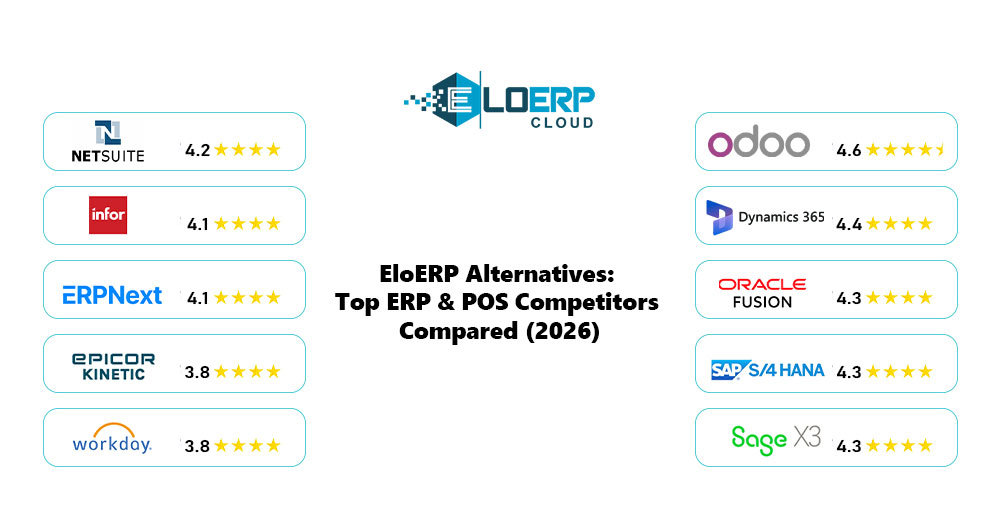
About this comparison: this page is published by EloERP, so we have an interest in how it reads. We don't describe other vendors' products or prices here — they change often and vary by region and plan — so check those in each vendor's own trial and pricing page before you decide.
If you're researching EloERP alternatives, you're comparing cloud ERP and POS systems for your business. This guide sets out the questions that decide between EloERP and the alternatives most often considered alongside it — Odoo, ERPNext, Zoho One, SAP Business One, Lightspeed and others — what to test in each trial, and where EloERP fits.
Why People Look for EloERP Alternatives
The usual reasons, and what to check for each:
- Operating in a market EloERP doesn't cover: EloERP integrates with FBR (Pakistan, through PRAL), PRA, ZATCA Phase 2 (Saudi Arabia), MyInvois (Malaysia) and UAE e-invoicing, and its interface runs in 10 languages including Arabic. If your country's tax system isn't on that list, ask us before you rule it in or out.
- Needing a specific module: check the module list first. Project Management and Manufacturing (bills of materials and work orders) are EloERP add-ons, priced separately.
- Budget or a preference for open-source software: compare the three-year cost, including hosting, setup and support, not the licence alone.
- An existing investment in another ecosystem: weigh the switching cost honestly against what you would gain.
- A very specialised industry: test your own workflow in the trial, not a generic demo.
EloERP vs Top Alternatives: Quick Comparison
Put each option through the same checks. The right-hand column is what EloERP does:
| What to check | Why it matters | EloERP |
|---|---|---|
| POS in the same system as stock and accounts | No exports or end-of-day imports | Yes — retail and restaurant POS modes, one database |
| Inventory depth | Batches, expiry, serials, variants, pack sizes | Batch & expiry, IMEI/serial, variants, multi-UOM, multi-warehouse |
| Accounting | A real ledger, not an export | Double-entry GL, P&L, balance sheet, bank reconciliation |
| Payroll | One system for staff costs | HR & Payroll add-on (priced separately) |
| E-invoicing in your country | Tax reporting at the point of sale | FBR, PRA, ZATCA Phase 2, MyInvois, UAE |
| Offline selling | The counter keeps working without internet | Offline POS, syncs when the connection returns |
| Pricing model | Predictable three-year cost | Yearly subscription (monthly on request); pricing on request |
EloERP vs Odoo
Odoo is an open-source business-application suite. If it's on your shortlist alongside EloERP, settle these in both trials:
- POS for your industry: ring up a real sale for your business — a pharmacy batch, a restaurant table order, a jewellery item by weight — and check what happens to stock and the ledger.
- Your country's tax: confirm how e-invoicing is delivered and who maintains it. EloERP has FBR digital invoicing built in, connecting through PRAL.
- Pricing: get a written three-year quote for the apps or modules you need. EloERP is a yearly subscription (monthly on request), priced on request, with add-ons priced separately.
- Implementation: ask who sets it up, how long it takes and what it costs.
Our recommendation: if you run a retail, pharmacy, restaurant or distribution business and want POS, inventory and accounting working together from day one, start with EloERP's 15-day free trial.
EloERP vs ERPNext (Frappe)
ERPNext is an open-source ERP. Questions to settle in both trials:
- Hosting and upkeep: who runs the servers, applies updates and takes backups? EloERP is cloud-hosted: nothing to install, updates applied for you, and backups you can create and download.
- POS: test your busiest counter scenario — split payments, held orders, returns, shift close.
- Manufacturing: if you produce goods, test a bill of materials and a work order. EloERP's Manufacturing add-on supports multi-level BOMs, make-to-stock and make-to-order.
- Total cost: whatever the licence costs, add hosting, setup and support — compare three-year totals.
Our recommendation: EloERP, if you want retail, pharmacy or restaurant workflows without running your own servers.
EloERP vs Zoho One
Zoho One is a suite of business applications. Questions to settle:
- Physical retail: do you need a counter POS tied to live stock? EloERP's POS is built for it — barcode scanning, cash registers with X/Z reports, loyalty, credit and instalment sales.
- Sales pipeline: EloERP includes a CRM with leads and a deals pipeline; test it against how your sales team works.
- How the pieces connect: check whether sales, stock and accounts are one database or separate apps that sync.
- Pricing: get a written quote for the apps and users you need.
Our recommendation: EloERP, if you sell physical products and need POS, inventory and accounting in one system.
EloERP vs SAP Business One
SAP Business One is an ERP suite. Questions to settle:
- Implementation: who implements it, on what timeline, and at what cost?
- Multi-company and multi-branch: EloERP runs multiple companies from one account and multiple branches per company, with branch-level and consolidated trial balance, P&L and balance sheet.
- Controls: EloERP has role-based permissions down to field level, approval thresholds with maker-checker, and a full audit trail.
Our recommendation: EloERP, for SMBs that want ERP controls without an enterprise-style rollout.
EloERP vs Lightspeed
Lightspeed is a cloud POS. Questions to settle:
- Accounting: does the POS post to a full general ledger, or to a separate accounting package? EloERP's POS posts straight to its own ledger.
- Online stores: EloERP connects to Shopify, WooCommerce and Daraz, pulling orders in and keeping stock in step.
- Payroll and HR: available in EloERP as the HR & Payroll add-on.
- Your region: check e-invoicing and local tax support for your country.
Our recommendation: EloERP, if you want POS, accounting and e-commerce orders in one system. See also EloERP vs Lightspeed.
Summary: When to Choose EloERP
| Your situation | What EloERP gives you |
|---|---|
| Retail pharmacy needing batch/expiry tracking | Batch & expiry on receipts and sales, near-expiry report with value at risk |
| Restaurant needing KOT + POS + accounts | Tables, KOT to kitchen display, delivery/takeaway/drive-thru, ledger posting |
| Retail chain with several branches | Branch stock and transfers, consolidated reports, offline POS |
| Distributor or wholesaler | Price tiers, credit limits, purchase-to-pay with three-way matching |
| Business selling online and in store | Shopify, WooCommerce and Daraz orders in the same system |
| Business in Pakistan, Saudi Arabia, Malaysia or the UAE | FBR/PRA, ZATCA Phase 2, MyInvois and UAE e-invoicing integrations |
Still comparing options? Book a live EloERP demo — bring the workflow that matters most to you and test it side by side with the alternatives you're considering.
Related Reading: ERPNext vs Odoo vs Zoho | EloERP vs Odoo vs ERPNext Compared | Free ERP Software Comparison 2026