
POS System Price in Pakistan 2026: Complete Cost Guide
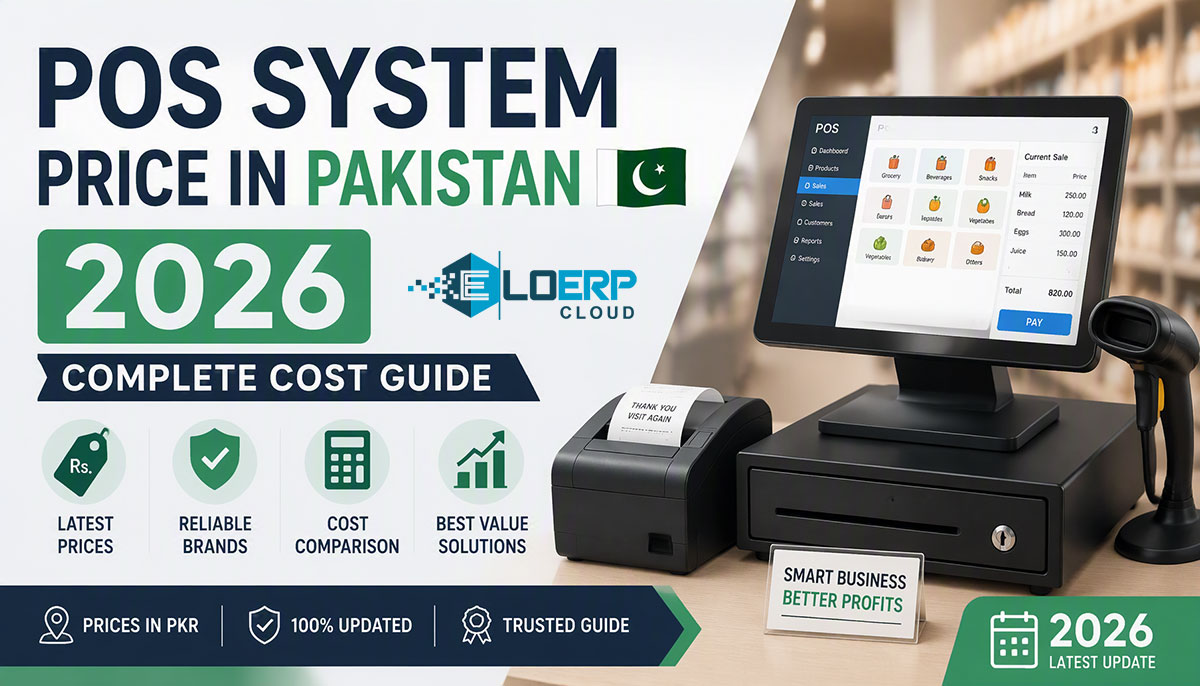
A complete POS system in Pakistan combines hardware (Rs 25,000-120,000 one-time) and software (a monthly or yearly subscription; amounts vary by vendor). Flat-rate cloud POS systems like EloERP (a yearly subscription, monthly on request) eliminate per-terminal fees, so the software bill does not grow with every register you add.
POS system pricing in Pakistan is hard to compare: vendors use different models, and many quote on request. This guide breaks down every cost component with market figures so you can budget accurately and identify hidden fees before signing contracts.
POS System Costs in Pakistan: Complete Breakdown (2026)
Every POS investment involves three cost categories: hardware (one-time capital expense), software (recurring subscription or license), and hidden operational costs that surface after implementation.
Hardware costs range from Rs 40,000 to Rs 120,000+ per terminal, depending on whether you choose entry-level Android tablets or premium all-in-one touchscreen systems. A complete single-terminal setup includes the point-of-sale device itself, thermal receipt printer (Rs 8,000-25,000), barcode scanner (Rs 5,000-18,000), and cash drawer (Rs 4,000-12,000).
Software pricing models vary dramatically. Per-terminal subscriptions typically charge Rs 3,000-8,000 monthly per register, totaling Rs 36,000-96,000 annually for a single location. This model becomes prohibitively expensive for multi-location businesses: three terminals cost Rs 108,000-288,000 yearly. Flat-rate subscriptions eliminate per-terminal fees, charging one yearly price regardless of how many registers you operate.
Hidden costs include FBR compliance modules (Rs 0-50,000/year depending on whether it's built-in or an add-on), training fees (Rs 5,000-15,000 per user at some vendors), setup charges (Rs 10,000-50,000), and payment gateway transaction fees (1.5-3.5% per sale). These secondary costs often exceed the base software price over a three-year period.
The total cost difference between pricing models becomes stark at scale: a single-location business might pay similar amounts under either model, but a three-terminal operation pays the per-terminal fee three times over every month, while a flat-rate plan stays the same.
POS Hardware Costs in Pakistan
POS hardware represents the largest upfront expense in your system budget. Market averages based on 2026 listings show clear price tiers across device categories.
POS Terminals range from Rs 25,000 to Rs 80,000 depending on form factor and features. Entry-level Android tablets (7-10 inch screens) cost Rs 25,000-35,000 and work well for counter service in small shops or food trucks. Mid-range dedicated POS terminals with integrated receipt printers run Rs 50,000-60,000 and suit high-volume retail environments. Premium all-in-one systems with large touchscreens, customer-facing displays, and built-in scanners reach Rs 70,000-80,000, ideal for supermarkets or department stores.
Receipt Printers are essential for legal compliance and customer documentation. Thermal printers (the standard for POS) cost Rs 8,000-25,000. Budget 58mm models handle low-volume operations at Rs 8,000-12,000, while 80mm high-speed printers for busy restaurants or retail chains run Rs 18,000-25,000. Avoid dot-matrix printers despite lower prices; thermal printing is faster, quieter, and produces FBR-compliant digital invoicing receipts with QR codes.
Barcode Scanners range from Rs 5,000 to Rs 18,000. Handheld laser scanners cost Rs 5,000-8,000 and work for grocery stores or pharmacies with shelf-stable inventory. Presentation scanners (stationary units where you wave items over the scan window) run Rs 12,000-18,000 and speed checkout at convenience stores or supermarkets. Wireless models add Rs 3,000-5,000 to either category.
Cash Drawers are required for businesses handling physical currency. Basic manual-release drawers cost Rs 4,000-7,000. Electronic cash drawers that open automatically when the receipt prints range from Rs 8,000-12,000 and integrate better with POS software, reducing drawer-opening errors.
A complete single-terminal hardware setup totals Rs 42,000-127,000 depending on your device choices. Budget configurations (Android tablet + basic printer + handheld scanner + manual drawer) start around Rs 42,000. Premium setups (all-in-one terminal + high-speed printer + presentation scanner + electronic drawer) reach Rs 127,000.
Bring Your Own Hardware (BYOH) eliminates these costs if you already own compatible devices. Many cloud POS systems run on existing tablets, smartphones, or computers. Verify device compatibility with your chosen vendor before committing; not all software supports all hardware. EloERP supports cloud-based deployment on various devices—consult their support team for specific compatibility requirements before repurposing existing tablets.
Hardware costs multiply by your terminal count: three registers require three sets of equipment. This is where BYOH strategies save Rs 100,000+ for multi-location businesses already owning tablets or considering phased hardware upgrades.
POS Software Pricing Models in Pakistan (2026)
Software costs dwarf hardware expenses over time. Pakistan's POS market offers three distinct pricing models with dramatically different total cost implications.
Model 1: Per-Terminal Pricing
Per-terminal subscriptions charge Rs 3,000-8,000 monthly for each point-of-sale device. This model dominates traditional POS vendors and scales linearly: two terminals cost double, five terminals cost five times the base rate.
A single-terminal business pays Rs 36,000-96,000 annually. A three-terminal setup (common for small retail chains or restaurants with bar + kitchen + cashier stations) costs Rs 9,000-24,000 monthly, totaling Rs 108,000-288,000 yearly. A five-terminal operation reaches Rs 180,000-480,000 annually in software fees alone.
Per-terminal pricing makes sense for single-location businesses that will never expand beyond one or two registers. The model's advantage is low entry cost: you can start with one terminal at Rs 3,000/month and cancel if the business doesn't work out. The disadvantage emerges during growth—every new location or register increases your monthly bill.
Model 2: Flat-Rate Subscription
Flat-rate subscriptions charge one price regardless of terminal count. You pay the same price whether you operate one register or twenty.
EloERP's pricing illustrates this model: Cloud Suite (1 location), Cloud Suite Pro (3 locations), or Cloud Suite Plus (unlimited locations and users), billed yearly (monthly on request), with pricing on request. FBR compliance is included at no additional cost across all tiers; add-ons such as HRM & Payroll are priced separately on request. No setup fees, no per-terminal charges.
The cost advantage compounds with scale. Under per-terminal models a three-terminal business pays Rs 108,000-288,000 a year and a five-terminal operation Rs 180,000-480,000; a flat-rate plan costs the same at one terminal or five.
Flat-rate pricing favors multi-location businesses, chains planning expansion, or single-location shops that need multiple registers (restaurants with separate bar/kitchen/counter terminals, retail stores with seasonal checkout lanes). The model's upfront cost is higher than starting with one per-terminal license, but the gap closes as you add registers.
Model 3: One-Time License
One-time perpetual licenses cost Rs 80,000-300,000+ upfront with no recurring subscription. This model is rare for modern cloud POS systems (which require ongoing server hosting and updates), but some legacy on-premise software still uses it.
Hidden costs undermine the no-subscription promise: annual maintenance contracts (Rs 15,000-40,000/year for updates and support), server hardware if hosting on-premise (Rs 50,000-150,000), and separate fees for compliance modules or new features. Total cost over three years often exceeds flat-rate subscription models once you account for these add-ons.
One-time licenses made sense before cloud computing, but they limit you to on-premise deployment (requiring local servers), complicate remote access (can't check sales from home), and create upgrade friction (major version changes require new license purchases). Most Pakistan businesses now choose cloud subscriptions for deployment flexibility.
Comparison: 1-Year and 3-Year Total Cost
| Scenario | 1 Terminal | 3 Terminals | 5 Terminals |
|---|---|---|---|
| Per-Terminal (1 year) | Rs 36,000-96,000 | Rs 108,000-288,000 | Rs 180,000-480,000 |
| Flat-Rate (1 year) | One yearly plan price | Same plan price | Same plan price |
| Per-Terminal (3 years) | Rs 108,000-288,000 | Rs 324,000-864,000 | Rs 540,000-1,440,000 |
| Flat-Rate (3 years) | Three yearly payments | Three yearly payments | Three yearly payments |
Per-terminal costs grow with every register; a flat-rate plan does not. Ask each vendor for a written quote and compare the two models at your own terminal count.
FBR Compliance Costs
Pakistan's Federal Board of Revenue sets out digital invoicing for Tier-1 retailers under SRO 1852. Check the current notifications on FBR's website (or ask your tax adviser) for what applies to your business and when. If the rules apply to you, your POS system must generate invoices with real-time Integration Request Numbers (IRN) and QR codes.
Native FBR integration costs nothing extra when built into the POS software. EloERP includes FBR Digital Invoicing across all pricing tiers (Cloud Suite, Cloud Suite Pro, and Cloud Suite Plus) at no extra charge. Each company profile has a simple toggle to enable FBR digital invoicing—no separate module purchase required.
Add-on FBR modules commonly range from Rs 15,000 to Rs 50,000 annually based on market research, though specific vendor pricing varies. These bolt-on solutions typically require separate installation, additional training, and manual activation for each sale. Integration gaps sometimes force double-entry (recording the sale in POS, then again in the compliance module), increasing error rates and staff workload.
The cost difference compounds over time. A Rs 40,000/year FBR add-on adds Rs 120,000 over three years on top of the base software — a hidden premium for fragmented compliance.
FBR Compliance: Included vs Add-On
| Approach | Year 1 | Year 3 | Integration Quality | Risk |
|---|---|---|---|---|
| Native (Included) | Included | Included | Single system, auto-generated IRN/QR | Low |
| Add-On Module | Rs 15,000-50,000 | Rs 45,000-150,000 | Separate module, manual steps | Moderate |
Ask every vendor during evaluation: "Is FBR Digital Invoicing included in the base price, or does it cost extra?" A Rs 40,000/year difference between answers makes this the single highest-value question in POS vendor selection.
For detailed FBR requirements, see our complete guide: FBR Digital Invoicing: Complete Guide for Pakistan Businesses.
Total Cost of Ownership (TCO): 3-Year Comparison
Total Cost of Ownership reveals the true price difference between POS models. We'll compare two realistic scenarios for a three-terminal business (retail chain or multi-station restaurant).
Scenario A: Per-Terminal Model (3 Terminals)
Software Subscription: Rs 6,000/month per terminal × 3 terminals = Rs 18,000/month × 36 months = Rs 648,000
Hardware (3 complete setups): Mid-range terminals (Rs 50,000 × 3) + receipt printers (Rs 15,000 × 3) + scanners (Rs 8,000 × 3) + drawers (Rs 8,000 × 3) = Rs 243,000
Training Fees: Rs 10,000 per user × 4 staff = Rs 40,000
Support & Maintenance: Rs 20,000/year × 3 years = Rs 60,000
FBR Compliance Add-On: Rs 30,000 one-time = Rs 30,000
Setup/Implementation: Rs 30,000 one-time = Rs 30,000
Scenario A Total (3 years): Rs 1,051,000
Scenario B: Flat-Rate Model (EloERP, 3 Terminals)
Software: EloERP Cloud Suite Pro yearly subscription (up to 3 locations) — pricing on request, ask us for a quote
Hardware: Rs 0 (BYOH—using existing tablets) or Rs 75,000-105,000 if purchasing budget Android tablets. We'll use Rs 90,000 for moderate new hardware = Rs 90,000
Training Fees: none (self-serve 14-day trial, video tutorials)
Support: included in subscription
FBR Compliance: included across all tiers
Setup/Implementation: none (cloud deployment, no setup fees)
Scenario B Total (3 years): three yearly subscription payments + Rs 90,000 hardware
Savings Summary
Scenario A spends Rs 648,000 on per-terminal software alone, plus Rs 160,000 in training, support, FBR add-on and setup fees. In Scenario B the software is one yearly subscription and those extra fees do not apply.
The primary savings drivers are:
- No per-terminal multiplication (same software price for 1 or 10 terminals)
- Included FBR digital invoicing (no add-on module fee)
- No training fees (Rs 40,000 saved)
- No setup charges (Rs 30,000 saved)
- Included support (Rs 60,000 saved)
These calculations use conservative mid-range estimates. High-end per-terminal subscriptions (Rs 8,000/month per terminal) would push Scenario A above Rs 1,500,000, widening the gap further.
Ask for an EloERP quote: Book a demo
Hidden POS Costs to Watch For
Base software and hardware prices tell only part of the story. These hidden costs surface after contract signature and often exceed your initial budget.
Training fees range from Rs 5,000 to Rs 15,000 per user at vendors that charge separately for onboarding. A five-person team costs Rs 25,000-75,000 before you process your first sale. Ask during demos: "Is training included, or charged separately?" Some vendors like EloERP include unlimited training via video tutorials and documentation, eliminating this expense entirely.
Implementation and setup fees vary from Rs 10,000 to Rs 50,000 depending on system complexity. On-premise installations requiring server configuration cost more than cloud systems you access via web browser. Cloud-first vendors typically eliminate setup fees; legacy software vendors build them into every contract. Verify setup costs in writing before signing.
Software updates and upgrades cost Rs 5,000-20,000 annually if charged separately from your subscription. Clarify whether your monthly fee includes updates or if version upgrades require additional payment. Most modern SaaS POS systems include continuous updates; older license-based models charge for major releases.
Compliance module add-ons for FBR, ZATCA, or MyInvois cost Rs 15,000-50,000 yearly when not included in base software. This was covered in the FBR compliance section, but it's worth repeating: a Rs 40,000/year add-on costs Rs 120,000 over three years. "Included compliance" versus "add-on compliance" is a six-figure decision.
Hardware maintenance and repairs average Rs 8,000-15,000 annually for three-terminal setups. Receipt printers jam, barcode scanners fail, touchscreens crack. Budget 10-15% of hardware cost yearly for maintenance. Extended warranties (offered by some hardware vendors) cost Rs 5,000-12,000 upfront but cap your downside risk.
Payment gateway transaction fees take 1.5-3.5% of every card or digital payment. A shop processing Rs 1,000,000 monthly in credit cards pays Rs 15,000-35,000/month in gateway fees. These are unavoidable (card networks and banks take their cut), but rates vary by provider. Negotiate transaction fees separately from POS software costs.
Contract lock-ins don't cost money directly, but they trap you in unfavorable pricing. Some vendors require 12-24 month commitments with early termination penalties of 50-100% of remaining contract value. A two-year contract at Rs 10,000/month with 100% termination penalty means you owe Rs 120,000 if you cancel after six months. Choose vendors offering month-to-month or annual contracts with no termination fees.
Data migration and export fees bite when you switch vendors. Some POS systems charge Rs 10,000-30,000 to export your sales history, customer data, and inventory records. Others lock data in proprietary formats you can't access after canceling. Verify data export options before committing: can you download your data in standard formats (CSV, Excel, PDF) at any time?
Add these hidden costs to your TCO calculation. A Rs 5,000/month subscription with Rs 40,000 in annual hidden fees actually costs Rs 100,000 yearly, not Rs 60,000.
How to Choose the Right POS Pricing Model for Your Business
Your terminal count and growth plans determine which pricing model minimizes total cost.
Single-location businesses with 1-2 terminals can choose either per-terminal or flat-rate pricing without major cost difference. Per-terminal models offer lower entry cost (Rs 3,000/month to start) and easy cancellation if the business doesn't scale. Flat-rate models cost more upfront than a single per-terminal plan but include more features and eliminate expansion friction. Choose per-terminal if you're testing a new business concept with uncertain future; choose flat-rate if you're confident in the model and might add registers during peak seasons.
Multi-location businesses with 3-10 terminals strongly benefit from flat-rate pricing. At five terminals, per-terminal models cost Rs 180,000-480,000 yearly, while a flat-rate plan costs the same as it did at one terminal. Every additional location under flat-rate pricing is free (software-wise); under per-terminal models, every location multiplies your bill.
Scaling businesses planning 10+ terminals require flat-rate pricing—per-terminal costs become prohibitively expensive. Ten registers at Rs 6,000/month each cost Rs 720,000 annually, while an unlimited-terminal flat-rate plan does not grow with the register count. That makes per-terminal models hard to justify at enterprise scale. Large chains should negotiate custom enterprise pricing above standard flat-rate tiers.
Budget-constrained startups minimize costs by combining BYOH hardware strategy with flat-rate cloud software. Use existing tablets or budget Android devices (Rs 25,000-35,000 each), choose software with FBR digital invoicing included, and select a flat-rate plan. Your first-year cost is then one yearly software subscription plus Rs 0-35,000 for hardware if needed — compare that with Rs 100,000+ under bundled per-terminal models.
Enterprise retail chains should negotiate directly with vendors rather than accepting published pricing. At 20+ terminals, you have leverage to request volume discounts, custom feature development, dedicated support, and multi-year pricing locks. Start with flat-rate vendors' enterprise tiers, then negotiate downward.
Decision Framework
- Count your current and planned terminals (next 12-36 months)
- If ≤2 terminals with no growth plans: per-terminal viable
- If ≥3 terminals or definite expansion plans: flat-rate required
- Check if FBR compliance is included or add-on (Rs 0 vs Rs 40,000/year)
- Verify setup fees, training costs, contract terms
- Calculate 3-year TCO for both models using your specific numbers
- Choose the model with lower TCO and better expansion flexibility
Most Pakistan businesses with growth ambitions choose flat-rate models. The terminal-count economics overwhelmingly favor flat-rate once you operate three or more registers.
Explore system selection criteria: How to Choose the Right POS System
Software-Only vs Bundled Hardware Packages
Vendors offer POS as bundled packages (hardware + software together) or software-only subscriptions (bring your own hardware). Each approach has cost and operational trade-offs.
Bundled Package Advantages
Single vendor accountability: One company handles hardware warranty, software support, and integration issues. If your receipt printer malfunctions, you call one support line instead of coordinating between hardware manufacturer and software vendor.
Pre-configured setup: Hardware arrives pre-installed with software, reducing setup time from hours to minutes. Staff training is simpler because devices are standardized.
Simplified procurement: One purchase order, one invoice, one contract. Finance and accounting teams prefer bundled deals for budget tracking.
Bundled Package Disadvantages
Inflated hardware costs: Bundled packages typically mark up hardware 30-50% above market price. A Rs 50,000 terminal sells for Rs 65,000-75,000 when bundled. Across three terminals, you overpay Rs 45,000-75,000 for convenience.
Vendor lock-in: Bundled hardware often ties you to that vendor's software through proprietary integrations or contract terms. Switching vendors means replacing all hardware, creating Rs 100,000+ switching costs that trap you in unfavorable pricing.
Limited hardware choice: Bundled vendors offer two to three device options (budget, mid, premium). You can't choose best-in-class components—you're stuck with whatever they bundle.
Software-Only (BYOH) Advantages
Cost savings: Purchasing hardware separately or repurposing existing devices saves Rs 40,000-120,000+ per terminal. Consumer tablets (Rs 25,000-35,000) work fine for low-volume retail; you don't need vendor-branded hardware marked up to Rs 75,000.
Hardware flexibility: Choose the exact screen size, processing power, and form factor your business needs. A food truck uses a 7-inch tablet; a department store uses a 15-inch touchscreen; a jewelry shop uses a tablet with biometric scanner. BYOH lets you optimize per location.
Use existing devices: If you already own compatible tablets, smartphones, or computers, software-only subscriptions eliminate hardware costs entirely. A restaurant with three iPads can run cloud POS without buying new devices.
Easier vendor switching: Cloud POS software runs on generic hardware. Switching vendors means changing login URLs, not replacing Rs 300,000 in proprietary terminals.
Software-Only (BYOH) Disadvantages
Self-setup required: You handle hardware purchasing, software installation, printer configuration, and network setup. This takes technical competency or consultant fees (Rs 10,000-20,000 for professional setup).
Compatibility verification needed: Not all software runs on all devices. Check system requirements before purchasing tablets. Confirm your chosen POS supports your hardware's operating system (Android, iOS, Windows) and has drivers for your receipt printer and scanner models.
Multi-vendor support complexity: Hardware issues go to the device manufacturer, software issues go to the POS vendor, and printer problems go to the printer company. Troubleshooting "it's not working" requires identifying which vendor to call.
EloERP BYOH Compatibility
EloERP supports cloud-based deployment accessible via web browser on various devices. For specific device compatibility requirements, consult EloERP support before committing to BYOH to ensure your existing tablets or planned hardware purchases will work correctly with receipt printers and barcode scanners.
Recommendation
Choose BYOH for: Multi-location businesses focused on cost minimization, tech-capable owners comfortable with device setup, shops with existing compatible tablets/computers, and businesses planning phased hardware upgrades.
Choose bundled for: Single-location owners prioritizing simplicity over cost, businesses without technical staff, and operators who value one-vendor support for all issues.
The cost gap (Rs 50,000-100,000+ savings under BYOH) favors software-only for most growing businesses. The simplicity gap favors bundled for small single-location shops.
See integrated system benefits: 7 Benefits of Integrated ERP and POS Systems
Comparing POS Pricing in Pakistan: What to Verify Before Buying
Vendor sales calls focus on features. You need to focus on total cost and contract terms. This 10-point checklist extracts the pricing information vendors often hide.
10-Point Pricing Verification Checklist
1. Is the price per-terminal or flat-rate? This single question determines whether three terminals cost three times as much as one, or the same. Clarify the pricing model upfront. If the salesperson says "it depends," ask for both quotes in writing.
2. How many users and terminals are included? "Unlimited users" sounds great until you discover it means unlimited users per terminal but you still pay per terminal. Verify whether user limits apply per-device or system-wide. EloERP's Cloud Suite Plus includes unlimited locations and users in one yearly subscription.
3. Are software updates included or extra? Some vendors charge Rs 10,000-20,000 for major version upgrades. Others include continuous updates in the subscription. Confirm update policy in the contract.
4. Is FBR compliance included or an add-on? This is a Rs 0 versus Rs 15,000-50,000/year question. Pakistan businesses must have FBR Digital Invoicing. If it's an add-on, add that cost to your TCO calculation. EloERP includes FBR digital invoicing across all pricing tiers.
5. Are there setup or training fees? Rs 0 versus Rs 10,000-50,000 can swing your first-year budget. Cloud systems typically eliminate setup fees; on-premise systems charge for installation. Training should be included—if it's not, negotiate it in or choose a vendor with self-serve resources.
6. What is the contract length? Month-to-month contracts offer flexibility. Annual contracts lock you in but sometimes offer discounts. 24-month contracts trap you with early termination penalties. Avoid multi-year commitments until you've tested the system for at least six months.
7. Is support included? Email support is standard. Phone support costs extra at some vendors. WhatsApp support is common in Pakistan. Verify support hours (9-5 vs 24/7), response time SLAs, and whether support is free or Rs 10,000-30,000 additional annually.
8. Are there transaction limits or volume caps? Some "unlimited" plans cap monthly invoices at 1,000 or 5,000 transactions, charging overage fees beyond that. High-volume retailers can hit caps quickly. Verify transaction limits and overage costs.
9. Can you bring your own hardware (BYOH)? If yes, you save Rs 40,000-120,000 per terminal. If no, you're locked into vendor hardware at marked-up prices. Ask: "Can I use my own tablet and receipt printer, or must I buy your bundled package?"
10. What is the total cost over three years? Don't optimize for monthly price. Calculate: (monthly fee × 36 months) + hardware + training + setup + FBR add-on + support fees + likely overages. Compare vendors on 3-year TCO, not sticker price.
Red Flags to Avoid
- No written quote: If a vendor won't put the full price in writing — software, add-ons, FBR, setup and support — before you commit, walk away.
- FBR as a paid add-on: Native compliance is standard in 2026. Paying extra for legally required features suggests outdated software.
- Mandatory hardware bundles: Forcing bundled purchases at marked-up prices is vendor lock-in.
- 24+ month contracts: Long commitments with termination penalties trap you in bad vendor relationships.
- No data export: If you can't download your data, you're a hostage. Insist on CSV/Excel export capability.
Walk away from vendors who won't answer these questions directly. Transparent vendors provide detailed quotes, contract summaries, and TCO calculators.
Compare leading options: Best POS Software in Pakistan (2026 Comparison)
Conclusion: Transparent Pricing Matters
POS software in Pakistan commonly costs Rs 36,000-96,000 a year per register on per-terminal plans, plus Rs 40,000-120,000 in one-time hardware costs. The difference between expensive and cost-effective implementations isn't features—it's pricing model selection and vendor transparency.
Flat-rate cloud subscriptions spare multi-location businesses the per-terminal models that multiply costs with each register. Native FBR integration (Rs 0 add-on) beats bolt-on modules (Rs 15,000-50,000/year) by Rs 45,000-150,000 over typical ownership periods. BYOH hardware strategies cut upfront costs 40-60% compared to vendor-bundled packages marked up 30-50%.
Clear pricing builds trust and enables accurate budgeting. Whether a vendor publishes a price list or quotes on request, get the full cost, contract terms and a three-year estimate in writing before you decide.
Calculate your three-year total cost of ownership using your actual terminal count, transaction volume, and growth plans. Compare vendors on TCO, not monthly fees. Prioritize flat-rate pricing if you operate (or plan to operate) three or more terminals. Verify FBR compliance is included, not a paid add-on. Demand contract flexibility—month-to-month or annual terms, no multi-year lock-ins.
EloERP's flat-rate plans cover complete cloud ERP + POS with included FBR Digital Invoicing, unlimited users on Cloud Suite Plus, and no setup fees. EloERP is billed yearly (monthly on request) and pricing is on request: schedule a personalized demo to see the system live and get a quote.
Test any system before committing. Start your 15-day free trial—no credit card required.
Sources
- FBR Digital Invoicing Requirements: https://fbr.gov.pk
- Pakistan Revenue Automation Limited (PRAL): https://pral.com.pk