
Restaurant POS System Pakistan: ERP + Kitchen + Accounting in One
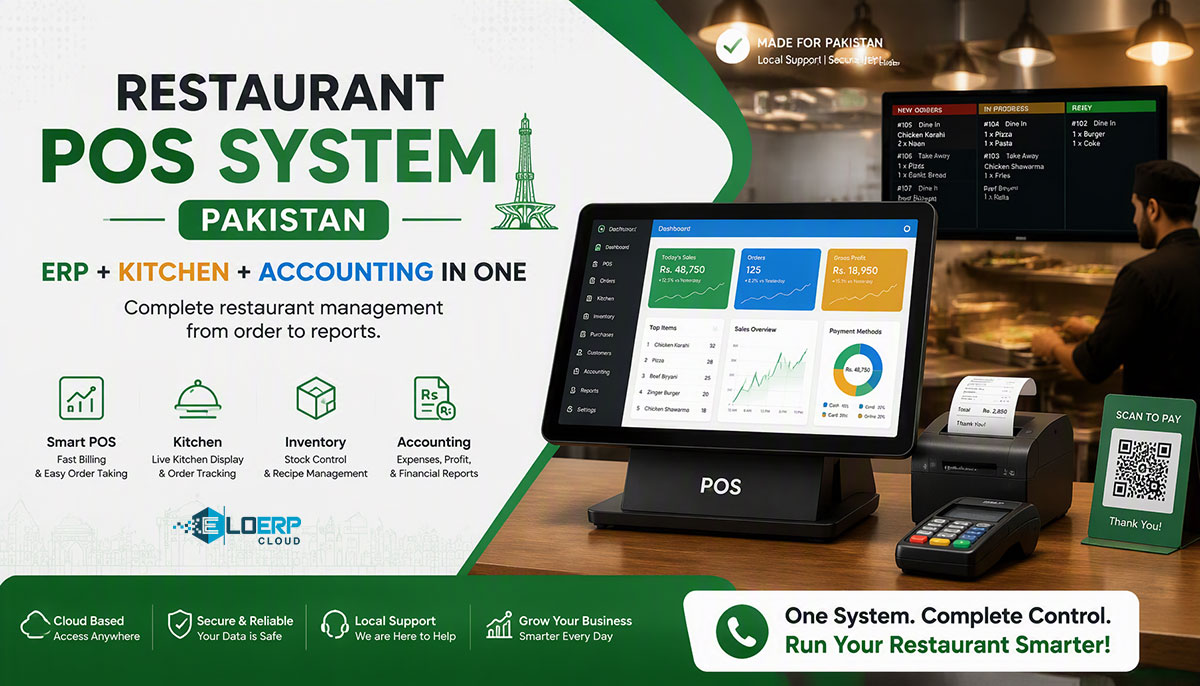
You're running a restaurant, juggling five different tools: a POS terminal for billing, Excel for inventory, Tally for accounting, manual FBR invoicing at day's end, and handwritten kitchen order tickets. By month-end, you're reconciling three days' worth of discrepancies between what you sold, what you stocked, and what your books say you made. There's a better way: one system that handles every sale from table to ledger to FBR in real time.
What is a restaurant POS system and why do Pakistan restaurants need one?
A restaurant POS (Point of Sale) system is software that processes customer orders, tracks sales, manages inventory, and generates invoices. In Pakistan, restaurants use POS systems to handle table orders, kitchen tickets, FBR digital invoicing, and real-time stock tracking — replacing manual billing and disconnected tools with one integrated platform.
Why Pakistan Restaurants Are Switching to Integrated ERP+POS
Most Pakistan restaurants patch together three separate tools: a POS terminal for billing, accounting software (Tally or QuickBooks) for bookkeeping, and manual FBR compliance uploads. Every night, someone exports sales data from the POS, imports it to accounting, then manually creates FBR invoices in IRIS. This three-step handoff creates gaps: stock numbers don't match sales, food costs are guesses until month-end, and FBR deadlines trigger panic.
Integrated ERP+POS systems eliminate these handoffs. Every sale updates your POS, stock ledger, accounting books, and FBR compliance in one transaction. Here's how point-solution POS tools compare to all-in-one systems:
| Pain Point | Point-Solution POS (OneClick, CORN, etc.) | Integrated ERP+POS (EloERP) |
|---|---|---|
| Accounting sync | Manual CSV export to Tally/QuickBooks | Auto-updates ledger with every sale |
| Multi-branch visibility | Per-location reports (manual consolidation) | Real-time consolidated dashboard (all locations) |
| Recipe costing | Manual spreadsheet calculations | Auto-deducts ingredients per portion sold |
| FBR invoicing | Bolt-on module or manual IRIS uploads | Built-in (every sale generates IRN + QR) |
| Delivery integration | Requires middleware (Deliverect/HubRise) | Multi-platform delivery management |
Every feature in the right column is built into EloERP's restaurant module. When a waiter closes a table, the system updates cash/bank (debit), revenue (credit), inventory (COGS deduction), and FBR (IRN generation) — simultaneously. No export, no import, no month-end reconciliation.
Start your 15-day free trial — no credit card required, full restaurant features + FBR e-invoicing included.
Core Features: What Makes EloERP Different for Restaurants
Table Management & Floor Plans
EloERP's table management uses visual floor maps: you see which tables are occupied (red), vacant (green), or reserved (yellow) at a glance. Drag-and-drop setup means you build your floor plan once — T-01 to T-30 for a 30-table restaurant — then assign waiters to sections.
Split bills across 4 diners, transfer Table 5's order to Table 8 when customers move, merge two tables for a group booking. The system tracks every table's order status, elapsed time, and running total. When the bill closes, the sale posts to accounting and the table goes green again.
Kitchen Order Tickets (KOT) & Kitchen Routing
When a waiter takes an order, the system prints a kitchen order ticket in the back-of-house. Each KOT shows dish name, quantity, table number, special instructions, and a sequential number (KOT-00001, KOT-00002) so the chef knows prep priority.
Orders route to the right station automatically: appetizers print at cold prep, mains at the grill, desserts at pastry. Once the chef marks KOT-00145 complete, the waiter sees "ready to serve" on their terminal. No shouting across the kitchen, no lost paper chits, no confusion about which table ordered the biryani without onions.
Recipe-Based Food Costing & Ingredient Tracking
This is where most restaurant owners discover they've been losing money on "bestsellers." EloERP's recipe costing breaks every dish down to gram-level precision. Your chicken biryani recipe specifies: 250g basmati rice (PKR 42), 200g chicken (PKR 68), 15g spice mix (PKR 18) = PKR 128 total cost.
Every time you sell one biryani, the system deducts 250g from rice inventory, 200g from chicken stock, 15g from spices. At day's end, you see theoretical food cost (what recipes say you should have used) vs. actual food cost (what inventory shows you used). A 5% variance? Normal portioning fluctuation. A 15% variance? You've got waste, theft, or over-portioning — and now you know to investigate.
This real-time visibility prevents the month-end shock when you realize your food cost hit 38% instead of your target 30%.
Real-Time Inventory Sync Across Multiple Locations
If you run 3 branches — Lahore, Karachi, Islamabad — you see all three stock levels from one dashboard. Lahore's running low on chicken? Transfer 50kg from Karachi's excess stock with a two-click inter-branch transfer. The system adjusts both locations' inventory instantly and posts the accounting entries (debit Lahore stock, credit Karachi stock).
Set reorder alerts: when tomatoes drop below 20kg, the system notifies your procurement team. Use weighted-average COGS so your cost calculations stay accurate even when supplier prices fluctuate. Track high-value items (saffron, imported olive oil) with batch numbers and expiry dates.
FBR Digital Invoicing (Built-In, Not Bolt-On)
Pakistan's FBR requires Tier-1 retailers — restaurants with annual turnover ≥PKR 50 million, 5+ employees, or card payment acceptance — to integrate digital invoicing. When your waiter closes a bill, EloERP sends the sale to FBR's PRAL API, receives an Invoice Registration Number (IRN) and QR code, then prints both on the customer receipt.
This happens in under 2 seconds, in the background, with zero manual steps. Compare that to end-of-day manual uploads: 150 bills × 30 seconds each = 75 minutes of admin work every night. With EloERP, FBR invoicing happens automatically at the counter, with no manual intervention.
Read more: FBR Tier-1 retailer compliance requirements for Pakistan restaurants (external source: SwitcherTechno FBR guide).
Multi-Platform Delivery Management
Cloud kitchens and delivery-focused restaurants need one place to see all orders — whether from your own website, aggregator platforms, or phone orders. EloERP's delivery management brings every order into a single kitchen queue.
Kitchen staff work from one screen instead of juggling 3 tablets. Mark orders ready, assign to riders, track delivery status. The system handles commission calculations automatically: if an order sells for PKR 450 and the platform takes 30% commission (PKR 135), your net revenue posts as PKR 315 — the accounting is correct from sale one.
Accounting & Double-Entry Ledger (Real-Time)
Every sale triggers four accounting entries automatically:
- Debit cash/bank (asset increases)
- Credit sales revenue (income increases)
- Debit COGS (expense increases — the food cost from your recipe)
- Credit inventory (asset decreases — ingredients leave stock)
At any moment, you see today's P&L: total sales, total food cost, gross margin. Drill down by location (which branch is most profitable?), by menu item (is the tikka masala margin better than the korma?), by hour of day (lunch vs. dinner revenue). No waiting for month-end. No CSV exports. No accountant spending 3 days reconciling your books.
How to Choose a Restaurant POS System in Pakistan (Buyer's Guide)
How to choose a restaurant POS system in Pakistan
To choose the right restaurant POS system in Pakistan, prioritize all-in-one integration (POS + inventory + accounting + FBR), real-time visibility, multi-branch support, recipe-based costing, kitchen efficiency tools, multi-platform delivery management, built-in FBR invoicing, cloud accessibility, clear pricing, and fast implementation. Avoid point-solutions that require patching together 3–5 separate tools.
Use this 10-point checklist before you commit:
1. All-in-one vs. point-solution: Does it include POS + inventory + accounting + FBR in one system, or do you need three separate subscriptions? All-in-one solutions like EloERP eliminate the tool patchwork that creates reconciliation gaps.
2. Real-time visibility: Can you see today's food cost, stock levels, and P&L right now, or do you wait until month-end for your accountant's report? Real-time dashboards show problems (over-portioning, theft, stockouts) when you can still fix them.
3. Multi-branch support: If you plan to open a second or third location, can the system consolidate all branches in one dashboard? Or does each branch operate as a separate silo, forcing you to manually compile reports?
4. Recipe-based costing: Does it auto-deduct ingredients per portion (250g rice, 200g chicken), or do you guess food cost with spreadsheets? Recipe costing reveals which dishes are profitable and which ones lose money after ingredient costs.
5. Kitchen efficiency: Does it print sequential KOT tickets (KOT-00001, KOT-00002) so chefs know prep priority? Can you route orders to specific stations (grill, cold prep, pastry)? Manual order-taking creates bottlenecks during rush hours.
6. Delivery integration: Does it bring all delivery orders — your own website, aggregator platforms, phone orders — into one kitchen queue? Or do you juggle multiple tablets and risk missing orders?
7. FBR compliance: Is digital invoicing built-in (auto-generates IRN + QR with every sale), or do you bolt on a separate invoicing module? Built-in compliance means zero end-of-day manual uploads.
8. Cloud vs. desktop: Can your manager check sales from home at 11 PM, or does the system only run on one PC at the restaurant? Cloud systems provide anywhere-access; desktop systems lock data on-premise.
9. Pricing clarity: Does the quote show the full cost upfront? Watch for per-terminal fees (3 terminals × PKR 5,000 = PKR 15,000/month adds up), per-location fees (4 branches × PKR 10,000 = PKR 40,000/month), and extra charges for FBR compliance or support.
10. Implementation speed: Does setup take 24 hours or 30 days? EloERP's cloud setup completes in one day (menu import, floor plan setup, recipe entry, staff training). Compare that to enterprise ERP deployments requiring 30–60 days of consultant engagement.
Get EloERP pricing: ask us for a quote for your restaurant.
Restaurant POS vs. Traditional ERP: Which Do You Need?
Most restaurant owners ask: "Should I buy a POS system or an ERP system?" The answer used to be "both" — which meant two subscriptions, two training processes, and constant CSV exports to keep them in sync. Integrated ERP+POS systems eliminate that tradeoff.
Traditional POS (point-solution):
- Handles sales, billing, basic stock tracking
- Requires separate accounting software (Tally, QuickBooks) for bookkeeping
- Charges per-location fees (expensive for multi-branch chains)
- Weak multi-branch consolidation (each location operates as separate entity)
Traditional ERP (enterprise software):
- Handles accounting, inventory, procurement, HR
- Weak or missing POS module (you still need a separate POS terminal)
- Long implementation timelines (30–90 days of consultant setup)
- High upfront costs (PKR 50,000–200,000 setup fees)
Integrated ERP+POS (EloERP positioning):
- One system handles POS + inventory + accounting + FBR in real time
- No manual sync (every sale updates ledger automatically)
- Fast cloud setup (24-hour deployment, not 30-day consultant engagement)
- Annual subscription (monthly on request), no per-location or per-terminal fees
Here's how they compare side-by-side:
| Feature | POS-Only | ERP-Only | Integrated ERP+POS |
|---|---|---|---|
| Sales & billing | ✓ | ✗ | ✓ |
| Double-entry accounting | ✗ | ✓ | ✓ |
| Real-time inventory | Partial | ✓ | ✓ |
| Multi-branch consolidation | Weak | ✓ | ✓ |
| FBR e-invoicing | Bolt-on | Bolt-on | Built-in |
| Recipe costing | ✗ | ✗ | ✓ |
| Implementation time | 1–3 days | 30–90 days | 1 day |
| Pricing model | Per-location | High upfront | Annual subscription |
If you're running a single-location cafe with simple needs (billing + basic inventory), a POS-only tool works. But if you plan to expand, need real food-cost visibility, or want your accounting automated, an integrated system saves the dual-subscription headache.
Real Customer Scenarios: How Restaurants Use EloERP
These are composite scenarios based on common restaurant profiles in Pakistan. No specific customer names are used.
Scenario 1: Multi-Branch Casual Dining Chain (8 Locations, Lahore + Islamabad)
Before EloERP:
- 8 separate POS systems (mix of vendors — 3 branches use OneClick, 4 use local standalone POS, 1 still uses manual billing)
- Manual stock reconciliation via spreadsheets: manager downloads sales from each POS, emails Excel files to head office, accountant manually keys totals into master ledger (3-day month-end process)
- FBR compliance: accountant downloads sales reports from 8 systems, manually uploads invoices to FBR IRIS (4 hours every week)
- No centralized visibility: owner can't see which branch is profitable without waiting for month-end compiled reports
After EloERP:
- All 8 branches on one cloud system (owner logs in, sees real-time dashboard for all locations)
- Every sale auto-updates stock, ledger, and FBR — zero manual reconciliation
- Owner sees live P&L by branch, by menu item, by hour: "Lahore DHA branch lunch sales: PKR 45,000 (margin 42%). Islamabad F-7 dinner sales: PKR 38,000 (margin 35%)."
- FBR invoices auto-reported from all 8 locations — accountant's weekly 4-hour task eliminated
- Month-end close time: 3 days → 2 hours (just final review, no data compilation)
Scenario 2: Cloud Kitchen (Delivery-Only, 3 Virtual Brands)
Before EloERP:
- Operates 3 virtual brands from one kitchen (biryani brand, burger brand, dessert brand) — all delivery via aggregator platforms
- Order tablets show customer orders but NO cost data — owner guesses food cost ("biryani probably costs around PKR 120?")
- No stock tracking: kitchen staff orders ingredients when they notice shortages, leading to frequent stockouts mid-service
- Manual FBR invoicing: at end of day, owner manually creates invoices for all delivery orders (time-consuming, error-prone, often skipped during rush periods)
After EloERP:
- Recipe-based costing reveals actual costs: biryani recipe shows rice PKR 42, chicken PKR 68, spices PKR 18 = PKR 128 total (owner was underestimating cost by PKR 8 per portion)
- Owner sees net margin per dish AFTER platform commission: biryani sells for PKR 450, platform commission PKR 153 (34%), food cost PKR 128 = net margin PKR 169 (37.5%)
- Auto-stock depletion: when biryani sells, system deducts 250g rice, 200g chicken, 15g spices. Kitchen staff see reorder alerts before stockouts happen.
- FBR invoices auto-generated for every delivery order — IRN + QR code on every receipt
- Key insight discovered: 2 menu items (specialty burger, premium dessert) were losing money after commission — owner repriced both, turning PKR -15/portion loss into PKR +22/portion profit
Scenario 3: Fine Dining Restaurant (High Food Waste, Inventory Shrinkage)
Before EloERP:
- Chef orders ingredients based on "feel" and experience — no written recipes, no portion control standards
- Monthly inventory reveals 15–20% shrinkage (combination of theft, spoilage, over-portioning — unclear which is the main culprit)
- Food cost averages 38% of revenue (industry best practice: 28–32% for fine dining)
- Owner suspects over-portioning but has no data to prove it
After EloERP:
- Recipe standardization: every dish now has exact ingredient quantities (grilled salmon: 200g salmon fillet, 50ml lemon butter sauce, 30g garnish). Chef and sous-chefs follow digital recipes, ensuring consistency.
- KOT tickets show exact portions, reducing over-plating: previously, chef would eyeball "generous" portions; now system enforces 200g fillet (not 250g)
- Daily variance report compares theoretical food cost (what recipes say should be used) vs. actual food cost (what inventory shows was used). Insight: 12% variance traced to spoiled produce (cold storage issue), not theft.
- Food cost drops from 38% to 31% over 3 months (7-point improvement)
- Financial impact: 7% food cost improvement on PKR 5 million annual revenue = PKR 350,000 annual savings
Learn more about industry benchmarks: Restaurant food cost control best practices — industry target is 28–32% food cost as percentage of revenue (external source: Hubplate).
Pricing & Plans
Here's how common restaurant POS pricing models work, so you know what to ask about:
| Model | How It Works | Best For | Example Cost (10-table restaurant) |
|---|---|---|---|
| Per-terminal pricing | Monthly fee per POS device | Single-location cafes | PKR 15,000/month (3 terminals × PKR 5,000) |
| Per-location pricing | Monthly fee per branch | Small chains (2–5 locations) | PKR 40,000/month (4 branches × PKR 10,000) |
| Annual subscription | One price, all features included | Multi-branch or growth-stage restaurants | One flat rate, whatever the number of terminals or branches |
EloERP uses annual subscription pricing: billed yearly (monthly on request), across three tiers (Cloud Suite, Cloud Suite Pro, and Cloud Suite Plus), with pricing on request. All tiers include unlimited users, unlimited locations, and the core restaurant features — POS, inventory, accounting, FBR invoicing, recipe costing, KOT printing. Add-ons such as HRM & Payroll and the Waiter mobile app are priced separately on request. No per-terminal fees, no per-location fees, no hidden costs for FBR invoicing or multi-branch support.
Compare that to per-location models, where the bill grows with every branch you open. EloERP's flat rate covers all 4 branches in one subscription.
Get pricing for your restaurant: ask us for a quote
FBR Compliance for Pakistan Restaurants (Table-Stakes, Not Hero)
Pakistan's Federal Board of Revenue (FBR) requires certain retailers to integrate digital invoicing. Tier-1 retailer criteria: annual turnover ≥PKR 50 million, 5 or more employees, or card payment acceptance. If your restaurant meets any of these thresholds, you must transmit each sale to FBR's PRAL system and print the Invoice Registration Number (IRN) + QR code on customer receipts.
When you close a table in EloERP, the system sends the sale details to FBR's API, receives an IRN and QR code, and prints both on the receipt — all in under 2 seconds. No manual uploads, no end-of-day batch processing. Every receipt carries its FBR invoice number, with no manual intervention.
Read the official requirements: FBR Tier-1 retailer compliance requirements for Pakistan restaurants (external source: SwitcherTechno compliance guide).
For a deeper dive into FBR digital invoicing mechanics, IRN generation workflows, and Tier-1 vs. Tier-2 compliance differences, see our complete guide: FBR Digital Invoicing Complete Guide (internal link — if live).
ZATCA E-Invoicing for Saudi Restaurants (Gulf Market Cross-Sell)
If you operate in Saudi Arabia or plan to expand there, ZATCA Phase 2 e-invoicing applies to restaurants with VAT-registered turnover exceeding SAR 375,000. Saudi Arabia's Zakat, Tax and Customs Authority (ZATCA) requires real-time invoice transmission, similar to Pakistan's FBR system but with stricter XML formatting (Fatoora QR codes, UBL 2.1 format).
EloERP supports both Pakistan's FBR and Saudi Arabia's ZATCA in one system. Toggle compliance settings per company: your Lahore branch uses FBR, your Riyadh branch uses ZATCA. No separate software, no dual subscriptions.
Read the official requirements: ZATCA Phase 2 e-invoicing requirements for Saudi restaurants (external source: ClearTax ZATCA guide).
For Saudi-specific POS features and ZATCA integration details, see our dedicated guide: ZATCA Phase 2 Restaurant POS for Saudi Arabia (internal link).
Frequently Asked Questions
What is the best POS system for restaurants in Pakistan?
The best restaurant POS system in Pakistan combines point-of-sale, inventory management, accounting, and FBR digital invoicing in one platform. Look for real-time stock updates, recipe-based food costing, kitchen order ticket (KOT) printing, multi-branch support, and built-in FBR digital invoicing. EloERP provides all of these in a cloud-based system with 24-hour setup and annual subscription pricing (no per-terminal or per-location fees).
How much does a restaurant POS system cost in Pakistan?
Per-terminal models in Pakistan can run PKR 5,000–15,000/month, and per-location pricing can run PKR 10,000/month per branch. Watch for hidden costs: some vendors charge extra for FBR invoicing modules, multi-branch access, or software updates. EloERP pricing is on request: an annual subscription (monthly on request) with no per-location or per-terminal fees, and add-ons priced separately. Ask us for a quote at eloerp.net/schedule-demo.
Do I need FBR digital invoicing for my restaurant?
Yes, if your restaurant meets FBR's Tier-1 retailer criteria: annual turnover ≥PKR 50 million, 5+ employees, or card payment acceptance. FBR requires real-time invoice transmission to PRAL and IRN + QR codes on customer receipts. EloERP auto-generates FBR invoices with every sale — it happens at the counter, not as an end-of-day manual task.
Can EloERP handle multiple restaurant locations?
Yes. EloERP supports unlimited locations on a single subscription. View real-time dashboards for all branches: Lahore sales, Karachi inventory, Islamabad P&L — all from one login. Transfer stock between branches with two clicks (system adjusts inventory and posts accounting entries automatically). Consolidate month-end reports across all locations without manual spreadsheet compilation.
Does EloERP integrate with Foodpanda and Uber Eats?
EloERP supports multi-platform delivery management, bringing orders from multiple sources into one kitchen queue. All orders — whether from your own website, aggregator platforms, or phone orders — appear in a single interface. Kitchen staff work from one screen, and the system handles commission calculations automatically (net revenue posts correctly after platform fees are deducted).
How does recipe-based costing work in a restaurant POS?
Recipe-based costing breaks every dish into ingredient-level detail. Your chicken biryani recipe specifies: 250g rice (PKR 42), 200g chicken (PKR 68), 15g spices (PKR 18) = PKR 128 total cost per portion. When you sell one biryani, the system auto-deducts those exact quantities from inventory. At day's end, compare theoretical food cost (what recipes say) vs. actual food cost (what inventory shows). Variances reveal waste, theft, or over-portioning before they become month-end surprises.
What is the difference between a POS and an ERP for restaurants?
A POS (Point of Sale) system handles sales, billing, and basic inventory. An ERP (Enterprise Resource Planning) system handles accounting, procurement, multi-branch consolidation, and financial reporting. Traditional setups require both — which means two subscriptions and constant CSV exports to sync them. Integrated ERP+POS systems like EloERP combine both in one platform: every sale updates POS, inventory, accounting, and FBR invoicing simultaneously — no manual sync required.
Can I track food cost in real time with EloERP?
Yes. EloERP shows today's food cost, stock levels, and gross margin in real time — no waiting for month-end reports. Recipe-based costing calculates theoretical food cost (what your recipes say you should use) and compares it to actual food cost (what inventory shows you used). Drill down by menu item (tikka masala margin: 62%), by location (Lahore food cost: 29%), or by hour of day (lunch vs. dinner profitability). Catch problems while you can still fix them.
Does EloERP support table management and KOT printing?
Yes. EloERP includes visual table maps (see which tables are occupied, vacant, or reserved), drag-and-drop floor plan setup (T-01 to T-30 numbering), split bills, table transfers, and table merging for group bookings. Kitchen order tickets (KOT) print sequentially (KOT-00001, KOT-00002) so chefs know prep priority. Orders route to specific stations automatically (grill, cold prep, pastry). When the chef marks a KOT complete, waiters see "ready to serve" on their terminals.
How long does it take to set up EloERP for a restaurant?
EloERP's cloud setup takes 24 hours from signup to first sale. Setup includes: menu import (or manual entry), floor plan creation, recipe entry (ingredient costs + portions), staff user accounts, and basic training. No consultant required, no 30-day enterprise deployment. Compare that to traditional ERP systems requiring 30–90 days of on-site consultant setup.
Is EloERP cloud-based or desktop software?
EloERP is cloud-based. Access your restaurant dashboard from any device with internet: laptop, tablet, smartphone. Your manager can check today's sales from home at 11 PM. Your accountant can review P&L from their office without visiting the restaurant. Data syncs in real time across all devices. No on-premise server to maintain, no software updates to install manually.
Can I try EloERP for free before buying?
Yes. EloERP offers a 15-day free trial with no credit card required. Full access to all restaurant features: table management, KOT printing, recipe costing, multi-branch dashboards, and FBR e-invoicing. Setup takes 24 hours. If it fits your workflow, subscribe. If not, the trial expires automatically — no cancellation hassles.
Get Started with EloERP for Your Restaurant
Stop patching together POS, accounting, inventory, and FBR invoicing tools. Try EloERP free for 15 days — full access to table management, kitchen order tickets, recipe costing, multi-branch dashboards, and FBR e-invoicing. No credit card required. Setup takes 24 hours.
Start Your Free Trial — 15 days, no card, full restaurant features + FBR e-invoicing.
Book a 30-Minute Demo — See table maps, KOT flow, recipe costing, and real-time accounting in action. Live walkthrough with your menu and floor plan.
Get pricing: ask us for a quote for your restaurant.
Related Solutions:
Sources
- FBR Integrated POS Software in Pakistan: The Complete 2026 Compliance Guide — FBR Tier-1 retailer requirements, IRN + QR code workflows, compliance deadlines
- e-Invoicing in Saudi Arabia: A Step-by-Step Guide for Your Business — ZATCA Phase 2 requirements, Fatoora QR codes, VAT registration thresholds
- How to Control Restaurant Food Costs: 7 Proven Strategies for 2026 — Industry benchmarks for food cost percentage (28–32% target for fine dining)
- Restaurant Inventory Management: The Ultimate Guide — Best practices for weekly counts, high-value item tracking, turnover ratios
- A Framework Development of Food Wastage and Its Prevention Strategies in the Hospitality Industry of Pakistan — Peer-reviewed research on food waste in Pakistan restaurants (60% of daily waste is food)