
FBR vs ZATCA vs MyInvois: E-Invoicing Compliance Compared (Pakistan, Saudi Arabia, Malaysia)
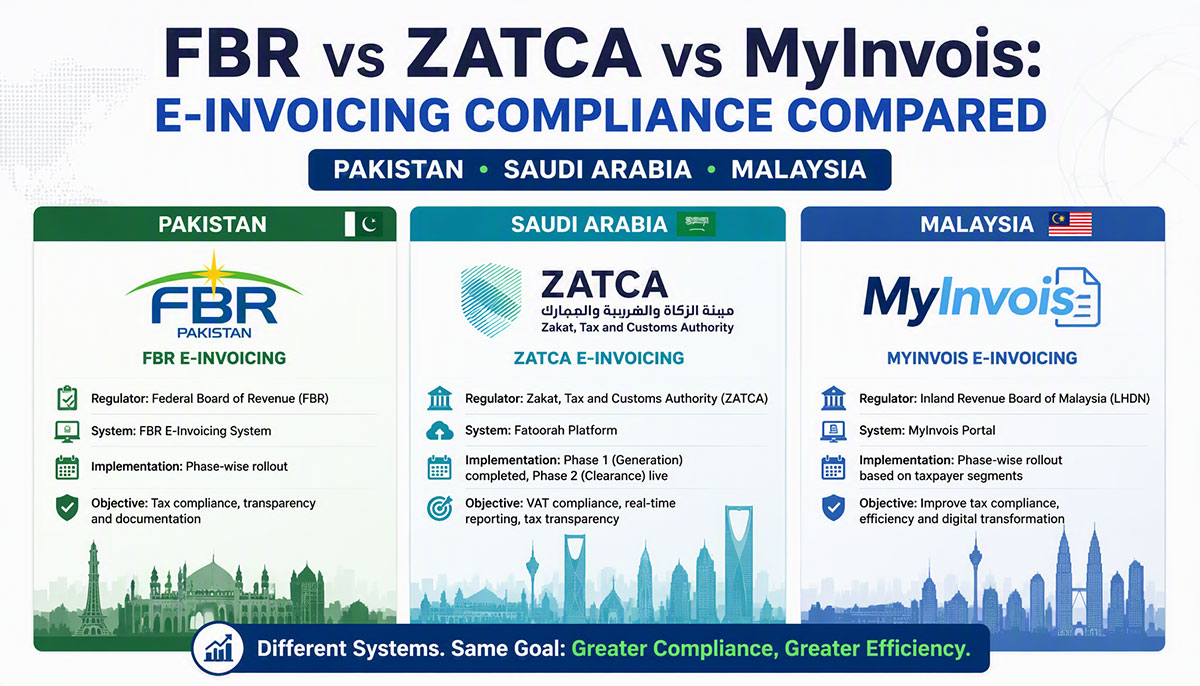
FBR (Pakistan), ZATCA (Saudi Arabia), and MyInvois (Malaysia) are regional e-invoicing systems with different formats and validation models. FBR uses JSON with real-time IRN generation, ZATCA requires XML (UBL 2.1) with digital signatures and clearance, and MyInvois uses JSON with API integration to LHDN. Multi-market businesses need software that supports all three natively to avoid fragmented systems and manual reconciliation.
If you operate retail outlets in Karachi and Riyadh, or manage accounting for clients in Pakistan, Saudi Arabia, and Malaysia, you face a practical problem: three different e-invoicing systems, three different formats, three different APIs. Each market has its own rules, and a mistake in one creates rework with that tax authority. This guide compares FBR, ZATCA, and MyInvois side-by-side — technical requirements, invoice formats, validation models — and shows how multi-market businesses run e-invoicing for all three from a single platform.
Why Multi-Market E-Invoicing Compliance Matters
Tax authorities across South Asia and the GCC now require real-time transmission of invoice data. Pakistan's Federal Board of Revenue (FBR), Saudi Arabia's Zakat, Tax and Customs Authority (ZATCA), and Malaysia's Inland Revenue Board (LHDN) each run separate e-invoicing systems, rolled out on their own timetables.
Regional expansion creates compliance fragmentation: A pharmacy chain expanding from Lahore to Riyadh must comply with FBR's IRN generation in Pakistan and ZATCA's XML clearance in Saudi Arabia. A QSR franchise operating in Malaysia, Pakistan, and the UAE needs MyInvois for Kuala Lumpur, FBR for Karachi, and UAE FTA for Dubai.
The cost of multi-system compliance: Using separate POS software for each country creates data silos, manual reconciliation, and triple the IT overhead. Accounting firms managing cross-border clients face three different portals, three different formats, three different rollout timetables.
Who needs this guide:
- Multi-location businesses with outlets in Pakistan, Saudi Arabia, or Malaysia
- Franchises expanding across South Asia and GCC markets
- Exporters and distributors serving buyers in these jurisdictions
- Accounting firms managing books for cross-border clients
- CFOs evaluating expansion into FBR, ZATCA, or MyInvois markets
The advantage of unified compliance: one ERP, one dataset, one dashboard — automatic e-invoicing per market.
Overview: FBR, ZATCA, and MyInvois E-Invoicing Systems
Quick comparison table:
| Feature | FBR (Pakistan) | ZATCA (Saudi Arabia) | MyInvois (Malaysia) |
|---|---|---|---|
| Governing body | Federal Board of Revenue | Zakat, Tax and Customs Authority | Lembaga Hasil Dalam Negeri (LHDN) |
| System name | FBR Digital Invoicing | Fatoora (ZATCA Phase 2) | MyInvois |
| Launch year | 2021 (SRO 1006/2021) | 2021 (Phase 1), 2023 (Phase 2) | 2024 (phased rollout) |
| Mandatory for | All sales-tax-registered persons (phased by turnover per SRO 1852(I)/2025) | All VAT-registered businesses (phased by turnover and sector) | Businesses above LHDN's turnover threshold (phased by turnover) |
| Invoice format | JSON (via PRAL API) | XML (UBL 2.1 standard) | JSON or XML (LHDN specification) |
| Validation | Real-time IRN generation (reporting model) | Real-time clearance (B2B) + reporting (B2C) | Real-time submission via MyInvois portal or API |
| QR code required | Yes (on printed receipts, encodes IRN) | Yes (embedded invoice hash + digital signature) | Not mandatory as of 2026 |
| Digital signature | No | Yes (X.509 certificates, XAdES-BES) | Yes (Digital Certificate issued by IRBM) |
All three systems share a common goal: real-time visibility of transactions for tax authorities. The differences lie in technical implementation, validation models, and complexity.
FBR Digital Invoicing (Pakistan) — How It Works
Who Must Comply
FBR's digital invoicing mandate applies to sales-tax-registered persons under SRO 1852(I)/2025, rolled out in phases by turnover, starting with the largest businesses. [1][2] Check the current notifications on FBR's website (or ask your tax adviser) for what applies to your business and when.
Tier-1 retailers (those operating in air-conditioned malls, chain stores, businesses with ≥PKR 1.2M annual electricity bills, or accepting card payments through POS terminals) were the first category to integrate under the original SRO 1006/2021. [3][4]
Technical Requirements
Every invoice transmitted to FBR must include: [5][6]
- Real-time transmission of sale data to PRAL (Pakistan Revenue Automation Limited)
- Invoice Record Number (IRN) generation for every transaction
- QR code on receipts (300×300px, v2.0 specification) encoding the IRN and basic invoice data for buyer verification
- JSON payload format with mandatory fields:
- Buyer NTN (National Tax Number)
- Item details (description, quantity, unit price)
- Tax amount (sales tax breakdown)
- Payment method (cash, card, digital wallet)
- Invoice total
Integration Workflow
- Sale recorded in your POS or ERP system
- Invoice data sent to FBR's PRAL API in JSON format
- FBR validates the data and returns an Invoice Record Number (IRN) instantly
- QR code generated from the IRN and printed on the receipt
- Periodic summary upload (batch transmission of aggregated sales for reconciliation)
Offline support: FBR allows temporary offline operation with deferred upload, within the time limits FBR sets for disconnection and for uploading after reconnection. [7]
ZATCA E-Invoicing (Saudi Arabia) — How It Works
Who Must Comply
ZATCA's e-invoicing regulation applies to: [8][9]
- All VAT-registered businesses in Saudi Arabia (excluding non-resident taxpayers)
- Parties issuing tax invoices on behalf of VAT-registered suppliers
- Both B2B and B2C transactions
Phased rollout: ZATCA Phase 2 integration is rolled out in waves based on business size and sector, and ZATCA notifies each wave in advance. [10] Check ZATCA's website (or ask your tax adviser) for which wave covers your business and when.
Technical Requirements
ZATCA Phase 2 is the most technically complex of the three systems: [9][10][11]
- XML format (UBL 2.1 standard): Universal Business Language specification for structured invoice data
- Digital signature: Cryptographic signing of each invoice using X.509 certificates (CSID) obtained from ZATCA-approved providers (Geotrust, Digicert)
- XAdES-BES (XML Advanced Electronic Signatures): Basic Electronic Signature profile for digital stamping
- QR code: Cryptographic stamp encoded in TLV (Tag-Length-Value) format, then Base64 encoded. Includes:
- Seller name and TRN (Tax Registration Number)
- Timestamp
- Invoice total
- VAT amount
- Digital signature (tags 6–9: invoice hash, digital signature, public key, certificate stamp)
- SHA-256 invoice hash chains: Each invoice includes a hash of the previous invoice for tamper-proofing
- UUID-based invoice identification: Unique identifier for every invoice
Integration Workflow
B2B invoices (clearance model):
- Invoice generated in your ERP
- XML file created per UBL 2.1 specification
- Digital signature applied using your CSID certificate
- Sent to ZATCA's Fatoora clearance API
- ZATCA validates the invoice and returns a clearance code
- Invoice finalized and sent to the customer (only cleared invoices are legally valid)
B2C invoices (reporting model):
- Invoice generated and finalized immediately
- Batch-reported to ZATCA within the reporting window ZATCA sets
ZATCA does not allow offline operation for B2B clearance — invoices must be cleared in real time. [10]
MyInvois E-Invoicing (Malaysia) — How It Works
Who Must Comply
Malaysia's e-invoicing is rolled out by LHDN in phases by turnover, starting with the largest businesses, and IRBM (Inland Revenue Board of Malaysia) has raised the exemption threshold for the smallest businesses. [12][13][14] Check LHDN's MyInvois website (or ask your tax adviser) for what applies to your business and when.
Technical Requirements
MyInvois requires: [12][13][14]
- 55 specific data fields covering seller and buyer details, transaction items, quantities, prices, taxes, totals, and payment information
- Digital Certificate issued by IRBM for signing each e-invoice
- Real-time submission to LHDN's MyInvois system via:
- Manual entry through the MyInvois Portal
- Automatic API integration
- Individual e-invoices for high-value transactions — LHDN limits consolidated invoices above a set transaction value
Invoice format: MyInvois accepts JSON or XML per LHDN specifications. Most implementations use JSON for simplicity. [12]
Integration Workflow
- Invoice generated in your ERP or POS system
- Invoice data formatted per LHDN's 55-field specification
- Digital signature applied using IRBM-issued certificate
- Submitted to MyInvois via portal or API
- LHDN validates and returns a validation reference for your records
Offline support: MyInvois requires real-time submission; prolonged offline operation is not supported. Businesses experiencing connectivity issues should use the portal's manual submission as a backup. [13]
Side-by-Side Comparison: FBR vs ZATCA vs MyInvois
Detailed comparison table:
| Dimension | FBR (Pakistan) | ZATCA (Saudi Arabia) | MyInvois (Malaysia) |
|---|---|---|---|
| Invoice format | JSON | XML (UBL 2.1) | JSON or XML |
| Real-time validation | Yes (IRN generation) | Yes (B2B clearance) | Yes (submission to LHDN) |
| QR code requirement | Yes (receipt-level, encodes IRN) | Yes (invoice hash + digital signature) | No (not mandatory as of 2026) |
| Digital signature | No | Yes (cryptographic, X.509 certificates) | Yes (IRBM Digital Certificate) |
| Clearance vs Reporting | Reporting (real-time transmission, no clearance required) | Hybrid (clearance for B2B, reporting for B2C) | Reporting (submission for validation) |
| Offline support | Yes (within FBR's time limits) | Not allowed (B2B clearance must be online) | Not supported (real-time submission required) |
| API complexity | Moderate (JSON, REST API) | High (XML, UBL schema, digital signatures, PKI certificates) | Moderate (JSON/XML, REST API, 55 data fields) |
| Compliance cost | Low-to-moderate (software integration, no PKI certificates) | Moderate-to-high (PKI certificates, XML infrastructure, UBL schema) | Low-to-moderate (Digital Certificate from IRBM, API integration) |
Key takeaway: ZATCA is the most technically complex (XML, digital signatures, PKI certificates). FBR is the most operationally flexible (offline support, simpler JSON format). MyInvois sits in the middle (JSON option, but no offline support).
Challenges for Multi-Market Businesses
Challenge 1: Fragmented Software Stack
Problem: One POS for Pakistan (FBR), different ERP for Saudi (ZATCA), third system for Malaysia (MyInvois).
Result: Data silos, manual reconciliation, high IT overhead. Each system maintains its own invoice records, customer database, and product catalog. Consolidating sales reports across markets requires manual exports and spreadsheet work.
Example: A QSR franchise with 15 outlets across Lahore, Riyadh, and Kuala Lumpur cannot see real-time sales performance across all locations from a single dashboard. Each market requires separate login credentials, separate support contracts, separate training for staff.
Challenge 2: Inconsistent Invoice Formats
Problem: FBR uses JSON, ZATCA uses XML (UBL 2.1), MyInvois accepts JSON or XML (but integration varies by vendor).
Result: Developer burden — maintaining three separate API integrations, three different validation rules, three different error-handling workflows. Testing complexity: each country's sandbox environment must be validated separately before going live.
Example: A distributor shipping electronics from Pakistan to GCC and Southeast Asia must generate different invoice formats depending on the buyer's jurisdiction. A B2B invoice to a Saudi buyer requires ZATCA clearance (XML), while a sale to a Malaysian retailer requires MyInvois submission (JSON). The same transaction, three different formats.
Challenge 3: Compliance Timing & Phasing
Problem: Each country has different rollout timelines, waves, and turnover thresholds.
Result: It is easy to lose track of one market while focusing on another: three rollout calendars, three sets of notifications, three sets of rules.
Solution: Unified compliance dashboard showing all markets' status — active, pending, at-risk — in one view.
Challenge 4: Staff Training & Processes
Problem: Different QR codes, different receipt formats, different validation errors.
Result: Multi-location businesses need country-specific training. A cashier in Lahore learns FBR's IRN workflow. A cashier in Riyadh learns ZATCA's clearance rejection handling. A cashier in Kuala Lumpur learns MyInvois submission procedures. Turnover compounds the problem — each new hire requires geography-specific onboarding.
Solution: Standardized UI that handles all three systems behind the scenes. The cashier scans items, processes payment, prints the receipt — the ERP automatically formats the invoice per the branch's jurisdiction and transmits it to FBR, ZATCA, or MyInvois without manual intervention.
The Unified Compliance Advantage: How EloERP Handles All Three
One Platform, Three Compliance Modules
EloERP has native e-invoicing modules for all three markets:
- FBR Digital Invoicing (Pakistan): Real-time IRN generation, QR code printing, PRAL API integration
- ZATCA Phase 2 (Saudi Arabia): UBL 2.1 XML generation, digital signatures (X.509 certificates), Fatoora clearance API, B2B/B2C workflow handling
- MyInvois (Malaysia): LHDN-format invoice transmission, 55-field validation, IRBM Digital Certificate integration
- UAE FTA (bonus): Peppol PINT AE for UAE e-invoicing
All modules are included in the base ERP — not sold as separate add-ons or third-party plugins.
Per-Company Compliance Toggle
Multi-entity businesses can enable FBR for Pakistan branches, ZATCA for Saudi branches, MyInvois for Malaysia branches — all from the same ERP instance.
Example setup:
- Company A (Lahore, Pakistan): FBR Digital Invoicing enabled
- Company B (Riyadh, Saudi Arabia): ZATCA Phase 2 enabled
- Company C (Kuala Lumpur, Malaysia): MyInvois enabled
Each branch operates with its own compliance configuration. The ERP automatically applies the correct format, validation rules, and API endpoints based on the branch's jurisdiction.
Centralized reporting: View compliance status across all markets in one dashboard — invoices transmitted, clearances received, rejected invoices, pending uploads — for Pakistan, Saudi Arabia, and Malaysia simultaneously.
Behind-the-Scenes Format Handling
EloERP automatically formats invoices per each country's specification:
- JSON for FBR (Pakistan) — includes buyer NTN, item details, tax breakdown, IRN request
- XML (UBL 2.1) for ZATCA (Saudi Arabia) — includes digital signature, clearance request, UUID, hash chain
- JSON or XML for MyInvois (Malaysia) — includes 55 mandatory fields, IRBM certificate signature
No need for country-specific POS hardware or software. Same user interface for cashiers in Lahore, Riyadh, and Kuala Lumpur. The system detects the branch's jurisdiction from the company settings and applies the correct compliance workflow in the background.
Developer burden eliminated: One integration with EloERP handles all three markets. No need to hire separate developers for FBR, ZATCA, and MyInvois APIs.
Compliance Audit Trail
Every invoice is logged with country-specific validation metadata:
- FBR: IRN, QR code data, transmission timestamp, PRAL response status
- ZATCA: Clearance code, digital signature, UUID, hash chain reference
- MyInvois: Validation reference, IRBM certificate ID, submission timestamp
Ready for multi-country audits: If FBR audits your Pakistan operations, export FBR-specific compliance reports. If ZATCA audits your Saudi operations, export ZATCA clearance logs. Each market's audit reports come from the same dataset.
Export compliance reports per market: Filter by jurisdiction, date range, invoice status (cleared, rejected, pending) — download as PDF or CSV for submission to tax authorities.
When You Need Multi-Market E-Invoicing Compliance
Use Case 1: Regional Franchise Chain
Example: QSR (quick-service restaurant) with outlets in Karachi, Riyadh, and Kuala Lumpur.
Challenge: Each country requires different e-invoicing compliance. FBR for Pakistan POS terminals, ZATCA Phase 2 for Saudi outlets, MyInvois for Malaysia locations.
EloERP solution: One POS system, automatic e-invoicing per location. The Karachi outlet's sales are transmitted to FBR with IRN generation. The Riyadh outlet's B2B invoices are cleared through ZATCA before printing. The Kuala Lumpur outlet's invoices are submitted to MyInvois in real time. Same menu, same POS interface, same training — only the compliance backend differs.
Use Case 2: Distributor with Cross-Border Sales
Example: Electronics distributor shipping from Pakistan to GCC and Southeast Asia.
Challenge: B2B invoices must meet the buyer's country compliance. A sale to a Saudi buyer requires ZATCA clearance (XML with digital signature). A sale to a Malaysian buyer requires MyInvois submission (JSON with 55 fields). A local Pakistan sale requires FBR IRN generation.
EloERP solution: Generate the right e-invoice format per buyer's jurisdiction. When you create a sales order, specify the buyer's country. EloERP automatically selects the correct compliance workflow — ZATCA clearance for Saudi buyers, MyInvois submission for Malaysian buyers, FBR transmission for Pakistan buyers. Same sales order form, same inventory deduction, same accounting entry — only the e-invoicing format differs.
Use Case 3: Accounting Firm with Multi-Country Clients
Example: Accounting firm managing books for businesses in Pakistan, Saudi Arabia, and Malaysia.
Challenge: Different e-invoicing portals, different formats, different rollout dates for each client. Manually tracking FBR, ZATCA, and MyInvois rollout notices for each client.
EloERP solution: White-label partner program — one ERP for all clients, e-invoicing handled per client's country. Set up each client as a separate company in EloERP, enable the appropriate compliance module (FBR, ZATCA, or MyInvois), and monitor all clients' e-invoicing status from a single dashboard. When a client's invoice is rejected by ZATCA, you see the alert immediately and can correct it before ZATCA's B2C reporting window closes.
Choosing E-Invoicing Software for Multi-Market Operations
Evaluation checklist:
- Does it support FBR (Pakistan), ZATCA (Saudi), and MyInvois (Malaysia) natively? (Not through third-party plugins — built-in modules.)
- Can you enable compliance per branch/company (not all-or-nothing)? (Multi-entity support with per-company compliance toggles.)
- Does it auto-generate country-specific invoice formats (JSON, XML, etc.) without manual configuration? (Format handling should be invisible to the user.)
- Is the compliance module built-in or a paid add-on? (Separate module fees compound costs for multi-market businesses.)
- Does it handle digital signatures (required for ZATCA and MyInvois)? (X.509 certificates for ZATCA, IRBM certificates for MyInvois.)
- Can you run compliance audits per market from one dashboard? (Export FBR reports, ZATCA clearance logs, MyInvois validation records separately.)
- Is support available for regulatory updates in all three countries? (FBR SROs, ZATCA wave announcements, MyInvois phase changes — your vendor should monitor and update the system automatically.)
EloERP comparison:
- ✅ Native FBR, ZATCA, MyInvois, UAE FTA e-invoicing
- ✅ Per-company toggle (multi-entity support)
- ✅ Auto-formats invoices (JSON, XML, etc.) behind the scenes
- ✅ Included in base ERP (not a separate module fee)
- ✅ Digital signatures for ZATCA Phase 2 (X.509 certificates) and MyInvois (IRBM certificates)
- ✅ Centralized e-invoicing dashboard (view FBR, ZATCA, MyInvois status in one screen)
- ✅ Regional support (Pakistan, GCC, Southeast Asia) — updates applied automatically when FBR, ZATCA, or LHDN announce regulatory changes
Ready to Manage FBR, ZATCA, and MyInvois from One Platform?
Stop juggling three different POS systems, three different APIs, three different compliance dashboards. EloERP handles Pakistan (FBR), Saudi Arabia (ZATCA), Malaysia (MyInvois), and UAE (FTA) e-invoicing from a single platform — included in the base ERP, not sold as add-ons.
Start a 15-Day Free Trial (no credit card required) — test FBR, ZATCA, and MyInvois e-invoicing in our sandbox before going live.
Book a 30-Minute Demo — see multi-market e-invoicing in action: one POS, three countries, automatic formatting.
Ask for a Quote — pricing on request for multi-entity businesses. One subscription, unlimited branches, all e-invoicing modules included.
Sources
[1] FBR Digital Invoice Registration — ISOLATE ERP, 2026
[2] FBR E-Invoicing Compliance Guide (2026) — InvoiceFlow, 2026
[3] FBR Integrated POS Software Pakistan: Complete Guide 2026 — EloERP, 2026
[4] Tier-1 Retailer FBR Requirements 2026 — EloERP
[5] FBR Digital Invoicing | IRIS & PRAL Integration for Businesses in Pakistan — Switcher Techno, 2026
[6] FBR Digital Invoice Pakistan: Complete Guide to E-Invoicing, API & Compliance (2026) — Wise Solutions, 2026
[7] FBR Digital Invoicing Complete Guide — EloERP
[8] ZATCA E-Invoicing: What is e-invoicing? — ZATCA Official, 2026
[9] ZATCA Phase 2 Complete Guide 2026 – Integration, Requirements & Timeline — LookPOS, 2026
[10] ZATCA E-Invoicing Phase 2 (2026): Wave 24 Guidelines & Integration — Out2Sol, 2026
[11] Implementing ZATCA Phase 2 E-Invoicing in WooCommerce: UBL XML, XAdES Signing, and Hash Chains — DEV Community, 2026
[12] e-Invoicing in Malaysia 2026: Guidelines, Requirements and Exemption — ClearTax Malaysia, 2026
[13] Malaysia E-Invoicing Mandate: Requirements, Timeline, and Best Practices — Axway, 2026
[14] e-Invoice Implementation Date Malaysia 2026: LHDN Phases and Relaxation Period — ClearTax Malaysia, 2026
Related reading: