
FBR Digital Invoicing Software: What Pakistani Businesses Need to Know in 2026
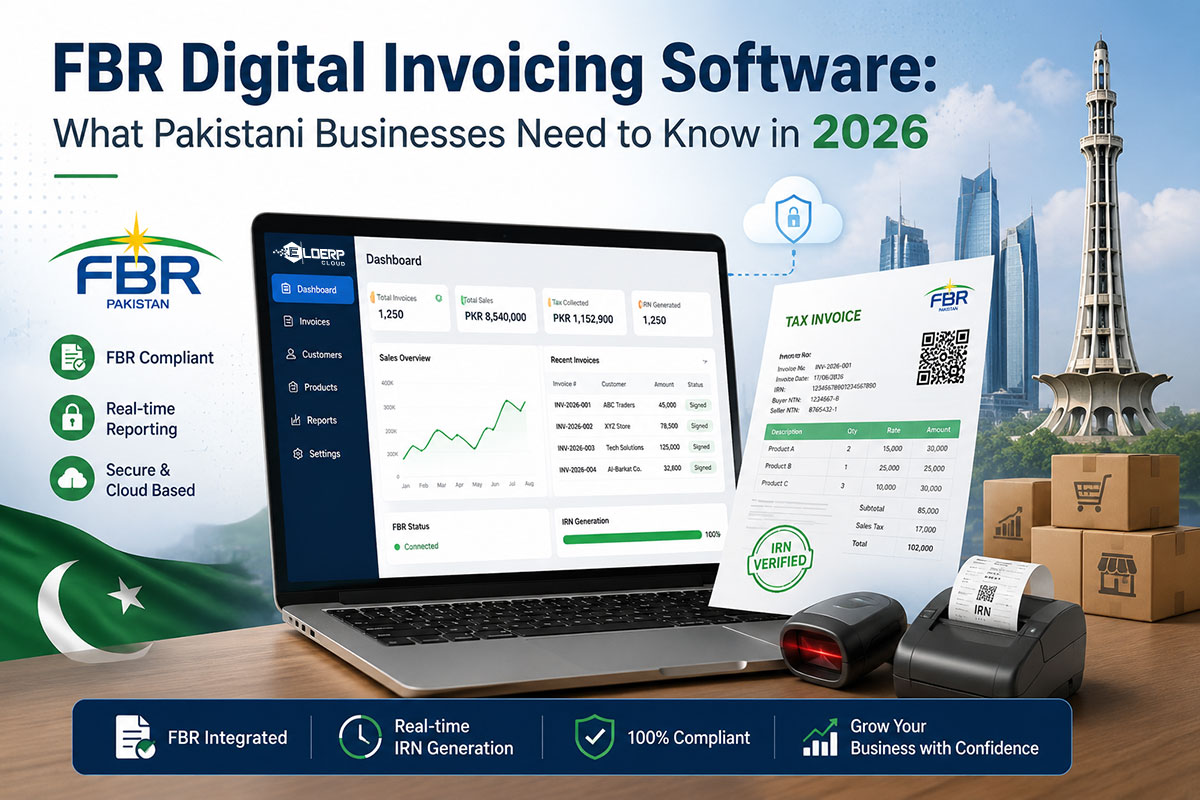
If you're a sales-tax-registered business in Pakistan, FBR digital invoicing is likely to apply to you. The Federal Board of Revenue (FBR) sets out real-time electronic invoicing for sales tax registered businesses in SRO 1852(I)/2025, rolled out in phases that started with public enterprises, importers, and the largest businesses. Check the current notifications on FBR's website (or ask your tax adviser) for what applies to your business and when. This guide explains what FBR digital invoicing software is, who needs it, how it works, and what to look for when choosing a solution. Let's start with the basics.
What Is FBR Digital Invoicing Software?
FBR Digital Invoicing Software is an electronic invoicing system that generates sales tax invoices, digitally signs them, and transmits invoice data in real time to Pakistan's Federal Board of Revenue (FBR) through the IRIS portal. The software receives a unique FBR Invoice Number (IRN) and QR code for each transaction, in the format SRO 1852(I)/2025 sets out.
This isn't just about printing receipts electronically. Electronic invoicing means generating, signing, and transmitting invoice data to FBR before or during the customer transaction — not at the end of the day or month. The system integrates with IRIS (FBR's official tax filing portal) via PRAL (Pakistan Revenue Automation Limited), FBR's official licensed technology integrator.
Here's how the real-time submission works: when you make a sale, your invoice data is sent to FBR at the exact time of the transaction. FBR's system validates the data and returns a unique Invoice Reference Number (IRN — officially called the "unique FBR invoice number," typically 22 characters) along with a QR code. Your printed invoice includes the IRN, QR code, and FBR digital stamp, letting customers verify its authenticity and giving FBR a real-time compliance record.
The key technical components are: the IRN (a unique identifier for every invoice), the QR code (machine-readable verification for customers and tax authorities), and PRAL API integration (the real-time data transmission channel).
A note on terminology: Some software vendors use "Unique Invoice Number (UIN)" — the official FBR term is "unique FBR invoice number" or Invoice Reference Number (IRN). Both refer to the same 22-character identifier returned by PRAL's system. For an in-depth implementation guide, see our complete guide to FBR digital invoicing.
How FBR Digital Invoicing Works (5-Step Process)
Customer makes a purchase: The sale is recorded in your POS or ERP system — whether at a retail counter, restaurant table, wholesale order, or any other transaction point.
Invoice data generated: Your system automatically creates an invoice with all required FBR fields: buyer NTN (if applicable), item details, tax amounts, seller information, and other mandated data points.
Real-time submission to PRAL: Invoice data is transmitted via API to PRAL for validation. This happens immediately at the point of sale, not batched for later submission.
FBR validation & IRN issuance: PRAL validates the data against FBR's Computerized System and returns a unique FBR Invoice Number (IRN) plus a QR code. This validation typically happens in seconds.
Invoice issued to customer: The receipt or invoice is printed with the IRN, QR code, and FBR digital stamp. Your customer receives a compliant document, and FBR has a real-time record of the transaction.
Most FBR-compliant software integrates with PRAL, which is free and government-backed. Alternative private integrators exist but charge fees — PRAL is the standard, zero-cost option.
Who Needs FBR Digital Invoicing Software?
FBR digital invoicing is mandatory for all sales-tax-registered businesses in Pakistan under SRO 1852(I)/2025. The mandate follows a phased rollout based on business size and sector.
Who Qualifies as "Tier-1"?
Under SRO 1852(I)/2025, Tier-1 classification includes:
- Businesses with annual sales or revenue exceeding PKR 1 billion
- All registered importers (regardless of revenue)
- Public enterprises and government-contracted suppliers
- Manufacturers and distributors in notified sectors (pharmaceuticals, electronics, FMCG, and others)
- Retailers operating in air-conditioned shopping malls
- Retailers with credit/debit card payment terminals
- Retailers whose annual electricity bill exceeds PKR 1.2 million
- Multi-branch retail chains, supermarkets, restaurants, pharmacies, and large-format stores
Even if you're below the PKR 1 billion threshold today, you may be required in future FBR phases. Planning ahead is the safest approach.
Sector-Specific Applicability
The mandate applies across sectors including retail (supermarkets, clothing stores, electronics shops, pharmacies, mobile outlets), restaurants and cafes, wholesale and distribution operations, manufacturing facilities, and sales-tax-registered service businesses such as salons, repair centers, and hotels.
Benefits of FBR Digital Invoicing Software (Beyond Compliance)
While compliance is the legal driver, FBR digital invoicing software offers operational benefits that improve how you run your business:
Automatic FBR formatting: Every invoice carries the IRN, QR code, and digital stamp FBR requires. You eliminate manual invoicing work and the risk of format errors.
Real-time audit trail: Every sale is recorded with FBR in real time, creating a transparent, tamper-proof record that makes audits easier and reduces disputes with tax authorities.
Reduced manual errors: Automated invoice generation eliminates handwritten receipts, copy-paste mistakes, and missing invoice numbers, giving you clean financial records.
Faster Sales Tax Return (STR) filing: Invoice data auto-populates in Annex-C of your STR through IRIS portal integration. No manual entry means faster month-end close.
Customer verification: The QR code on receipts lets customers instantly verify invoice authenticity via the FBR portal, building trust and reducing fraud claims.
Multi-branch visibility: If you operate multiple stores or branches, centralized FBR-compliant invoicing gives your head office a real-time view of all sales across locations.
Future-proof operations: FBR is expanding the e-invoicing mandate. Businesses that comply today avoid last-minute scrambles when new phases roll out.
Many businesses initially view FBR digital invoicing as a compliance burden. In practice, automated invoicing reduces manual work, improves record accuracy, and speeds up tax filing — turning a legal requirement into an operational upgrade.
How to Choose FBR Digital Invoicing Software
Not all FBR-compliant software is created equal. When evaluating solutions, consider these critical factors to ensure your software meets FBR requirements AND supports your business needs:
1. Real-time PRAL Integration (Not Batch Upload)
Must-have: Your software must submit invoices to PRAL in real time at the point of sale, not queue them for batch upload at the end of the day.
Why it matters: FBR requires real-time transmission. Batch systems may not meet the compliance standard.
How to verify: Ask your vendor: "Does your software call the PRAL API immediately when an invoice is generated, or does it queue invoices for later submission?"
2. Automatic IRN & QR Code Generation
Must-have: The system must automatically receive the IRN from PRAL and generate an FBR-compliant QR code on every invoice.
Why it matters: Manual QR code creation or missing IRNs result in non-compliant invoices.
How to verify: Request a demo invoice. Check for the 22-character IRN and a scannable QR code with the FBR logo.
3. API Integration Quality (Uptime & Error Handling)
Critical: The PRAL API connection must be stable, and the software should handle network outages gracefully by queuing invoices and retrying on reconnection.
Why it matters: API downtime means you can't issue compliant invoices, which disrupts your business.
How to verify: Ask about fallback mechanisms: "What happens if the PRAL API is temporarily down — can I still invoice customers?"
4. Offline Mode Support (Optional but Valuable)
Nice-to-have: Some software offers offline invoicing with automatic sync when internet connectivity is restored.
Why it matters: Pakistan's internet reliability varies. Offline mode prevents sales disruption during outages.
How to verify: Ask: "Does your software support offline invoicing with automatic FBR sync when connectivity returns?"
5. Multi-Branch & Multi-Company Support
Important for chains: If you operate multiple stores or companies, your software should support centralized FBR invoicing across all locations and entities.
How to verify: Ask: "Can I manage FBR invoicing for all my branches from one dashboard?"
6. Integration with Your Existing System
Must-have: FBR invoicing software should integrate with your current POS, ERP, or accounting system — or be an all-in-one solution.
Why it matters: Manual re-entry of sales from your POS into separate FBR software means double work and error risk.
How to verify: Ask: "Does your software integrate with [your current POS/ERP name], or do I need to switch systems entirely?"
7. PRAL Certification & Vendor Track Record
Trust signal: Verify that your vendor is officially integrated with PRAL and has existing clients using FBR invoicing in production.
Why it matters: Unproven vendors may deliver non-compliant implementations.
How to verify: Request client references or case studies of businesses live on FBR digital invoicing.
8. Training & Support
Important: FBR invoicing involves regulatory complexity. Your vendor should provide training for your team plus ongoing support.
How to verify: Ask about the onboarding process, training materials, and support channels (phone, WhatsApp, email).
9. Cost Structure (Per-Terminal vs Flat-Rate)
Budget consideration: Some vendors charge per POS terminal, others offer flat-rate pricing.
Why it matters: Per-terminal pricing can be expensive for multi-location businesses.
Compare options: Flat-rate models (like EloERP) are often more cost-effective for chains.
10. Compliance Update Guarantee
Future-proofing: FBR regulations evolve with new SROs and updated formats. Your vendor should guarantee compliance updates.
How to verify: Ask: "Are FBR compliance updates included, or do you charge separately for regulatory changes?"
Ready to compare solutions? Check our roundup of the best FBR digital invoicing software in Pakistan for 2026.
FBR Digital Invoicing vs Traditional Invoicing: What Changes?
| Aspect | Traditional Invoicing | FBR Digital Invoicing |
|---|---|---|
| Invoice generation | Manual/printed receipt books or standalone POS | Electronic invoice generated via FBR-integrated software |
| FBR submission | Manual entry in STR (monthly) | Real-time automatic transmission to IRIS via PRAL |
| Invoice number | Sequential number from receipt book | FBR-issued IRN (22-character unique ID) |
| Verification | No customer verification | QR code on receipt → instant FBR portal verification |
| Audit trail | Paper records, manual record-keeping | Digital, tamper-proof FBR record for every transaction |
| Compliance risk | High (manual errors, missing invoices, formatting mistakes) | Low (automated compliance, real-time validation) |
| STR filing | Manual data entry in Annex-C | Auto-populated from FBR's live invoice records |
Ready to Implement FBR Digital Invoicing?
EloERP includes FBR digital invoicing with real-time PRAL integration and automatic IRN and QR code generation — built into our all-in-one cloud ERP + POS system. Learn more about EloERP's FBR-integrated POS solution.
Try EloERP free for 15 days (no credit card required).
Need a guided walkthrough of FBR invoicing setup for your multi-branch business? Schedule a 30-minute demo.