
UAE E-Invoicing: Complete 2026 Guide to FTA Compliance
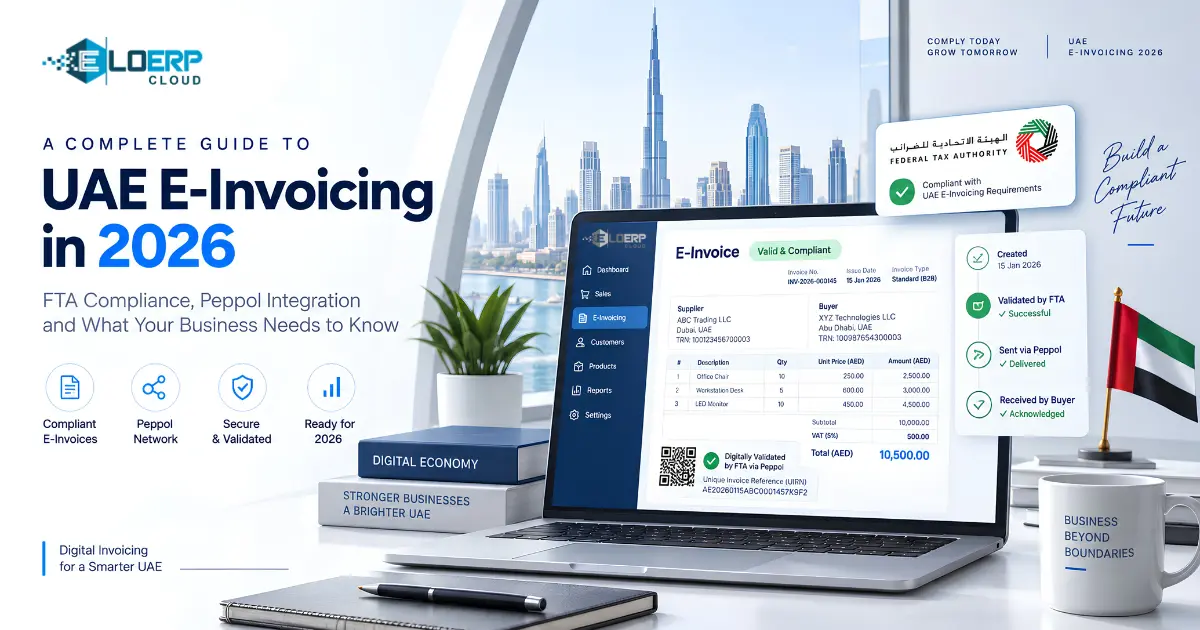
UAE e-invoicing is a Federal Tax Authority (FTA) mandate requiring VAT-registered businesses to issue electronic invoices in UBL XML format (Universal Business Language — a standardized machine-readable invoice structure, like PDF for documents but processable by accounting systems) via the Peppol network. VAT-registered businesses are brought in by phase, starting with the largest. Invoices must include 51 mandatory fields including TIN, VAT breakdown, and supplier/buyer details. Check the FTA's website (or ask your tax adviser) for what applies to your business and when.
The UAE Federal Tax Authority is rolling out mandatory e-invoicing across all VAT-registered businesses, adopting a unique Peppol-based system with stricter oversight than most global implementations. For retail chains, restaurants, wholesalers, and service businesses operating in the UAE, this guide explains what the FTA requires, who must comply, technical specifications, and how the phased rollout works.
What is UAE E-Invoicing?
UAE e-invoicing is the Federal Tax Authority's electronic invoicing mandate requiring businesses to exchange structured digital invoices via the Peppol network instead of paper or PDF invoices. The system uses a Decentralised Continuous Transaction Control and Exchange (DCTCE) model — a five-corner Peppol architecture where the FTA receives real-time tax data as invoices move between trading partners.
Legal basis: Cabinet Decision on Tax Procedures issued by Ministry of Finance
Technical standard: Peppol PINT AE v1.0.1 (Pan-European Public Procurement Online International variant for UAE) in UBL XML format, officially published by the Ministry of Finance as the mandated invoice specification
Scope: B2B and B2G transactions only (B2C excluded except for certain government-facing transactions)
What it replaces: Paper invoices, PDF invoices, and other unstructured invoice formats — only structured data in PINT AE format qualifies as a compliant e-invoice under the mandate.
Phased Implementation Timeline
The UAE is rolling out e-invoicing in phases based on business revenue: large businesses first, then medium and small businesses, then government entities, with VAT groups later. Each phase has its own date for appointing an Accredited Service Provider (ASP) and for going live, and a voluntary pilot phase lets businesses start early.
Source: Tradeshift UAE E-Invoicing Mandate 2026
Who Must Comply with UAE E-Invoicing?
Mandatory Compliance
All VAT-registered businesses in the UAE must comply with e-invoicing. This includes:
- Revenue threshold: Businesses with annual turnover exceeding AED 375,000 must register for VAT and subsequently comply with e-invoicing requirements
- Free zone businesses: Explicitly included in the mandate per FTA Version 1.1 guidelines — free zone status does not exempt you from e-invoicing
- Non-corporate tax registrants: Even if you're not registered for corporate tax, you must still obtain a Tax Identification Number (TIN) for e-invoicing purposes
Who is excluded:
- Businesses below the AED 375,000 mandatory VAT registration threshold (though voluntary VAT registration between AED 187,500 and AED 375,000 is permitted)
- Most B2C transactions (retail sales to consumers — though some government-facing B2C may be brought in later)
- Certain exempt services including specific airline transport and limited financial services
Implementation Priority by Revenue
The FTA is rolling the mandate out in waves:
Phase 1: The largest businesses (above the FTA's revenue threshold) appoint an Accredited Service Provider (ASP) and go live first.
Phase 2: All other VAT-registered businesses follow.
Phase 3: Government entities and B2G transactions.
Source: Tradeshift UAE E-Invoicing Timeline
UAE E-Invoicing Technical Requirements
Peppol PINT AE Standard
The UAE adopted Peppol PINT AE (Pan-European Public Procurement Online International for the United Arab Emirates) — a structured data standard based on UBL XML with UAE-specific extensions.
What makes UAE Peppol unique:
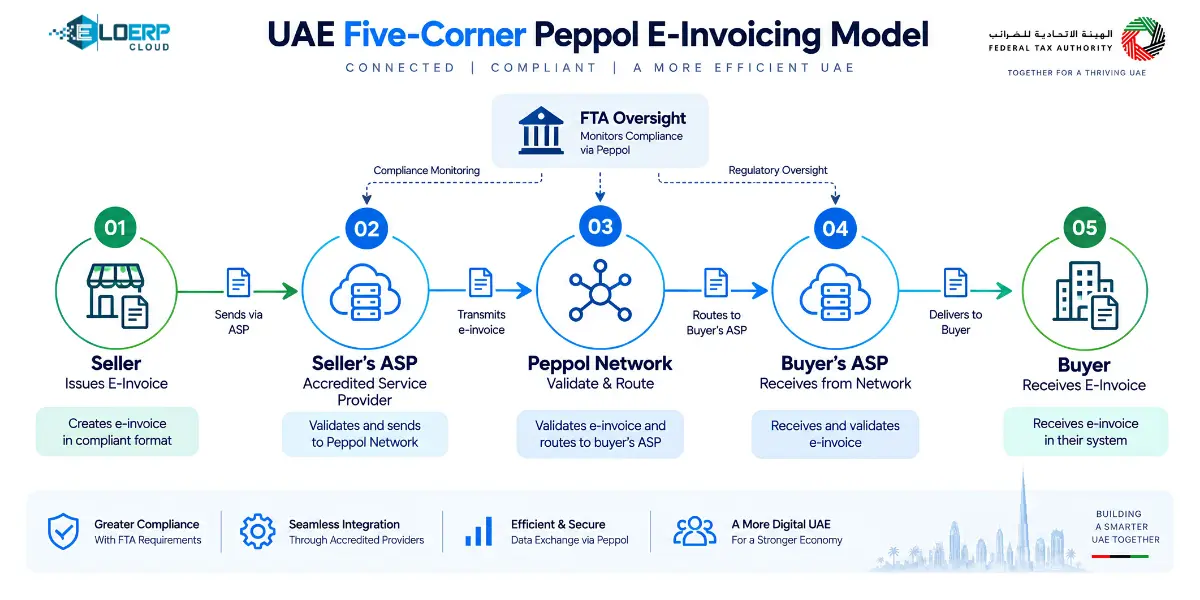 The UAE uses a five-corner Peppol model instead of the standard four-corner exchange:
- Supplier (invoice issuer)
- Supplier's Peppol access point (ASP)
- Buyer's Peppol access point (ASP)
- Buyer (invoice recipient)
- Federal Tax Authority (receives real-time tax data as invoices transmit)
This fifth corner gives the FTA continuous visibility into all B2B transactions — a stricter oversight model than standard Peppol implementations.
Source: Tradeshift Five-Corner Model
Mandatory Invoice Fields
The Federal Tax Authority requires 51 mandatory fields for every electronic tax invoice (per FTA technical guidance issued 23 February 2026), organized into:
Invoice identifiers:
- Unique invoice number
- Invoice issue date and time
- Invoice type code
Party identification:
- Supplier Tax Identification Number (TIN) — derived from first 10 digits of Corporate Tax Registration Number
- Buyer TIN or VAT registration number
- Full legal names and addresses
Tax breakdown:
- VAT treatment per line item
- VAT category and rate
- Taxable amount and VAT amount by category
- Total invoice amount including VAT
UAE-specific fields:
- Place of supply (UAE mainland vs. free zone)
- Free zone transaction indicator
- Payment terms and method
Source: Tradeshift 51 Mandatory Fields
Peppol Access Point Requirement
You cannot legally submit e-invoices without an FTA-accredited Accredited Service Provider (ASP). Your accounting or ERP system must connect to the Peppol network through one of the FTA's 48 accredited ASPs (as of August 2026, with 4 additional providers under final accreditation assessment).
Choosing an ASP:
- Verify the provider appears on the Ministry of Finance official ASP list (per Ministerial Decision No. 64 of 2025) — do not rely on provider claims alone
- Global Peppol specialists include EDICOM, Pagero, Comarch, ClearTax (Defmacro), and Cygnet Digital
- Some ERP platforms like EloERP generate PINT AE e-invoices natively (no third-party plugin required); you still transmit them through an accredited ASP
UAE E-Invoicing Implementation Steps
Step 1: Confirm VAT Registration
If your annual turnover exceeds AED 375,000, you must be VAT-registered. The FTA sets a short window for registering after you cross (or expect to cross) the threshold — see the FTA's VAT registration guidance.
Step 2: Obtain Your Tax Identification Number (TIN)
Your TIN is derived from the first 10 digits of your Corporate Tax Registration Number. If you're not registered for corporate tax, you must still obtain a TIN specifically for e-invoicing — this is a separate FTA requirement.
Step 3: Appoint an Accredited Service Provider (ASP)
Before the ASP appointment date for your phase, you must:
- Select an ASP from the Ministry of Finance's official accredited list
- Sign a service agreement with the ASP
- Register your business details (TIN, trading name, legal address) with the ASP
- Notify the FTA of your ASP appointment through official channels
Step 4: Update Your Accounting/ERP System
Your invoicing system must be able to:
- Generate invoices in UBL XML format conforming to Peppol PINT AE specification
- Include all 51 mandatory fields required by the FTA
- Transmit invoices to your ASP's Peppol access point automatically
- Store e-invoice records for the FTA-required retention period (typically 5 years for UAE tax records)
Two implementation approaches:
- Native integration: Some ERP systems like EloERP have Peppol PINT AE built-in — no plugin required
- Third-party plugin: Legacy accounting software may require a separate integration module purchased from your ASP
Step 5: Test E-Invoice Transmission
Before your go-live date, conduct end-to-end testing:
- Issue test invoices in UBL XML format
- Confirm successful transmission via your ASP's Peppol access point
- Verify all 51 mandatory fields are populated correctly
- Test edge cases (free zone transactions, multi-currency, credit notes)
Step 6: Train Your Team
Update your invoicing workflows:
- Accounts staff must understand which invoice fields are FTA-mandatory
- Sales teams must collect accurate TIN numbers from customers
- Finance must monitor for system failures and notify the FTA as its rules require
Step 7: Go Live on Your Phase Date
Go live on the date set for your phase: the largest businesses first, then medium and small businesses, then government entities and B2G transactions.
Record-Keeping Requirements
The FTA requires businesses to archive all e-invoices and electronic credit notes for at least 5 years (standard UAE tax record retention period). Your ASP and accounting system must maintain a compliant audit trail including:
- Original UBL XML invoice files
- Transmission timestamps and delivery confirmations
- Amendment history for corrected invoices
- System failure logs and FTA notifications
How EloERP Handles UAE E-Invoicing
EloERP includes native Peppol PINT AE support — no third-party plugin required. Every sale, invoice, or credit note automatically generates a Peppol PINT AE UBL XML e-invoice, ready for your Peppol access point (ASP) to transmit.
Built-In FTA E-Invoicing Features
Automatic UBL XML generation: Create a sale in EloERP (retail POS, restaurant order, or B2B invoice) → the system auto-generates a Peppol PINT AE e-invoice with all 51 mandatory fields populated.
Real-time validation: Invoice fields are validated against FTA requirements before transmission — the system flags missing or invalid fields before an invoice is issued.
Peppol-ready output: EloERP generates the PINT AE e-invoice data your Peppol access point needs.
Multi-currency support: Issue invoices in AED or foreign currencies — the system handles currency conversion and VAT calculation per FTA rules.
Free zone transaction handling: Automatically flags free zone sales with the required Peppol PINT AE indicator.
Audit trail: Full e-invoice archive with 5-year retention, transmission logs, and e-invoicing reports for FTA audits.
Cross-Border Gulf E-Invoicing
EloERP supports four e-invoicing mandates from a single system:
- UAE: Peppol PINT AE (this system)
- Saudi Arabia: ZATCA Phase 2 Fatoora e-invoicing
- Pakistan: FBR Digital Invoicing with real-time IRN and QR codes
- Malaysia: MyInvois e-invoicing (LHDN mandate)
For multi-country businesses: Operate across UAE, KSA, Pakistan, and Malaysia with a single ERP platform instead of maintaining separate systems per country.
EloERP vs. Advisory Firms: Software vs. Consulting
Traditional compliance approach: Hire an advisory firm for an FTA readiness assessment → they deliver a report telling you WHAT to fix → you hire developers to build it → 6-12 month implementation cycle.
EloERP approach: Peppol PINT AE e-invoicing is built in from day one. Every sale, invoice, or credit note auto-generates a UBL XML e-invoice with all 51 FTA-mandatory fields. No consulting fees, no custom development, no "assessment phase." You can issue PINT AE e-invoices the day you go live.
Cost comparison:
- Advisory firm FTA readiness assessment: consulting fees, before any software development and implementation
- EloERP: Native Peppol PINT AE e-invoicing included in all plans at no extra charge
Time to first e-invoice:
- Consulting-led approach: 6-12 months (assessment → development → testing → go-live)
- EloERP: Immediate (activate FTA toggle, issue your first PINT AE e-invoice today)
Whichever phase you fall into, native software support avoids consulting delays and custom development failures.
UAE E-Invoicing vs Other Gulf Markets
The Gulf Cooperation Council (GCC) countries are all implementing e-invoicing, but with different technical standards and timelines:
| Country | Mandate | Technical Standard | Rollout | Oversight Model |
|---|---|---|---|---|
| UAE | FTA e-invoicing | Peppol PINT AE (UBL XML) | Phased by business size | Five-corner (FTA receives real-time data) |
| Saudi Arabia | ZATCA Phase 2 | Fatoora XML | Phased waves (active) | Two-phase clearance (real-time approval) |
| Pakistan | FBR Digital Invoicing | FBR-specific JSON/XML | Phased (Tier-1 retailers first) | Real-time IRN and QR generation |
| Malaysia | MyInvois | LHDN JSON/XML | Phased by turnover | Real-time submission to LHDN |
Key difference — Peppol vs. Proprietary:
- UAE: Uses global Peppol standard (interoperable with EU and other Peppol countries)
- Saudi/Pakistan/Malaysia: Proprietary national standards (not interoperable outside their borders)
EloERP advantage: Because EloERP supports all four systems natively, a business operating in Dubai (UAE), Riyadh (KSA), Karachi (Pakistan), and Kuala Lumpur (Malaysia) can use one platform for multi-country e-invoicing instead of maintaining four separate ERP systems.
Frequently Asked Questions
When does UAE e-invoicing apply to my business?
The dates depend on your business size: the largest businesses appoint an ASP and go live first, followed by medium and small businesses, then government entities. A voluntary pilot phase lets businesses start early. Check the FTA's website (or ask your tax adviser) for what applies to your business and when.
Source: Tradeshift UAE E-Invoicing Timeline
Do small businesses need to comply with UAE e-invoicing?
Yes, if you are VAT-registered. The mandatory VAT registration threshold is AED 375,000 annual turnover — if you exceed this threshold, you must register for VAT and subsequently comply with e-invoicing.
Businesses with turnover between AED 187,500 and AED 375,000 can voluntarily register for VAT (and would then need to comply with e-invoicing if they choose voluntary registration).
Businesses below AED 187,500 turnover are not required to register for VAT or implement e-invoicing.
Source: UAE VAT Registration Threshold
What is Peppol and how does it work in UAE?
Peppol (Pan-European Public Procurement Online) is a global electronic procurement and invoicing network. The UAE adopted the Peppol PINT AE variant (International for UAE) which uses a five-corner model:
- Your business issues an invoice in UBL XML format
- Your Accredited Service Provider (ASP) transmits it via Peppol access point
- The Federal Tax Authority receives real-time tax data (this is the unique "fifth corner")
- Your customer's ASP receives the invoice
- Your customer's accounting system imports the invoice automatically
This real-time FTA oversight is stricter than standard Peppol implementations in Europe (which use four corners without tax authority visibility).
Source: Tradeshift Five-Corner Model
How much does UAE e-invoicing compliance cost?
ASP fees: Accredited Service Providers typically charge monthly subscription fees ranging from AED 200 to AED 1,500+ per month depending on transaction volume and features.
Software upgrade costs: If your accounting system doesn't support Peppol PINT AE natively, you may need to purchase a plugin or upgrade to compliant software (costs vary by vendor).
Training and implementation: Budget for staff training and workflow updates (typically 10–20 hours of internal time for SMEs).
EloERP approach: Native Peppol PINT AE support is included in all EloERP plans. Pricing is on request: EloERP is billed yearly (monthly on request), with add-ons priced separately and UAE-specific pricing available on request.
Can I use my existing accounting software for UAE e-invoicing?
It depends on whether your software supports Peppol PINT AE and can generate invoices in UBL XML format with all 51 FTA-mandatory fields.
Native support: Some modern cloud ERP systems (like EloERP, SAP, Oracle NetSuite) have built-in Peppol support.
Plugin integration: Legacy systems (QuickBooks Desktop, Tally on-premise, custom software) may require a third-party plugin purchased from your ASP.
Manual workaround: You cannot manually convert PDF invoices to e-invoices — the FTA requires structured data generated directly from your accounting system and transmitted via Peppol. PDF invoices do not qualify under the mandate.
Recommendation: Test your current software's Peppol capability before your ASP appointment date. If it lacks native support, evaluate upgrading to a platform with native PINT AE support like EloERP vs. paying ongoing plugin fees.
What is the difference between B2B, B2G, and B2C for UAE e-invoicing?
B2B (Business-to-Business): Mandatory in phases, large businesses first, then smaller businesses. All invoices between VAT-registered entities must be e-invoices.
B2G (Business-to-Government): Mandatory in the government phase. Any business selling to UAE government entities must issue Peppol e-invoices.
B2C (Business-to-Consumer): Generally excluded from the mandate. Retail sales to non-VAT-registered consumers do not require Peppol e-invoices (standard cash register receipts remain acceptable). However, some government-facing B2C transactions may be brought in later — confirm with FTA guidance for your sector.
Do free zone businesses need to comply with UAE e-invoicing?
Yes. The FTA explicitly confirmed that free zone businesses are not exempt from the e-invoicing mandate per Version 1.1 guidelines.
Free zone transactions must include the free zone indicator field in the Peppol PINT AE invoice to flag the special VAT treatment (typically zero-rated or exempt).
Source: Tradeshift UAE E-Invoicing Scope
Next Steps: Start UAE E-Invoicing with EloERP
Start Your Free 15-Day Trial
Test EloERP's native Peppol PINT AE e-invoicing in a live environment:
- Issue PINT AE UBL XML invoices from POS or back-office
- See automatic VAT calculation and FTA field validation
- Try the system with your actual product catalog and customers
- No credit card required → Start free trial at e.eloerp.net/register
Book a Live Demo
See UAE e-invoicing in action during a 30-minute screen-share demo:
- How EloERP generates Peppol PINT AE invoices from a retail sale
- Free zone transaction handling and multi-currency support
- E-invoicing reports and FTA audit trail
- Schedule demo →
UAE-Specific Pricing
Pricing for UAE businesses is on request:
- Yearly plans, with UAE pricing on request
- All plans include UAE FTA e-invoicing, ZATCA Phase 2, MyInvois, and FBR
- Multi-branch and multi-company pricing available
- Ask for a quote →
Regional Support
EloERP offers support for Gulf region businesses through:
- English and Arabic-language support channels
- Regional business hours (UAE/KSA time zones)
- Contact sales for UAE rollout assistance
Regulatory Sources
All regulatory statements in this guide are sourced from official FTA guidance and verified third-party compliance resources:
- UAE Federal Tax Authority (FTA): Official VAT registration and e-invoicing guidance — tax.gov.ae
- UAE Ministry of Finance — eInvoicing Accredited Service Providers: Official government register of accredited ASPs (per Ministerial Decision No. 64 of 2025) — MoF ASP List
- KPMG UAE Technical Guidance: FTA's February 23, 2026 technical document detailing mandatory e-invoicing fields — KPMG Analysis
- Deloitte Middle East — PINT AE Specifications: Ministry of Finance published PINT AE specifications and UBL syntax bindings — Deloitte Guide
- Tradeshift UAE E-Invoicing Mandate 2026: Five-corner model, phased timeline, technical specifications — Tradeshift Resource
- Finline.ae ASP List: FTA-accredited service providers (48 accredited, 4 pre-approved as of Aug 2026) — Finline ASP List
- Avalara UAE E-Invoicing Readiness Guide: ASP requirements, PINT AE format, and implementation timeline — Avalara Guide
- ClearTax UAE E-Invoicing Guide: B2B, B2G, B2C scope clarification and compliance requirements — ClearTax Guide
- UAE VAT Registration Thresholds: Mandatory AED 375,000 threshold, voluntary AED 187,500 threshold — FTA VAT Registration