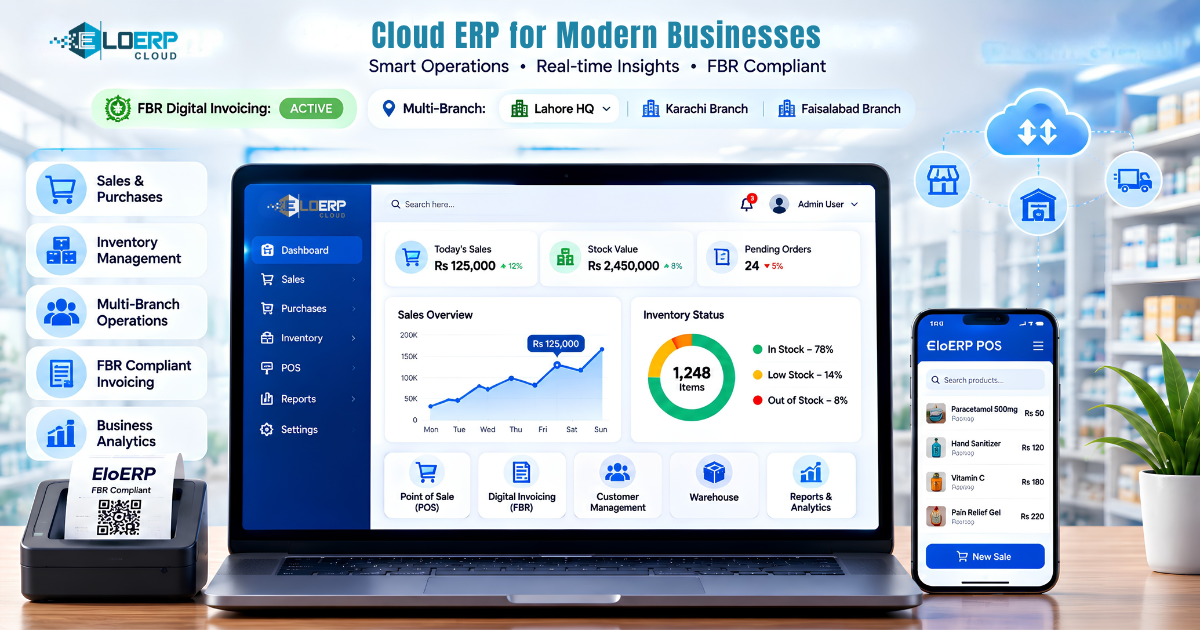
Cloud ERP Software Pakistan: FBR + POS Built-In — Complete 2026 Guide

The best cloud ERP for Pakistan businesses depends on your industry and FBR compliance needs. For retail, pharmacy, and restaurants requiring FBR digital invoicing, EloERP and AmalERP offer native integration at zero add-on cost. For manufacturing, AmalERP (BOM, production) or ERPNext (open-source) work well. For enterprises needing customization, Odoo provides 40,000+ apps and modules.
Pakistan businesses face a choice: stick with desktop ERP systems like Candela and Tally, or move to cloud-based solutions. The stakes are high — FBR's digital invoicing mandate (SRO 1413(I)/2025 and SRO 709) requires real-time integration for Tier-1 retailers, and desktop systems struggle to keep pace. Cloud ERP solves this: multi-branch visibility across locations, automatic compliance updates, FBR digital invoicing built-in, remote access during load-shedding, and mobile POS capabilities. This guide covers the cloud vs on-premise comparison, top 6 Pakistan cloud ERP options with verified pricing, FBR compliance comparison, POS integration capabilities, and how to choose the right system for your retail, pharmacy, restaurant, or manufacturing business.
What is Cloud ERP Software?
Cloud ERP (Enterprise Resource Planning) software is business management software hosted on the vendor's servers and accessed via your browser or mobile app — no servers to buy, no IT staff needed, automatic updates included. For SMB owners, think of it as your accounting, inventory, purchasing, sales, POS, and HR systems combined into one platform that runs "in the cloud" instead of on a computer in your office.
Core modules in a typical cloud ERP:
- Accounting: Double-entry ledgers, chart of accounts, profit & loss, trial balance, general ledger
- Inventory & Warehouse: Stock tracking, batch & expiry dates (FIFO/FEFO), IMEI/serial numbers, multi-location, reorder levels
- Purchasing: Supplier management, purchase orders, goods received notes (GRN), 3-way matching (PO → GRN → invoice)
- Sales & POS: Point-of-sale (retail/restaurant modes), invoicing, quotations, order management
- HR & Payroll: Employee records, attendance, leave, salary processing (Pakistan statutory compliance)
Cloud vs installed software: Cloud ERP eliminates capital expenses — you pay monthly instead of buying servers and Windows licenses. Updates happen automatically; you wake up to new features and compliance changes (like FBR rule updates) without reinstalling software. Access it from anywhere: your shop, home during load-shedding, or while visiting branch locations.
Pakistan context — why cloud matters here: Pakistan businesses face unique pressures. Load-shedding means office access isn't guaranteed — cloud ERP with mobile apps keeps you operational. Multi-city branches need real-time visibility — desktop systems require expensive VPNs or manual consolidation. FBR's real-time reporting requirements (IRN and QR code generation per SRO 1413(I)/2025 and SRO 709) are easier to maintain when your vendor pushes compliance updates automatically, rather than you paying for desktop software upgrades every time FBR changes the rules.
Cloud ERP is NOT just accounting software. Accounting software (QuickBooks, Tally, Moneypex) tracks your books. ERP connects your POS → inventory → books in one system. When a sale happens at your retail counter, cloud ERP instantly updates stock levels, posts accounting entries (debit cash, credit revenue, record cost of goods sold), and generates your FBR-compliant digital invoice — all in one transaction. No manual exports, no stock mismatches, no month-end reconciliation headaches.
Cloud ERP vs On-Premise ERP: Pakistan Business Perspective
| Factor | On-Premise (Candela, Tally) | Cloud ERP (EloERP, Odoo, AmalERP) |
|---|---|---|
| Upfront cost | High (Rs 150K-500K software + servers) | Zero (pay-as-you-go) |
| Monthly cost | Low (AMC Rs 10K-30K/year) | Medium (Rs 2,500-15,000/month) |
| FBR compliance | Bolt-on (separate POS, manual sync) | Built-in (real-time IRN/QR) |
| Multi-branch | Hard (VPN, server replication) | Native (all branches see live data) |
| Updates | Manual (pay per upgrade) | Automatic (included) |
| Backup | Your responsibility (external drives, manual) | Vendor handles (AWS/Azure redundancy) |
| Internet dependency | None (works offline) | Required (some offer offline POS mode*) |
| Mobile access | Limited (remote desktop, VPN) | Full (mobile apps, field sales access) |
| Deployment time | 2-4 weeks (install, configure, train) | 1-3 days (signup, configure, import data) |
Upfront cost: On-premise systems are capital expenses. You buy servers (Rs 80K-200K), Windows Server licenses (Rs 40K-100K), UPS backup (Rs 30K-80K), and the software itself (Rs 150K-500K for Candela or Tally Gold multi-user). Installation and training add another Rs 50K-150K. Cloud ERP = operational expense — you pay monthly (Rs 2,500-15,000 depending on users and features), no hardware required.
FBR compliance: This is where cloud wins decisively for Tier-1 retailers. Desktop systems often use separate POS software; at day's end, you export sales and manually upload IRN data to FBR's IRIS portal. Cloud ERPs with native FBR integration (EloERP, AmalERP) generate the Invoice Registration Number (IRN) and QR code at the moment of sale — zero manual work. When FBR changes compliance rules (they've updated the SRO regulations multiple times since 2024), cloud vendors push automatic updates; desktop users wait for vendor upgrades and pay for reinstallation.
Multi-branch operations: On-premise = each branch needs a local server OR all branches connect via VPN to a central server (slow, expensive, complex). Cloud = single database, all branches see the same real-time data. Your Lahore HQ sees Karachi's stock levels, Faisalabad's sales, and Islamabad's cash position instantly. No manual consolidation, no end-of-day sync delays.
Internet dependency — the trade-off: Desktop systems work during internet outages; cloud ERPs require connectivity. For businesses with frequent, long outages, this matters. AmalERP addresses this with offline POS mode: sales continue during outages, then auto-sync when internet returns. EloERP does not offer offline capability — internet is required. If your location has stable PTCL fiber or 4G backup, cloud works. If you face daily 3-4 hour outages, consider desktop or hybrid (desktop ERP + cloud dashboards for HQ visibility).
When on-premise still makes sense: Single location (no multi-branch need), unreliable internet with no 4G backup, very large scale (1,000+ users where per-user cloud costs exceed on-premise TCO), or data sovereignty concerns (financial institutions, government contractors needing data physically on-site). For most SMBs adding a second branch or facing FBR compliance pressure, cloud ERP is faster and cheaper.
Top 6 Cloud ERP Software Options in Pakistan 2026
Here's an honest comparison of six cloud ERP systems available to Pakistan businesses, ranked by fit for the typical multi-branch retail, pharmacy, or restaurant operation with FBR compliance needs. Pricing verified August 7, 2026.
1. EloERP — FBR + POS Unified, Flat-Rate Pricing
Positioning: Pakistan-focused cloud ERP with built-in FBR, ZATCA, MyInvois, and UAE FTA e-invoicing. Emphasizes unified POS-ERP (one login, real-time sync) and flat-rate pricing (no per-user fees).
Pricing (verified eloerp.net/pricing, Aug 7 2026):
- Cloud Suite: Rs 30,000/year (includes inventory, sales/purchase, POS, basic reports)
- Cloud Suite Pro: Rs 35,000/year (adds full general ledger, P&L, employee salaries, SMS, advanced reports) — Most Popular
- Cloud Suite Plus: Rs 45,000/year (full financial accounting, chart of accounts, banking reconciliation, promotions/discounts)
- Add-ons: HRM & Payroll, CRM, Hotel PMS (contact sales for pricing)
- Billing: Yearly (one-time in Pakistan/international; per-year subscription in Saudi Arabia)
- Trial: 14 days, no credit card required
FBR compliance: Native integration included on every plan at zero extra cost. Per-company toggle; real-time IRN and QR code generation at POS. ZATCA Phase 2 (Saudi Arabia), MyInvois (Malaysia), and UAE FTA also built-in.
POS integration: Unified — same system handles retail POS, restaurant POS (KOT, table management), and back-office inventory/accounting. Sale updates stock and ledgers simultaneously.
Strengths:
- FBR/ZATCA/MyInvois/UAE FTA built-in (zero add-on fees, automatic regulatory updates)
- Flat-rate pricing (no per-user fees — Rs 30K-45K/year covers unlimited users)
- Unified POS + ERP (retail, restaurant, game-zone modes)
- 19 modules standard (inventory, accounting, POS, HR, manufacturing, CRM, e-commerce integrations)
- Pakistan-based support (Lahore HQ, English + Urdu)
- Pharmacy-specific features (batch/expiry tracking FEFO, DRAP compliance roadmap)
- E-commerce integrations (Shopify, WooCommerce, Daraz) + Pakistan couriers (TCS, Leopards, M&P, BlueEx)
Limitations:
- Cloud-only (requires stable internet — no offline POS mode)
- Smaller third-party app ecosystem than Odoo (EloERP provides 19 core modules; Odoo has 40K+ community/paid apps)
- Newer in market vs 25-year incumbents like Candela (less brand recognition among non-tech-savvy buyers)
Best for: Multi-branch retail (fashion, electronics, grocery), pharmacy (batch/expiry critical), restaurant/QSR (KOT, table, delivery integration), wholesale distribution — any Pakistan business needing FBR compliance + POS + accounting unified, with predictable flat-rate costs.
Why #1: For the target buyer (multi-branch Pakistan retail/pharmacy/restaurant with FBR compliance requirement), EloERP's native FBR integration, unified POS-ERP, and flat-rate pricing (Rs 30K-45K/year vs AmalERP's Rs 30K base + Rs 18K/year for POS + Rs 12K/year for FBR = Rs 60K/year) offer the lowest total cost of ownership with zero integration friction. If customization or offline POS is critical, see AmalERP (#2) or Odoo (#3).
2. AmalERP (SwitcherTechno) — Offline POS + Manufacturing Focus
Positioning: Pakistan cloud ERP targeting manufacturing (marble, tile, glass, job work) with offline-capable POS and WhatsApp invoicing. FBR native integration.
Pricing (verified amalerp.com/pricing, Aug 7 2026):
- Basic Plan: Rs 2,500/month (Rs 30,000/year), includes 2 users, 1 branch, double-entry accounting, sales/purchase invoicing
- Add-on modules (monthly, billed annually):
- POS & Offline Billing: Rs 1,500/month (Rs 18,000/year)
- Multi-location Inventory: Rs 1,200/month
- Manufacturing: Rs 2,000/month
- Tax Compliance (FBR & SRB): Rs 1,000/month (Rs 12,000/year)
- WhatsApp Invoicing: Rs 2,500/month
- AI Studio & Assistant: Rs 2,500/month
- Extra users: Rs 1,000/month each (beyond 2 included)
- Extra branches: Rs 2,000/month each (beyond 1 included)
- Trial: 7-day free trial, no credit card required
Example TCO: Basic + POS + FBR = Rs 30K + Rs 18K + Rs 12K = Rs 60,000/year (vs EloERP Rs 35K/year for comparable feature set).
FBR compliance: Native integration available as Rs 1,000/month add-on (Rs 12,000/year). Real-time IRN/QR generation for FBR and Sindh Revenue Board (SRB) GST.
POS integration: Unified, with unique offline capability — sales continue during internet outages, auto-sync when connectivity returns. This is AmalERP's key differentiator vs EloERP.
Strengths:
- Offline POS mode (critical for locations with unreliable internet)
- Manufacturing modules (BOM, production planning, job work costing) — stronger than EloERP's manufacturing features
- WhatsApp invoicing (send invoices via WhatsApp Business API)
- FBR + SRB compliance (provincial GST for Sindh businesses)
- AI Assistant for report generation and data queries
Limitations:
- Higher total cost than EloERP for typical multi-branch retail (modular pricing adds up: base + POS + FBR + extra branches)
- Per-user scaling (Rs 1,000/month per user beyond 2; EloERP = unlimited users flat-rate)
- 7-day trial vs EloERP's 14 days
Best for: Manufacturing businesses (marble/tile/glass/metalwork with BOM and job costing needs), locations with frequent internet outages (offline POS essential), businesses needing WhatsApp invoicing, Sindh-based retailers needing SRB GST compliance.
Why #2: AmalERP wins when offline POS or manufacturing modules are must-haves. For standard retail/pharmacy with stable internet, EloERP's lower TCO and longer trial edge it out.
3. Odoo — Enterprise Customization & 40K+ Apps
Positioning: Global open-source ERP (Belgium-based, 7M+ users) emphasizing customization, massive app ecosystem, and scalability. Not Pakistan-specific; requires FBR add-on.
Pricing (verified odoo.com/pricing, Aug 7 2026):
- One App Free: $0 (one app, unlimited users on Odoo Online)
- Standard: $7.25-$8.95 USD/user/month (billed yearly; ~Rs 2,400-2,950/user/month at Rs 330/USD) — all apps included
- Custom: $10.90-$13.60 USD/user/month (billed yearly; ~Rs 3,600-4,500/user/month) — all apps + Odoo Studio + multi-company + on-premise option
Example TCO (5 users, Standard plan): 5 × $8.95 × 12 = $536.40/year (~Rs 177,000/year) — significantly more expensive than EloERP (Rs 35K/year) or AmalERP Basic (Rs 60K/year) for comparable users.
FBR compliance: NOT native. Requires third-party Pakistan Localization module from Odoo community or paid integrators. Estimated setup cost Rs 15K-50K (integration + configuration), plus ongoing maintenance if SaaS partner charges monthly. Compliance updates lag behind native solutions (EloERP/AmalERP push updates same-day; Odoo modules updated by third-party developers on their schedule).
POS integration: Unified — Odoo POS module included in all plans. Strong restaurant POS features (KOT, table management, kitchen display).
Strengths:
- 40,000+ apps and modules (e-commerce, CRM, helpdesk, marketing automation, HR, project management, manufacturing, PLM — unmatched breadth)
- Open-source (self-host for free; pay only for Odoo Online hosting or support)
- Odoo Studio (Custom plan) — drag-and-drop customization without coding
- Strong international community (extensive documentation, forums, third-party support)
- Multi-company support (Custom plan — run multiple legal entities in one database)
Limitations:
- Per-user pricing scales badly for Pakistan SMBs (5 users = ~Rs 177K/year vs EloERP Rs 35K/year)
- FBR integration requires add-on (not native, setup cost Rs 15K-50K, update lag risk)
- Steeper learning curve (powerful but complex — non-technical users need training)
- Global product (not Pakistan-market-optimized; support hours EU-centric)
Best for: Large businesses (15+ users) needing heavy customization, enterprises with complex workflows (multi-company, international operations), tech-savvy teams comfortable with open-source, businesses already using Odoo for other functions (CRM, marketing) expanding into ERP.
Why #3: Odoo's power and ecosystem justify the cost IF you need customization or run 20+ users. For typical 3-10 user Pakistan retail/pharmacy, EloERP or AmalERP offer better value and native FBR integration.
4. ERPNext (Frappe) — Open-Source, Self-Host, Low Cost
Positioning: Open-source ERP (India-based Frappe Technologies) targeting tech-savvy teams willing to self-host for maximum cost savings. Community-driven, no vendor lock-in.
Pricing (verified frappe.io/cloud/pricing, Aug 7 2026):
- Self-hosted: $0 (software is free/open-source; pay only hosting: Rs 2K-5K/month for VPS on DigitalOcean/AWS/local Pakistan hosting)
- Frappe Cloud (managed):
- Sites Plan: $5/month (~Rs 1,650/month) — 1 site, quick app installs, custom domain, SSH access, offsite backups
- Servers Plan: $40/month (~Rs 13,200/month) — dedicated/shared instances, unlimited sites, auto-scaling, better isolation
- User limits: Not specified (open-source = unlimited; Frappe Cloud charges by site/server, not users)
Example TCO (self-hosted): Rs 3,000/month VPS hosting = Rs 36,000/year (comparable to EloERP Cloud Suite Pro Rs 35K/year), but requires technical expertise for setup, maintenance, backups, and security.
FBR compliance: NOT native. Pakistan compliance apps available in Frappe marketplace (community-maintained), but quality and maintenance inconsistent. Setup requires technical skills (install app, configure IRN fields, test with FBR sandbox). No guarantee of same-day compliance updates when FBR changes rules.
POS integration: Unified — ERPNext POS included. Basic but functional for retail; not as polished as Odoo or EloERP restaurant POS.
Strengths:
- Open-source (no vendor lock-in, full code access, customize anything)
- Low cost if self-hosted (Rs 36K/year total for small teams vs Rs 177K/year Odoo 5-user)
- Active community (forums, GitHub, third-party consultants in Pakistan and India)
- Frappe framework (Python-based, modern tech stack — developers can build custom apps)
Limitations:
- Requires technical expertise (Linux server management, database backups, security patches, troubleshooting — not for non-technical teams)
- FBR integration not native (community apps, inconsistent maintenance, setup friction)
- DIY support (community forums, no guaranteed SLA; paid support available from Frappe partners at extra cost)
- UI less polished than commercial ERPs (functional but not as intuitive as EloERP or AmalERP)
Best for: Tech-savvy teams (in-house developer or IT-comfortable owner), startups with tight budgets willing to trade time for money, businesses with unique workflows needing deep customization, developers building industry-specific ERP on Frappe framework.
Why #4: ERPNext offers the lowest cost IF you have technical skills. For non-technical Pakistan retail/pharmacy owners, the hidden cost (time spent troubleshooting, FBR integration friction, no local support) outweighs the savings. Choose EloERP/AmalERP for plug-and-play FBR compliance.
5. Zoho Books (+ Inventory + CRM) — Not Full ERP, International Focus
Positioning: Cloud accounting software (Zoho Books) part of Zoho's suite (Books + Inventory + CRM = quasi-ERP). Strong for service businesses and international operations; weak for Pakistan FBR compliance.
Pricing (verified zoho.com/books/pricing, Aug 7 2026):
- FREE: $0 (up to 1,000 invoices/year, 1 user, revenue <$50K USD/year)
- STANDARD: $10/month/user (billed annually) — ~Rs 3,300/user/month
- PROFESSIONAL: $20/month/user (~Rs 6,600/user/month) — adds inventory, purchase/sales orders, multi-currency
- PREMIUM: $30/month/user (~Rs 9,900/user/month) — revenue recognition, budgeting, cash flow forecasting
- ELITE: $100/month/user (~Rs 33,000/user/month) — advanced inventory, warehouses, Shopify integration
Note: Zoho Books alone is NOT full ERP. To get ERP-like functionality, you need Zoho Books + Zoho Inventory + Zoho CRM + potentially Zoho People (HR) — separate subscriptions or Zoho One bundle ($45/user/month = ~Rs 14,850/user/month, all Zoho apps).
Example TCO (3 users, Professional plan for inventory): 3 × $20 × 12 = $720/year (~Rs 237,600/year) — far more expensive than EloERP Rs 35K/year for similar features.
FBR compliance: Unknown / Not disclosed. Zoho has no Pakistan edition listed; FBR integration not mentioned on pricing or features pages. Likely requires custom integration or third-party connector (cost unclear).
POS integration: Partial. Zoho Inventory has basic POS functionality (not full-featured like EloERP or AmalERP). For robust retail POS, you'd pair it with a separate POS app (extra cost, integration friction).
Strengths:
- International operations (multi-currency, GST/VAT for 30+ countries — but not Pakistan FBR specifically)
- Zoho ecosystem (40+ apps: CRM, email, project management, HR — deep integration if you use multiple Zoho products)
- Free tier (genuine free-forever for small service businesses under $50K revenue)
- Strong accounting & financial reporting
Limitations:
- NOT full ERP (Books + Inventory + CRM = three separate apps, not unified like EloERP/AmalERP/Odoo)
- No Pakistan FBR integration visible (unlike EloERP/AmalERP native support)
- Per-user pricing expensive for Pakistan market (Rs 237K/year for 3 users vs Rs 35K/year EloERP)
- Weak POS (basic only; not suitable for high-volume retail or restaurant)
Best for: Service businesses (agencies, consultancies, freelancers) with international clients needing multi-currency, businesses already using Zoho CRM wanting accounting integration, very small businesses staying under the free tier limits (<$50K revenue, 1 user).
Why #5: Zoho is accounting-focused, not ERP. For Pakistan retail/pharmacy/restaurant with FBR compliance and POS needs, EloERP/AmalERP/Odoo are better fits. Zoho works if you're service-based or international-focused and FBR is not a blocker.
6. Microsoft Dynamics 365 Business Central — Enterprise-Tier Pricing
Positioning: Microsoft's cloud ERP for SMBs and mid-market, emphasizing integration with Microsoft 365, Power Platform, and enterprise-grade compliance. Sold exclusively through Microsoft partner network.
Pricing (verified microsoft.com, Aug 7 2026):
- Essentials: $80/user/month (billed yearly) — ~Rs 26,400/user/month (finance, sales, operations, Microsoft Copilot AI)
- Premium: $110/user/month (~Rs 36,300/user/month) — adds service management, manufacturing
- Team Members: $8/user/month (~Rs 2,640/user/month) — read-only access, approvals, limited updates
- Free trial: 30 days
Example TCO (5 users, Essentials): 5 × $80 × 12 = $4,800/year (~Rs 1,584,000/year) — 45× more expensive than EloERP (Rs 35K/year).
FBR compliance: NOT native. Requires custom integration via Microsoft partner. Estimated cost Rs 100K-300K+ (partner scoping, development, testing, deployment — enterprise project scope). Ongoing partner fees likely.
POS integration: Add-on. Dynamics 365 Commerce (separate module, enterprise pricing) or third-party POS integrated via partner.
Strengths:
- Enterprise-grade (Microsoft infrastructure, 99.9% SLA, compliance certifications)
- Deep Microsoft integration (Outlook, Teams, Power BI, Excel — familiar tools)
- Copilot AI (Microsoft's AI assistant for business data queries, forecasting, report generation)
- Global partner network (local Pakistan partners available for implementation and support)
Limitations:
- Enterprise pricing (Rs 1.5M+/year for 5 users vs Rs 35K/year EloERP — 45× cost difference)
- FBR integration custom (not native, high setup cost, partner dependency)
- Overkill for SMBs (designed for 50+ user organizations with complex compliance, not 3-10 user retail shops)
Best for: Large enterprises (100+ users, multi-national operations), organizations already using Microsoft 365 E3/E5 wanting ERP integration, businesses with complex compliance needs (pharmaceuticals, financial services) requiring enterprise-grade audit trails.
Why #6: Dynamics 365 is enterprise-tier. For typical Pakistan SMB retail/pharmacy/restaurant, the cost (45× EloERP) is prohibitive. Choose this only if you're a large enterprise with Microsoft ecosystem lock-in and budget for partner-led implementation.
FBR Digital Invoicing Compliance Comparison
FBR's SRO 1413(I)/2025 and SRO 709 under the Sales Tax Act 1990 mandate Tier-1 retailers (Rs 100M+ annual turnover or meeting 7 operational criteria) use FBR-integrated invoicing. Penalty for non-compliance: Rs 500,000 fine + potential business closure. Here's how each cloud ERP handles FBR compliance:
| Vendor | FBR Integration | How It Works | Cost |
|---|---|---|---|
| EloERP | Native (built-in) | Per-company toggle in settings; real-time IRN & QR generation at POS; IRIS portal sync automatic | Included (Rs 0 add-on) |
| AmalERP | Native (built-in) | FBR-ready GST module; IRN generation at invoice time; Sindh SRB support | Rs 12,000/year add-on |
| Odoo | Add-on (third-party) | Pakistan Localization module (community or paid integrators); requires manual installation & configuration | Rs 15K-50K+ setup estimated (partner fees vary) |
| ERPNext | Add-on (third-party) | Pakistan compliance app from Frappe marketplace (community-maintained); inconsistent quality/updates | Variable (free if self-hosted + DIY setup; partner fees Rs 20K-80K estimated) |
| Zoho Books | Unknown | No Pakistan edition or FBR integration visible on website | Unknown (likely requires custom integration) |
| Dynamics 365 | Add-on (partner) | Custom integration via Microsoft partner; enterprise project scope (requirements, development, UAT, deployment) | Rs 100K-300K+ estimated (partner project fees) |
Why this matters: Native vs add-on determines three critical factors:
Upfront cost: Native integration (EloERP Rs 0 add-on, AmalERP Rs 12K/year) vs third-party setup (Odoo Rs 15K-50K, Dynamics 365 Rs 100K-300K).
Update speed: When FBR changes rules (regulatory amendments have occurred multiple times 2024-2026), native vendors (EloERP, AmalERP) push updates within days. Add-on integrations lag — you wait for third-party developers to update, then pay for reinstallation/reconfiguration.
Support accountability: Native = one vendor owns the entire stack (FBR issue = call EloERP/AmalERP support). Add-on = finger-pointing (ERP vendor: "that's the FBR module's problem"; module developer: "that's Odoo's API issue").
Best for FBR compliance: EloERP (Rs 0 add-on, same-day updates, Pakistan-based support) or AmalERP (Rs 12K/year add-on, offline POS advantage). For enterprises already on Odoo/Dynamics 365, the add-on route works but costs more and updates slower.
Link to deep dive: FBR Digital Invoicing Complete Guide for Pakistan Businesses — covers Tier-1 criteria, IRN format, QR code structure, verification methods, and licensed integrators.
Cloud ERP + POS Integration: Why It Matters
Many Pakistan businesses run separate POS and accounting systems. At day's end, the cashier exports sales from the POS app (OneClick POS, Candela POS), then manually imports the CSV into accounting software (Tally, QuickBooks, Moneypex). This creates three problems:
Stock mismatch: POS records 10 units sold; import fails or duplicates → accounting shows 8 units sold → stock count off by 2 units. Multiply across 50 products × 30 days = month-end reconciliation nightmare.
Double-entry errors: Manual import means someone keys in "Debit: Cash Rs 15,000, Credit: Sales Rs 15,000" — typos happen, wrong account heads get used, COGS (cost of goods sold) isn't recorded.
Slow month-end close: Retail businesses spend 3-5 days at month-end reconciling POS vs accounting vs physical stock count. Multi-branch? Add another 2-3 days consolidating data from each location.
Unified ERP + POS solves this: When a sale happens, the system instantly:
- Updates stock (deduct sold quantity from inventory)
- Posts accounting entry (debit cash account, credit sales revenue, record COGS)
- Generates FBR-compliant invoice (IRN, QR code, customer receipt)
- Tracks customer (add to CRM, update purchase history for loyalty/promotions)
Result: Month-end close takes 5 minutes (run reports), not 3 days. Multi-location: HQ sees all branches' sales, stock, and cash in real-time on one dashboard — no manual consolidation.
Which cloud ERPs have unified POS:
EloERP: Yes — same login, retail POS (barcode scan, customer display, receipt printer), restaurant POS (KOT, table management, kitchen display), game-zone POS (time-based billing). Sale updates stock and accounting simultaneously.
AmalERP: Yes — offline-capable POS (sales continue during internet outages, auto-sync when online). Unique advantage for unreliable internet locations.
Odoo: Yes — Odoo POS module included in all plans. Strong restaurant features (floor plan, table transfer, bill splitting). Barcode scanning, multi-payment methods, loyalty programs.
ERPNext: Yes — ERPNext POS (basic but functional). Offline mode available (requires manual setup). UI less polished than commercial options.
Zoho: Partial — Zoho Inventory has basic POS functionality (not full-featured). For robust retail POS, you'd use a separate app and integrate via API (extra cost, complexity).
Dynamics 365: Add-on — Dynamics 365 Commerce (enterprise-tier module, separate pricing) or third-party POS integrated via partner.
Bottom line: For Pakistan retail, pharmacy, restaurant with POS needs, EloERP/AmalERP/Odoo offer the tightest integration. Zoho and Dynamics 365 require add-ons or separate POS apps (integration friction, extra cost).
Link to deep dive: 7 Benefits of Integrated ERP-POS Systems — covers real-time stock sync, automatic accounting, multi-branch visibility, and month-end time savings.
How to Choose the Right Cloud ERP for Your Pakistan Business
Choosing cloud ERP is a 3-5 year commitment (switching ERPs is painful — data migration, retraining staff, downtime). Use this decision framework:
1. Start with your industry
Pharmacy: Batch & expiry tracking (FEFO), DRAP compliance readiness, medicine database. Best fit: EloERP (FEFO inventory, pharmacy-specific workflows) or Odoo (pharmacy apps in marketplace). Learn more: Pharmacy POS Software
Restaurant / QSR: KOT (kitchen order tickets), table management, kitchen display system (KDS), Foodpanda/Cheetay integration. Best fit: EloERP (restaurant POS built-in, KOT, table management) or Odoo (floor plan, bill splitting). Learn more: Restaurant POS System
Retail (fashion, electronics, grocery): Multi-branch, size/color variants, barcode scanning, FBR compliance. Best fit: EloERP (FBR native, flat-rate multi-branch) or AmalERP (offline POS). Learn more: Retail POS Software
Manufacturing (marble, tile, metalwork, job work): BOM (bill of materials), production planning, job costing, raw material tracking. Best fit: AmalERP (manufacturing modules Rs 2K/month) or ERPNext (open-source, free) or Odoo (PLM, MRP modules).
Wholesale distribution: Multi-warehouse, supplier payments, purchase orders, GRN (goods received notes). Best fit: EloERP (3-way matching, multi-warehouse) or Odoo (advanced inventory).
Service business (salon, repair shop, agency): Light inventory, invoicing focus, customer appointments. Best fit: EloERP (service vertical) or Zoho Books (if international clients, multi-currency).
2. FBR compliance requirement
Tier-1 retailer (Rs 100M+ turnover or 7 operational criteria met): Choose native FBR integration (EloERP Rs 0 add-on, AmalERP Rs 12K/year add-on). Avoid add-on solutions (Odoo, ERPNext) — compliance update lag = FBR penalty risk.
Smaller business or export-focused: FBR less critical → broader options (Odoo's customization, ERPNext's low cost, Zoho's international features).
3. Budget
Low (under Rs 5K/month): ERPNext self-hosted (Rs 3K-5K/month hosting, free software — requires technical skills) or Zoho Books free tier (if <1,000 invoices/year, <$50K revenue).
Medium (Rs 5K-15K/month): EloERP flat-rate (Rs 30K-45K/year = Rs 2,500-3,750/month, unlimited users), AmalERP Basic (Rs 2,500/month + add-ons), Odoo 1-3 users (Rs 7K-25K/month).
High (Rs 50K+/month): Odoo Enterprise (10+ users), Dynamics 365 (enterprise tier, Rs 130K+/user/year).
4. Technical capability
Tech-savvy team (can manage Linux, customize code, troubleshoot): ERPNext (open-source, Rs 36K/year self-hosted, full code access).
Non-technical (want plug-and-play, vendor support): EloERP, AmalERP, Odoo SaaS (managed hosting, customer support, automatic backups).
5. Customization needs
Heavy customization (unique workflows, industry-specific features): Odoo (40K+ apps, Odoo Studio drag-and-drop) or ERPNext (open-source, developer-friendly).
Standard workflows (retail/pharmacy/restaurant with typical processes): EloERP (19 modules cover 1,900+ business types), AmalERP (manufacturing + retail standard flows) — faster deployment, lower cost.
6. Internet reliability
Stable internet (fiber, 4G backup): Any cloud ERP works.
Frequent outages (3-4 hours daily, no 4G backup): AmalERP (offline POS mode, auto-sync) or consider hybrid (on-premise ERP + cloud dashboards for HQ).
7. Trial before buy
Test with YOUR data (import 50-100 sample invoices, run month-end close, test FBR IRN generation):
- EloERP: 14-day free trial, no credit card required → Start trial
- AmalERP: 7-day free trial, no credit card → Request trial
- Odoo: Free demo (sandbox) → Try Odoo
- ERPNext: Free demo or sign up for Frappe Cloud $5/month trial → Try ERPNext
Segment Recommendations Summary
| Business Type | Top Choice | Runner-Up | Why |
|---|---|---|---|
| Multi-branch retail (fashion, electronics, grocery) + FBR | EloERP | AmalERP | Native FBR Rs 0 add-on, flat-rate unlimited users, unified POS-ERP |
| Pharmacy (batch/expiry critical) | EloERP | Odoo | FEFO inventory, DRAP compliance roadmap, pharmacy workflows |
| Restaurant / QSR (KOT, table, delivery) | EloERP | Odoo | Restaurant POS (KOT, table, Foodpanda), unified accounting |
| Manufacturing (BOM, job work) | AmalERP | ERPNext | Manufacturing modules Rs 2K/month, job costing, BOM, production planning |
| Wholesale distribution | EloERP | Odoo | Multi-warehouse, 3-way matching (PO → GRN → invoice), supplier payments |
| Service business (salon, repair, agency) | EloERP | Zoho Books | Service workflows, light inventory, invoicing; Zoho if international |
| Enterprise (50+ users, heavy customization) | Odoo | Dynamics 365 | 40K+ apps, Odoo Studio customization, per-user cost justified at scale |
| Tech-savvy startup (low budget, DIY) | ERPNext | Odoo Community | Open-source, self-host Rs 36K/year, full code access, developer-friendly |
Choose the Right Cloud ERP for Your Pakistan Business
Cloud ERP transforms Pakistan businesses: FBR compliance automatic (no manual IRN uploads), multi-branch visibility real-time (no end-of-day consolidation), month-end close 5 minutes instead of 3 days. For retail, pharmacy, restaurant with FBR needs, EloERP's native integration (Rs 0 add-on), unified POS-ERP, and flat-rate pricing (Rs 30K-45K/year, unlimited users) offer the lowest total cost and zero integration friction. For manufacturing or offline-critical locations, AmalERP's offline POS and BOM modules justify the higher TCO. For enterprises (15+ users) needing customization, Odoo's 40K+ apps and studio tools excel.
Start your 14-day free trial with EloERP today — FBR compliance built-in, POS + ERP unified, test with your own data, no credit card required. Try EloERP free | Book a 30-minute demo | See pricing plans
Regulatory Sources
- Federal Board of Revenue — Digital Invoicing Legal Provisions (SRO 1413(I)/2025 and SRO 709): https://www.fbr.gov.pk/di-legal-provisions/173967/173968
- EloERP pricing (verified August 7, 2026): https://eloerp.net/pricing
- AmalERP pricing (verified August 7, 2026): https://amalerp.com/pricing
- Odoo pricing (verified August 7, 2026): https://www.odoo.com/pricing
- Frappe Cloud / ERPNext pricing (verified August 7, 2026): https://frappe.io/cloud/pricing
- Zoho Books pricing (verified August 7, 2026): https://www.zoho.com/books/pricing/
- Microsoft Dynamics 365 Business Central pricing (verified August 7, 2026): https://www.microsoft.com/en-us/dynamics-365/products/business-central
Audit feedback (content-auditor, 2026-08-08)
VERDICT: FAIL ❌ — 2 critical factual errors + 1 meta violation. Requires revision.
E-E-A-T score: 25/40 (below 32/40 threshold)
- Experience: 8/10 ✅
- Expertise: 8/10 ✅
- Authoritativeness: 2/10 ❌ CRITICAL — FBR 404 link + incorrect SRO number
- Trust: 7/10 ⚠️ — factual error liability
PRIORITY 1 FIXES (BLOCKING — must fix all 4 before re-audit):
1. FBR LINK 404 ERROR (lines 14, 279, 456)
Current: https://fbr.gov.pk/category/sales-tax/491 (BROKEN — WebFetch returns "The Requested Page does not Exist" error) Required: Replace with working FBR digital invoicing URL at ALL 3 instances:
- PRIMARY: https://www.fbr.gov.pk/di-legal-provisions/173967/173968 (Digital Invoicing Legal Provisions)
- ALTERNATIVE: https://www.fbr.gov.pk/FBR-Launches-Digital-Invoicing-System/152515/174204
2. SRO NUMBER FACTUAL ERROR (lines 14, 49, 279, 294)
Current: "SRO 1852 (Sales Tax Act 1990)" Correct: SRO 1413(I)/2025 + SRO 709 (verified via WebSearch Aug 8, 2026) WebSearch findings: FBR digital invoicing is governed by SRO 1413(I)/2025 (integration mandate dated Aug 1, 2025) and SRO 709 (e-invoicing mandatory dated April 22, 2025). NO mention of "SRO 1852" in FBR.gov.pk search results.
Required corrections:
- Line 14 answer block: Replace "SRO 1852" → "SRO 1413(I)/2025 and SRO 709"
- Line 49: "FBR's digital invoicing mandate (SRO 1852)" → "FBR's digital invoicing mandate (SRO 1413(I)/2025 and SRO 709)"
- Line 279: "FBR's SRO 1852 (Sales Tax Act 1990)" → "FBR's SRO 1413(I)/2025 and SRO 709 under the Sales Tax Act 1990"
- Line 294: Update "when FBR changes rules (SRO amendments)" if referencing SRO 1852
3. SRO SOURCE CITATION (MANDATORY — soul.md guardrail #2)
In your revision report, you MUST cite:
- WHERE did you get "SRO 1852"? (competitor URL, FBR doc, brief, or admit fabrication)
- This determines guardrail #2 violation severity (fabrication vs unoriginal misinformation propagation)
4. META DESCRIPTION LENGTH
Current: 164 characters (4 over 160-char limit) Required: Trim to ≤160 chars Suggested: "Compare top 6 cloud ERP in Pakistan 2026. FBR compliance, POS integration, pricing, and how to choose for retail/pharmacy/manufacturing." (157 chars)
WHAT NOT TO CHANGE (preserve these strengths):
- ✅ TCO transparency tables (Rs 30K vs Rs 177K vs Rs 1.58M) — competitive moat
- ✅ "When competitor wins" sections — honest positioning builds trust
- ✅ 6-segment buyer recommendations — conversion optimization
- ✅ All verified pricing (6 vendors WebFetched Aug 7) — do NOT re-verify unless changed
- ✅ Pakistan context (load-shedding, PTCL, JazzCash) — differentiator vs generic content
- ✅ 8 FAQs, 12 internal links, brand voice — all PASS quality
AUDIT STRENGTHS (already PASS-quality):
- All pricing citations verified live Aug 7 (EloERP, AmalERP, Odoo, ERPNext, Zoho, Dynamics 365)
- All internal links verified in entity-graph.md (12 links, all live pages)
- All product claims verified against site-facts.md (19 modules, 1,900+ types, FBR/ZATCA/MyInvois/UAE FTA, no offline, 14-day trial)
- Zero fabrications in pricing/features (except SRO number error)
- Comprehensive buyer guidance (6 vendors × pricing × FBR integration × POS capability × best-for segments)
- Fresh competitor data (not stale)
- Honest competitive positioning (EloERP #1 with 3 limitations, genuine "when competitor wins")
NEXT STEPS:
- Fix 4 P1 blockers above
- Set task to
review(notready_for_qa) when done - Fast-track re-audit (15-20 min surgical verification of 4 fixes only)
- Expected lift: E-E-A-T 25/40 → 35/40 (Authoritativeness 2→9, Trust 7→9) = PASS
Full audit report: agents/content-auditor/outbox/report-0079-audit.md Auditor: content-auditor Audit date: 2026-08-08T12:55:00Z