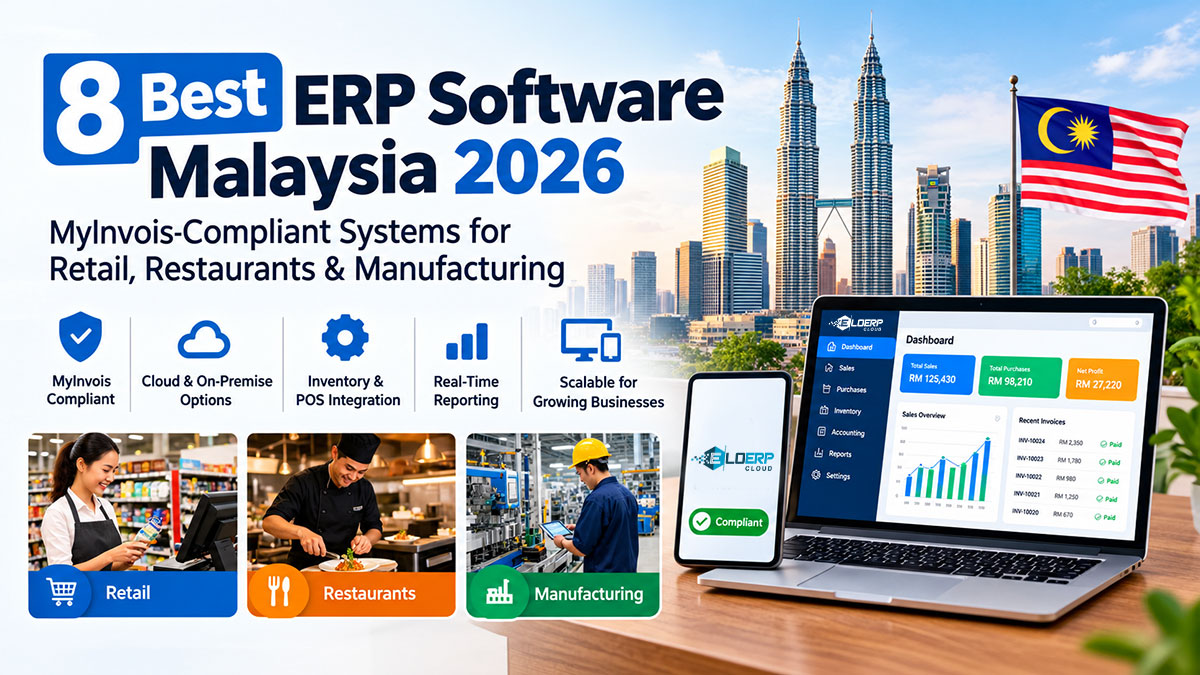
8 Best ERP Software Malaysia 2026: MyInvois-Compliant Systems for Retail, Restaurants & Manufacturing

Malaysia businesses need ERP software that handles point-of-sale operations, inventory management, accounting, and MyInvois e-invoicing compliance — now mandatory for all businesses since Phase 4 (1 January 2026) expanded coverage to companies with RM 1 million to RM 5 million revenue. Choosing the right ERP means evaluating MyInvois readiness, cloud versus desktop architecture, pricing transparency in MYR, and industry fit for retail, restaurant, wholesale, or manufacturing operations.
The best ERP software for Malaysia businesses in 2026 includes MyInvois-compliant cloud systems like EloERP, AutoCount, and Odoo, plus legacy desktop options like UBS and SQL Account. Key selection criteria: LHDN e-invoicing integration, real-time inventory and accounting sync, SST 6% tax automation, multi-location support, and transparent MYR pricing. Retail and restaurant businesses prioritize POS integration; manufacturers need BOM and production modules.
This guide compares eight ERP systems available in Malaysia — local incumbents (UBS, AutoCount, SQL Account) and global cloud solutions (EloERP, Odoo, ERPNext, SAP Business One, Oracle NetSuite) — across MyInvois compliance status, deployment models, transparent pricing, core modules, and Malaysia-based support availability. Learn about Malaysia's MyInvois requirements
Quick Comparison Table: Top 8 ERP Software Malaysia 2026
| ERP Software | MyInvois Compliant? | Cloud/Desktop | Starting Price (MYR) | Best For | POS Included? | Malaysia Support |
|---|---|---|---|---|---|---|
| EloERP | ✅ Native integration | Cloud | Contact for MYR pricing | Retail, restaurant, wholesale | ✅ Built-in | Yes |
| AutoCount | ✅ Platform integration (AIP) | Hybrid (cloud + desktop) | Contact for quote | Accounting-first SMEs | ✅ Add-on module | Yes (Malaysia HQ) |
| UBS | ✅ Free on-premise integration | Desktop | Contact for quote | Small accounting firms | ❌ No | Yes (Malaysia HQ) |
| SQL Account | ✅ Native LHDN API | Hybrid (cloud + desktop + mobile) | Contact for quote | Retail, manufacturing, multi-outlet | ✅ SQL X-Store module | Yes (Malaysia HQ) |
| Odoo | ✅ Native (v17+, free Malaysia localization) | Cloud | Free (Community) / $8.95/user/mo (Standard) | Customization-heavy businesses | ✅ POS module | Global (partners in MY) |
| ERPNext | ⚠️ Manual/custom API | Cloud + self-hosted | Free (self-host) / $5+/mo (Frappe Cloud) | Tech-savvy teams, open-source | ✅ POS module | Global (partners in MY) |
| SAP Business One | ✅ Partner add-on integration | Hybrid | Contact for quote (enterprise pricing) | Mid-market manufacturing | ⚠️ Third-party | Global (partners in MY) |
| Oracle NetSuite | ✅ API integration (Southeast Asia localization) | Cloud | Contact for quote (enterprise pricing) | Large enterprises, multi-national | ⚠️ Third-party | Global (partners in MY) |
Notes:
- ✅ = Native or officially supported
- ⚠️ = Requires third-party service, manual integration, or custom development
- ❌ = Not available
- Pricing as of September 2026; contact vendors for current Malaysia-specific rates
- SST 6% applies to software services in Malaysia (verify with vendor)
1. EloERP — MyInvois-Native Cloud ERP for Retail & Restaurants
Overview:
EloERP is a cloud-native all-in-one ERP and POS system built for Malaysia retail, restaurant, wholesale, pharmacy, and distribution businesses. MyInvois e-invoicing integration is native (no plugin required) — invoices transmit to LHDN automatically with real-time Unique Invoice Reference Number (UIRN) and QR code generation on every transaction.
Key Features:
- MyInvois compliance: Built-in LHDN API integration with automatic invoice submission, credit/debit notes, consolidated invoices, self-billed invoices, and full audit trail
- Point of Sale: Retail (barcode scanning, quick billing), restaurant (Kitchen Order Ticket, dine-in/takeaway/delivery), and pharmacy modes (batch/expiry FEFO tracking)
- Inventory: Multi-location stock sync, batch/expiry management, IMEI/serial tracking for electronics and high-value items, automatic reorder points
- Accounting: Double-entry bookkeeping, SST 6% automation, multi-currency support, financial reports (P&L, balance sheet, cash flow)
- Multi-branch: Centralized dashboard for retail chains — each branch POS syncs to head office in real-time
- Integrations: Shopify, WooCommerce e-commerce platforms
- Language: English interface (Malay interface planned)
Pricing (MYR, as of Sep 2026):
- Contact for Malaysia-specific MYR pricing (view pricing)
- 14-day free trial (no credit card required)
- Flat-rate pricing model (no hidden fees, no per-transaction charges)
- Annual and monthly payment plans available
Pros:
- MyInvois compliance built-in at zero additional cost (vs third-party services)
- Cloud-native architecture (access from anywhere, automatic updates, no server maintenance)
- All-in-one system (POS, inventory, accounting, e-invoicing in one platform — no disconnected tools)
- Free trial with self-service setup (no forced sales calls)
- Multi-country compliance (FBR Pakistan, ZATCA Saudi Arabia, UAE FTA) for cross-border expansion
Cons:
- Newer brand in Malaysia market versus AutoCount/UBS incumbency (less local brand recognition)
- Malay-language interface planned but not yet live (English-only currently)
- Pricing requires contact (not publicly displayed in MYR on website)
Best for:
Retail chains, restaurants/cafes, pharmacies, and wholesale distributors seeking MyInvois-ready cloud ERP with transparent feature set, self-service trial, and POS integration built-in. Learn more about EloERP's Malaysia features
2. AutoCount — Established Malaysia Accounting + ERP Software
Overview:
AutoCount is a Malaysian-developed accounting and ERP software with over 30 years in the market. Offers hybrid deployment (cloud + desktop). MyInvois compliance available via AutoCount E-Invoice Platform (AIP), which bridges AutoCount software to LHDN MyInvois system with support for Standard, Consolidated, and Self-Billed e-Invoices.
Key Features:
- MyInvois compliance: AutoCount Invoice Platform (AIP) integration — automatic submission to LHDN portal with retry logic if MyInvois server experiences downtime
- Accounting: SST 6% ready, Malaysia statutory reports, multi-company consolidation, payroll integration
- Inventory management: Stock control, warehouse management, multi-location tracking
- POS module: Available as add-on (AutoCount POS integrates with AIP for e-invoicing at point-of-sale)
- Deployment: Hybrid — choose cloud subscription or desktop perpetual license
- Customization: Malaysia-specific statutory compliance built-in (SST, EPF, SOCSO reports)
Pricing (MYR):
- Contact for quote (pricing not publicly listed on website)
- Perpetual license (one-time cost + annual maintenance) or cloud subscription model
- Implementation and training fees may apply
Pros:
- Established Malaysia brand (over 30 years)
- Malaysia-based development and support team (local expertise)
- Hybrid deployment flexibility (choose cloud or desktop based on preference)
- AIP platform handles MyInvois compliance automatically with downtime retry
- Strong accounting focus (statutory compliance for SST, payroll, tax filing)
Cons:
- Pricing transparency: not publicly listed (requires sales contact for quote)
- MyInvois integration via separate platform (AIP) versus native in-app (adds one extra system layer)
- Desktop-era architecture (cloud version is newer, may have feature parity differences)
- POS is add-on module (not core product like EloERP's unified design)
Best for:
Malaysia SMEs prioritizing local vendor support, established brand trust, and statutory accounting compliance, willing to contact sales for pricing and accept AIP platform for MyInvois integration.
Source: AutoCount LHDN e-Invoice Solution
3. UBS Accounting Software — Desktop Legacy for Small Firms
Overview:
UBS is a legacy desktop accounting software popular with small Malaysia accounting firms and service businesses. Offers free on-premise MyInvois integration to comply with LHDN mandates. Established Malaysia incumbent, but desktop-only architecture makes it less suitable for modern multi-location retail or restaurant chains.
Key Features:
- MyInvois compliance: Free on-premise integration — data integrates into UBS accounting software with one click after MyInvois validation
- Desktop accounting: Double-entry accounting, financial reports (P&L, balance sheet, trial balance)
- Invoicing: Generate invoices that sync with MyInvois portal (manual or automated submission)
- Malaysia statutory reports: SST reporting if supported (verify with vendor for current version)
Pricing (MYR):
- Contact for quote (estimated desktop perpetual license model based on industry reports)
- One-time purchase model (not recurring cloud subscription)
- Annual maintenance or support fees may apply
Pros:
- Established Malaysia brand (incumbent desktop tool)
- Free MyInvois integration included (no additional compliance software cost)
- One-time purchase model appeals to cost-conscious small businesses (vs recurring SaaS fees)
- Familiar to Malaysia accounting professionals
Cons:
- Desktop-only (no cloud access, cannot check financials from mobile or remote locations)
- Single-location architecture (no multi-branch real-time sync like cloud ERP)
- No POS module (accounting-only tool, not suitable for retail/restaurant operations)
- Aging desktop architecture (lacks modern cloud ERP features like dashboards, mobile apps, API integrations)
- MyInvois integration requires on-premise setup (less automated than cloud-native systems)
Best for:
Single-location small businesses, accounting firms, or service companies already using UBS desktop software, not planning multi-branch expansion, and willing to manage MyInvois compliance via on-premise integration rather than fully automated cloud systems.
Source: UBS e-Invoicing
4. SQL Account — Malaysia Retail & Manufacturing ERP
Overview:
SQL Account (sql.com.my) is a Malaysia-local ERP software focused on retail, manufacturing, and multi-outlet businesses. Offers hybrid deployment (cloud, desktop, mobile). MyInvois integration is native via LHDN API with support for Peppol e-invoicing for global data exchange.
Key Features:
- MyInvois compliance: Native LHDN MyInvois API integration plus Peppol e-invoicing for secure global transactions
- Deployment: Hybrid — SQL Cloud (cloud-based), desktop application, and SQL X-Mobile (mobile-responsive)
- Full ERP suite: Accounting, inventory, payroll (SQL Payroll), HR management, manufacturing modules
- Multi-outlet: SQL X-Store for retail chains — manage orders, inventory, and accounting across multiple locations
- Malaysia localization: Built for Malaysia businesses with SST compliance and statutory reporting
Pricing (MYR):
- Contact for quote (no published MYR pricing on website)
- Free demo available (inquiry required for pricing)
Pros:
- Native MyInvois integration (LHDN API built-in, not third-party)
- Hybrid deployment (cloud + desktop + mobile — flexibility for different business models)
- Full ERP scope (not just POS — includes accounting, manufacturing, payroll, HR)
- Multi-outlet support via SQL X-Store (suitable for retail chains)
- Malaysia-local vendor (local support and statutory compliance expertise)
- Peppol integration for international e-invoicing (useful for export businesses)
Cons:
- Pricing not transparent (requires sales inquiry for quote)
- Product complexity (full ERP suite may be overkill for simple single-location retail)
Best for:
Multi-outlet retail chains, manufacturers, and wholesale distributors needing full ERP with MyInvois compliance, hybrid deployment flexibility, and Malaysia-local support, willing to contact sales for pricing.
Source: SQL Account HQ
5. Odoo — Open-Source Modular ERP
Overview:
Odoo is a global open-source ERP with modular architecture — install only the apps you need (accounting, inventory, POS, manufacturing, CRM, etc.). Community edition is free (self-hosted); Standard and Custom editions are paid cloud/on-premise. MyInvois integration is native in Odoo 17+ via free Malaysia localization package — no third-party modules required.
Key Features:
- MyInvois compliance: Native integration in Odoo 17+ (free Malaysia localization downloads from Apps section). Odoo 19.0 EDI connects directly to LHDN API — click "Validate" on invoice, system sends JSON to LHDN, receives validation, attaches government unique ID in seconds.
- Modular apps: 30+ modules (accounting, inventory, POS, manufacturing, CRM, e-commerce, HR, project management, marketing automation)
- Deployment: Cloud (Odoo.com hosting), self-hosted, or on-premise
- Open-source: Community edition free (self-hosted, no official support), Standard/Custom editions paid
- Customization: Python-based framework, extensive partner ecosystem in Malaysia
Pricing (as of September 2026):
- Community (free): Self-hosted, open-source, community support only (no official helpdesk)
- Standard: $8.95 USD/user/month (approximately RM 42/user/month at 4.70 exchange rate), cloud-hosted by Odoo, includes all apps
- Custom: $13.60 USD/user/month (approximately RM 64/user/month at 4.70 exchange rate), adds Odoo Studio (customization tool), multi-company, choice of Odoo Online/Odoo.sh/on-premise, external API access
- MyInvois integration: Free for Odoo 17+ users (download Malaysia localization package in Apps)
Pros:
- MyInvois integration is free and native in Odoo 17+ (no third-party add-ons or extra licensing fees)
- Free Community edition (lowest entry cost for tech-savvy teams willing to self-host)
- Modular pricing (pay only for users and edition tier; all apps included in Standard/Custom)
- Highly customizable (Python codebase, open-source, strong developer community)
- Global ecosystem (extensive documentation, Malaysia partners, community forums)
- Odoo 19.0 EDI provides direct automated bridge to MyInvois portal (eliminates manual data entry)
Cons:
- Community edition requires technical expertise (self-hosting, server setup, security, maintenance, backups)
- Standard/Custom pricing is per-user (scales expensively for larger teams — 20 users = RM 840-1,280/month)
- Complexity (modular architecture has steeper learning curve vs all-in-one SaaS like EloERP or AutoCount)
- Implementation time (customization-heavy projects require partner engagement or internal dev resources)
Best for:
Businesses with technical capacity (or budget for Odoo partner implementation) seeking customizable open-source ERP, willing to use native MyInvois integration in Odoo 17+ Malaysia localization. Ideal for companies already using Odoo for other functions (CRM, marketing) expanding into ERP.
Sources:
6. ERPNext — Open-Source ERP for Tech Teams
Overview:
ERPNext (frappe.io/erpnext) is an open-source ERP alternative to SAP/Oracle, built on Frappe framework. Free to self-host; Frappe Cloud offers managed hosting starting at $5/month. Strong global community; Malaysia presence via implementation partners. MyInvois integration requires custom API development or third-party module (not native).
Key Features:
- Modules: Accounting, inventory, manufacturing (multi-level BOM), HR, CRM, project management, asset management
- Open-source: Free to download and self-host (GitHub)
- Cloud hosting: Frappe Cloud managed service (starting $5/month for basic sites)
- Customization: Python/JavaScript framework, developer-friendly for custom workflows
- Multi-currency, multi-company: Suitable for international operations
Pricing:
- Self-hosted: Free (download from GitHub, requires server, technical setup, maintenance)
- Frappe Cloud Sites Plan: Starting $5 USD/month (approximately RM 24/month) for compute-based shared hosting
- Frappe Cloud Servers Plan: Starting $40 USD/month (approximately RM 188/month) for dedicated instances with unlimited sites
- Implementation costs: Partner fees for setup, customization, MyInvois API integration (varies widely)
MyInvois Compliance:
- Status: Not native. Requires custom API integration (ERPNext has webhook/REST API architecture for external compliance systems).
- Implementation: Custom development needed to connect ERPNext invoices to LHDN MyInvois API, or engage partner for Malaysia localization module (verify availability via ERPNext community forums).
Pros:
- Free and open-source (self-hosted model has zero software licensing cost)
- Full ERP depth (manufacturing with BOM, project management, asset tracking — deeper than POS-focused systems)
- Active global community (discuss.erpnext.com forums, GitHub contributors)
- Developer-friendly (Python/Frappe framework allows unlimited customization)
- Frappe Cloud pricing is infrastructure-based (not per-user, suitable for large teams)
Cons:
- MyInvois integration NOT native (requires custom development or third-party module — adds time and cost)
- Self-hosting complexity (server setup, backups, security patches, SSL certificates, updates)
- Steeper learning curve versus plug-and-play SaaS (EloERP, AutoCount)
- No official Malaysia localization confirmed (community-driven, not vendor-supported)
- Implementation risk (custom MyInvois integration may not keep pace with LHDN regulation changes)
Best for:
Tech-savvy businesses or those with developer resources, seeking free open-source ERP with full manufacturing/project modules, willing to invest in custom MyInvois API integration development and ongoing maintenance.
Source: Frappe Cloud Pricing
7. SAP Business One — Mid-Market ERP for Manufacturers
Overview:
SAP Business One is the SME-focused ERP from SAP (global enterprise software leader). Designed for mid-market manufacturers and distributors (50-250 employees). MyInvois integration available via SAP partner add-ons — partner solutions (Clockwork, Advintek, others) connect SAP Business One to LHDN API with real-time validation, cancellation workflows, and embedded QR codes.
Key Features:
- Financial accounting: Multi-currency, consolidation, statutory reports
- Inventory & warehouse management: Real-time stock tracking, multi-location, serial/batch control
- Manufacturing: MRP (Material Requirements Planning), production planning, work orders, capacity planning
- CRM, sales, purchasing: Customer management, sales pipeline, procurement workflows
- Malaysia localization: SST compliance, statutory reports (verify with SAP partners)
- MyInvois integration: Partner add-ons (Clockwork, Advintek, others) connect SAP Business One to LHDN API automatically
Pricing (MYR):
- Contact for quote (enterprise pricing, partner-dependent)
- Perpetual license or SAP HANA Cloud subscription model
- Implementation costs (partner professional services, typically RM 20,000-100,000+ depending on scope)
Pros:
- SAP brand trust (global ERP leader, established Malaysia partner network)
- Mid-market ERP depth (manufacturing MRP, multi-site, multi-company consolidation)
- MyInvois compliance via certified partner add-ons (API integration with real-time validation and QR code generation)
- Malaysia partners provide local support, customization, training
- HANA Cloud option (modern cloud infrastructure vs on-premise servers)
Cons:
- Enterprise pricing (significantly higher than SME cloud ERP like EloERP, AutoCount, Odoo)
- Partner-dependent (cannot self-service; requires partner implementation engagement)
- Pricing opacity (no public rates; negotiation-based)
- Overkill for simple retail/restaurant POS needs (designed for complex manufacturing/distribution)
- MyInvois add-on may have separate licensing cost (verify with partner)
Best for:
Mid-market manufacturers (50-250 employees), distributors with complex inventory/production workflows, or multi-national subsidiaries needing SAP ecosystem integration, willing to invest in enterprise ERP with partner implementation.
Sources:
8. Oracle NetSuite — Cloud ERP for Enterprises
Overview:
Oracle NetSuite is a cloud-native ERP for mid-to-large enterprises (100+ employees). Southeast Asia Localization SuiteApp includes Malaysia invoicing features and templates. MyInvois compliance via API integration — when transactions are recorded in NetSuite, system formats them to LHDN structure, transmits for validation, and captures returned unique identifier.
Key Features:
- Cloud-native: No on-premise option (100% cloud, multi-tenant architecture)
- Financial management: Multi-entity, multi-currency, consolidation, real-time dashboards
- Inventory, order management: Advanced inventory, demand planning, e-commerce (SuiteCommerce)
- CRM, professional services automation: Customer management, project billing, resource management
- Malaysia localization: Southeast Asia Localization SuiteApp (manual installation required) with Malaysia invoice/credit note templates
- MyInvois integration: API-based connection to LHDN (typically via partner integration or custom SuiteCloud development)
Pricing (MYR):
- Contact for quote (enterprise pricing, user-based + module-based)
- Higher pricing tier than SAP Business One (typically 100+ employees, RM 10,000+/month minimum)
- Implementation costs (partner professional services)
Pros:
- Cloud-native architecture (no servers, automatic updates, global accessibility)
- Oracle ecosystem (database, integration with Oracle applications)
- Global enterprises (multi-subsidiary consolidation, international operations)
- Southeast Asia Localization SuiteApp includes Malaysia templates (SST, statutory compliance features)
- Strong financials and reporting (real-time dashboards, drill-down analytics)
Cons:
- Enterprise pricing (highest cost on this list — designed for large businesses, not SMEs)
- Overkill for SMEs (100+ employees minimum to justify cost; single-location retail should avoid)
- Partner-dependent implementation (cannot self-service; requires NetSuite partner engagement)
- Pricing opacity (no public rates, negotiation-based)
- MyInvois integration not out-of-box (requires partner integration or SuiteCloud custom development)
Best for:
Large enterprises (100+ employees), multi-nationals with Malaysia subsidiaries, businesses needing cloud ERP with global consolidation and real-time financials, willing to invest in top-tier enterprise software with partner implementation.
Sources:
- NetSuite Applications Suite - Malaysia Invoicing Features
- How NetSuite Handles Malaysia E-Invoicing Compliance
How to Choose the Best ERP Software for Your Malaysia Business
Step 1: Determine your business type and priority modules
- Retail chains: POS with barcode scanning + multi-location inventory + MyInvois (→ EloERP, SQL Account, AutoCount POS, Odoo POS)
- Restaurants/cafes: POS with Kitchen Order Ticket (KOT), dine-in/delivery modes, recipe costing, MyInvois (→ EloERP restaurant mode, Odoo restaurant POS)
- Wholesale distributors: Purchasing workflows, inventory control, invoicing, MyInvois (→ EloERP, AutoCount, SQL Account, ERPNext)
- Manufacturers: Multi-level BOM, production planning, MRP, inventory, accounting (→ ERPNext, SAP Business One, Oracle NetSuite, SQL Account manufacturing module)
- Small accounting firms or service businesses: Desktop simplicity, familiar tools, basic invoicing (→ UBS desktop, AutoCount desktop)
Step 2: Check MyInvois compliance status
- ✅ Native/built-in: EloERP (cloud-native), AutoCount (AIP platform), SQL Account (LHDN API), Odoo 17+ (free Malaysia localization), SAP Business One (partner add-ons), Oracle NetSuite (API integration via partners)
- ⚠️ Custom development required: ERPNext (manual API integration or third-party module)
- ✅ Free on-premise: UBS (free integration but manual sync vs cloud automation)
Why it matters: MyInvois is mandatory since 1 January 2026 for businesses with RM 1-5 million revenue (Phase 4). Native integration eliminates double-entry, reduces compliance errors, and avoids third-party service subscription costs.
Step 3: Evaluate cloud vs desktop
- Cloud (access anywhere, auto-updates, multi-branch real-time sync): EloERP, Odoo Standard/Custom, ERPNext Frappe Cloud, SAP HANA Cloud, Oracle NetSuite, SQL Cloud, AutoCount Cloud
- Desktop (one-time cost, local control, no recurring fees): UBS, AutoCount Desktop, SQL Desktop
- Hybrid (choose cloud or desktop): AutoCount, SQL Account, SAP Business One
Trade-off: Cloud suits multi-location businesses needing real-time visibility (retail chains, restaurant groups). Desktop suits single-location businesses preferring one-time purchase and local data control (small accounting firms, single-shop retailers).
Step 4: Pricing transparency vs "contact for quote"
- Transparent pricing: Odoo ($8.95/user/month Standard), ERPNext Frappe Cloud ($5+/month Sites Plan)
- Contact for quote: EloERP, AutoCount, UBS, SQL Account, SAP Business One, Oracle NetSuite
Why it matters: Transparent pricing enables faster evaluation and budgeting. "Contact for quote" extends sales cycles (1-4 weeks for quotes, negotiation, demos) but allows custom pricing for large deployments.
Step 5: Consider implementation complexity
- Self-service (plug-and-play, free trial available): EloERP (14-day trial), Odoo Community (if tech-savvy), AutoCount (trial available, partner optional)
- Partner-recommended (customization/training helpful): Odoo Standard/Custom, SQL Account, ERPNext
- Partner-required (cannot self-service): SAP Business One, Oracle NetSuite (mandatory partner implementation)
Decision matrix:
| Your Priority | Best ERP Option |
|---|---|
| Budget < RM 500/month, cloud, MyInvois-ready, self-service trial | EloERP, Odoo Standard |
| Established Malaysia brand, local support, hybrid deployment | AutoCount, SQL Account |
| Free open-source, technical team, customization | Odoo Community, ERPNext (self-hosted) |
| Mid-market manufacturer (50-250 employees), MRP/production planning | SAP Business One, ERPNext |
| Large enterprise (100+ employees), multi-national, global consolidation | Oracle NetSuite |
| Single-location, desktop preference, minimal recurring cost | UBS, AutoCount Desktop |
Compare MyInvois-compliant ERP features in detail
Frequently Asked Questions (FAQ)
1. What is the best ERP software for small businesses in Malaysia?
For small businesses (1-10 employees) in Malaysia, EloERP and AutoCount are top choices. EloERP offers MyInvois-ready cloud ERP with built-in POS, 14-day free trial, and flat-rate pricing (contact for MYR rates) — ideal for retail, restaurant, and pharmacy startups. AutoCount is an established Malaysia brand (over 30 years) with hybrid cloud/desktop options and local support, though pricing requires contacting sales. Budget-conscious tech teams can explore Odoo Community (free, self-hosted) or ERPNext (open-source), but both require technical setup and custom MyInvois integration versus native compliance in EloERP/AutoCount/Odoo 17+.
2. Is MyInvois e-invoicing mandatory for all Malaysia businesses?
Yes. Malaysia's LHDN (Inland Revenue Board) rolled out MyInvois e-invoicing in phases: Phase 1 (1 August 2024) for businesses with RM 100 million+ revenue, Phase 2 (1 January 2025) for RM 25-100 million revenue, Phase 3 (1 July 2025) for RM 5-25 million, and Phase 4 (1 January 2026) for RM 1-5 million. All businesses must issue invoices electronically through MyInvois-compliant systems within 7 calendar days after month-end. Choosing ERP software with native MyInvois integration (EloERP, AutoCount AIP, SQL Account LHDN API, Odoo 17+, or SAP/Oracle partner modules) avoids manual LHDN portal uploads and third-party compliance service costs. Official LHDN MyInvois Portal | Read the complete MyInvois compliance guide
3. What is the difference between cloud ERP and desktop accounting software?
Cloud ERP (EloERP, Odoo, NetSuite, SQL Cloud) runs on remote servers — access financials and inventory from anywhere (web browser, mobile app), automatic software updates, multi-location real-time sync, subscription pricing (RM 200+/month typically). Desktop software (UBS, AutoCount Desktop, SQL Desktop) installs on local PCs — one-time license cost (estimated RM 1,500-3,000+), no recurring subscription fees, but no cloud access, manual software updates, and single-location or local network only. Cloud suits multi-branch retail chains or restaurants needing real-time visibility across locations. Desktop suits single-location businesses preferring one-time purchase and local data control. MyInvois compliance is easier with cloud systems (automatic LHDN API sync) versus desktop on-premise integration (requires manual setup and sync).
4. How much does ERP software cost in Malaysia?
Malaysia ERP pricing (September 2026):
- Cloud subscription (SME): RM 200-600/month (EloERP contact for quote, Odoo Standard ~RM 34/user/month, AutoCount Cloud contact for quote)
- Desktop perpetual license: Contact for quote (UBS, AutoCount Desktop, SQL Desktop — estimated RM 1,500-3,000 one-time based on industry reports, plus annual maintenance)
- Enterprise ERP: Contact for quote (SAP Business One, Oracle NetSuite — typically RM 5,000+/month for mid-market, RM 10,000+/month for enterprise)
- Open-source free: Odoo Community (self-hosted), ERPNext self-hosted (free software, but server costs RM 100-500/month + implementation fees)
- Add-ons: MyInvois plugins (if not native), POS modules, extra users, customization (varies by vendor)
SST 6% service tax applies to software subscriptions in Malaysia (confirm with vendor if included in quoted price or added at checkout). Hidden costs to ask about: implementation fees (SAP/Oracle/Odoo partners charge RM 10,000-100,000+ for setup), MyInvois third-party services (if ERP lacks native integration), data migration, training.
5. Can I use Odoo or ERPNext for MyInvois compliance in Malaysia?
Odoo: Yes, natively. Odoo 17 and onward includes free Malaysia localization with MyInvois integration. Download the Malaysia localization package in Odoo Apps (free for all Odoo 17+ users). Odoo 19.0 EDI connects directly to LHDN API — when you validate an invoice in Odoo, the system sends JSON data to LHDN, receives validation, and attaches the government unique ID automatically. No third-party modules or custom development required for Odoo 17+.
ERPNext: Requires custom development. ERPNext does not have native Malaysia MyInvois integration. You must build custom API integration using ERPNext's webhook/REST API architecture to connect invoices to LHDN MyInvois system, or engage an ERPNext implementation partner for Malaysia localization module (verify availability via community forums at discuss.erpnext.com). Custom integration adds development time (2-6 weeks) and cost (RM 5,000-20,000+ depending on complexity).
Recommendation: Odoo 17+ is MyInvois-ready out-of-box (free Malaysia localization). ERPNext requires custom work (higher implementation risk and cost). Source: Odoo MyInvois Integration
6. What is the best ERP for restaurants and cafes in Malaysia?
EloERP is purpose-built for Malaysia restaurants and cafes — cloud POS with Kitchen Order Ticket (KOT) printing, dine-in/takeaway/delivery modes, table management, recipe costing (track ingredient costs), and MyInvois e-invoicing built-in at zero extra cost. Contact for Malaysia-specific MYR pricing. Odoo offers a restaurant POS module (Point of Sale app + Kitchen Display System) with customization flexibility and native MyInvois integration in Odoo 17+ (pricing: $8.95/user/month Standard edition, approximately RM 42/user/month). SQL Account may support restaurant operations via SQL X-Store (verify with vendor), but less restaurant-specific than EloERP/Odoo POS features. AutoCount is accounting-first (POS is add-on module, not optimized for F&B workflows like KOT or table management).
Key features for F&B: KOT (print orders to kitchen), table management (track dine-in tables, split bills), modifiers (customizations like "extra cheese" or "no onions"), delivery integration, recipe/ingredient costing (calculate food cost per dish), SST 6% auto-calculation on food sales.
7. Is AutoCount better than EloERP for Malaysia businesses?
Depends on your priorities.
Choose AutoCount if:
- You prioritize established Malaysia brand (over 30 years)
- You prefer hybrid deployment (choose cloud or desktop based on business needs)
- You want Malaysia-based development and support team (local expertise for statutory compliance)
- You're comfortable with "contact for quote" pricing (no public rates, requires sales engagement)
- You prioritize accounting depth over POS features (AutoCount is accounting-first, POS is add-on)
Choose EloERP if:
- You need self-service free trial (14 days, no credit card, test before committing)
- You want MyInvois integration built-in at zero extra cost (vs AutoCount AIP platform layer)
- You prioritize cloud-native architecture (access anywhere, automatic updates, multi-branch real-time sync)
- You need POS-first design (retail/restaurant modes built into core product, not add-on)
- You value flat-rate pricing model (no per-user charges, though MYR rates require contact)
Fair assessment: AutoCount has longer Malaysia market incumbency (over 30 years vs EloERP newer entry) and stronger local brand recognition. EloERP offers cloud-native architecture, MyInvois built-in, and self-service trial for faster evaluation. Both support SST 6%, multi-location, and MyInvois compliance. Test both (EloERP 14-day trial + AutoCount demo request) before deciding. Detailed feature comparison
8. Do I need a partner to implement ERP software in Malaysia?
Depends on the ERP system and your business complexity.
Self-service (no partner required):
- EloERP: 14-day free trial, self-service setup, optional onboarding support (contact sales for implementation assistance if needed)
- Odoo Community: Self-hosted (requires technical setup — server, database, SSL — but no forced partner engagement)
- ERPNext: Self-hosted (GitHub download, community support via forums)
Partner-recommended (optional, helpful for customization/training):
- AutoCount: Self-service trial available; partners provide implementation, customization, training (optional)
- Odoo Standard/Custom: Self-service possible for simple setups; partner recommended for customization, integrations, multi-company configurations
- SQL Account: Partners available for implementation (verify if required or optional)
Partner-required (mandatory, cannot self-service):
- SAP Business One: Cannot purchase directly from SAP; must engage SAP partner for implementation, licensing, ongoing support
- Oracle NetSuite: Partner implementation mandatory (enterprise software, no self-service option)
When to use a partner: Complex businesses (manufacturing with multi-level BOM, multi-company consolidation, heavy customization, industry-specific workflows) benefit from partner implementation (data migration from legacy systems, staff training, integrations with external platforms, custom MyInvois workflows). Simple retail/restaurant POS needs (single-location or small chains) can self-service with EloERP, AutoCount trial, or Odoo. Budget RM 5,000-50,000+ for partner implementation fees (varies by ERP complexity — SAP/Oracle partners charge RM 20,000-100,000+, Odoo partners RM 5,000-30,000, AutoCount partners RM 3,000-15,000).
9. What is SST in Malaysia, and does ERP software handle it?
SST (Sales and Service Tax) is Malaysia's consumption tax that replaced GST (Goods and Services Tax) in September 2018:
- Sales Tax: 5% or 10% on manufactured goods (depending on product category)
- Service Tax: 6% on services (including software subscriptions, restaurant meals, professional services)
- Common rate for businesses: 6% service tax on invoices
ERP software SST support:
- EloERP: SST 6% automation (auto-calculate service tax on invoices, SST reports for RMCD filing)
- AutoCount: SST-ready (Malaysia statutory compliance built-in, SST reports)
- SQL Account: SST compliance (Malaysia localization includes SST tax settings)
- Odoo: Manual tax configuration required (not Malaysia pre-configured — set up 6% service tax rate manually in Accounting > Configuration > Taxes)
- ERPNext: Manual setup (custom tax templates for SST 6%)
- SAP Business One, Oracle NetSuite: Malaysia localization includes SST (verify with partner)
CRITICAL: Ensure ERP uses SST 6% terminology, NOT "GST". GST was abolished in 2018 — any vendor website or software still referencing "GST-ready" indicates unmaintained Malaysia localization (red flag). Always check tax settings during trial/demo to confirm SST 6% service tax is configured correctly.
10. Can I migrate from UBS or SQL Desktop to cloud ERP?
Yes. Migration path from desktop to cloud ERP:
From UBS (desktop accounting) → Cloud ERP:
- Export UBS data: Chart of accounts, customer/supplier lists, opening balances (check UBS export formats — CSV or Excel typically supported)
- Choose cloud ERP: EloERP, AutoCount Cloud, Odoo, SQL Cloud
- Data migration: Import chart of accounts, contacts, opening balances into new cloud ERP (EloERP support team assists with migration; Odoo/AutoCount via partner or self-service import tools)
- Parallel run: Run UBS + new cloud ERP simultaneously for 1-2 months (validate financial balances match, train team on new system)
- Cutover: Switch fully to cloud ERP after validation period, archive UBS desktop data as historical reference
From SQL Desktop → SQL Cloud:
- SQL Cloud migration: SQL offers hybrid deployment — contact SQL Account to migrate from desktop license to SQL Cloud subscription (verify data migration path with vendor)
- Alternative (SQL Desktop → different cloud ERP): Export data from SQL Desktop (products, inventory, chart of accounts), import into EloERP/AutoCount Cloud/Odoo (similar process to UBS migration above)
Migration complexity: Desktop to cloud is moderate difficulty (data export/import, team retraining). Budget 1-4 weeks for migration project (depends on data volume, historical years to migrate, customizations in old system). Partner help recommended for complex accounting histories (5+ years of transactions, multi-company, custom reports).
MyInvois consideration: If migrating in 2026, prioritize cloud ERP with native MyInvois integration (EloERP, AutoCount AIP, SQL Cloud LHDN API, Odoo 17+) to ensure compliance from day one of cutover.
Ready to see how MyInvois-compliant cloud ERP works for Malaysia businesses?
Start your free 14-day trial of EloERP — no credit card required. MyInvois e-invoicing, POS, inventory, and accounting in one cloud system. Contact for Malaysia-specific MYR pricing.
Start Free Trial | Book a Demo | View Pricing
Sources
- LHDN MyInvois Portal (Official)
- AutoCount LHDN e-Invoice Solution
- UBS e-Invoicing
- SQL Account HQ
- Odoo Localization: MyInvois Integration in Malaysia
- Odoo Pricing
- Frappe Cloud Pricing
- SAP Business One LHDN Malaysia e-Invoice Add-On
- SAP Business One e-Invoice Integration Malaysia
- NetSuite Applications Suite - Malaysia Invoicing Features
- How NetSuite Handles Malaysia E-Invoicing Compliance