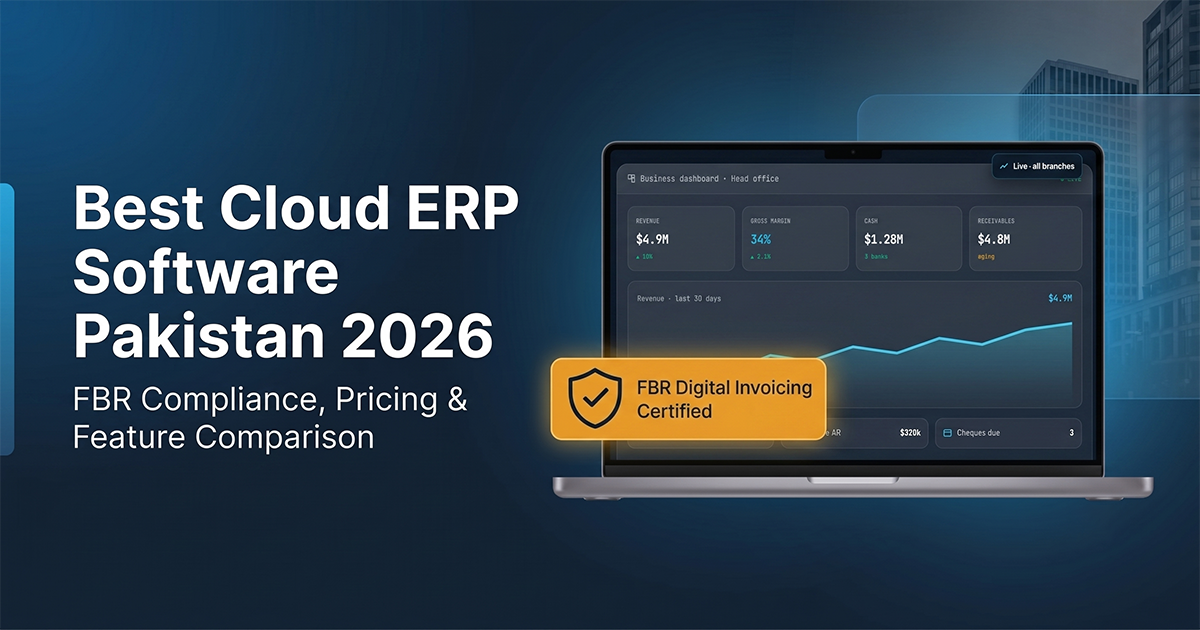
Best Cloud ERP Software Pakistan 2026 — FBR Compliance, Pricing & Feature Comparison

What Is Cloud ERP Software?
Cloud ERP (Enterprise Resource Planning) software integrates accounting, inventory, sales, purchasing, and HR into one online system accessible from any device. Unlike desktop ERP, cloud ERP requires no server setup, supports multi-branch access, and includes automatic updates. Popular in Pakistan for FBR digital invoicing compliance and multi-location business management.
Why Cloud ERP Matters for Pakistan SMEs
Pakistani businesses expanding beyond a single location face a recurring challenge: disconnected systems create month-end chaos. Your POS shows one inventory count, your accounting ledger shows another, and reconciling the two takes hours of manual work.
Cloud ERP solves this by unifying POS, inventory, purchasing, and accounting into one real-time database. A sale at the counter instantly updates stock levels, posts to the general ledger, and triggers reorder alerts if inventory falls below minimum levels.
Three factors drive cloud ERP adoption in Pakistan:
FBR digital invoicing compliance — Tier-1 retailers must transmit invoice data to FBR's IRIS portal in real-time per SRO 1852. Cloud ERP systems with built-in FBR integration eliminate the manual upload burden. Systems without native compliance require separate invoicing software or plugin setup, adding friction and cost.
Multi-branch visibility — Retail chains expanding across Lahore, Karachi, and Islamabad need centralized inventory control and consolidated reporting. Cloud ERP provides branch-level permissions, inter-branch stock transfers, and location-specific P&L analysis from one dashboard.
Remote access — Desktop ERP (Tally, older Candela RMS) requires physical presence at the server location. Cloud ERP lets owners monitor sales, approve purchase orders, and review financial reports from anywhere with internet access.
The alternative — running separate POS software, Excel spreadsheets, and disconnected accounting tools — creates data silos and reconciliation errors that compound as businesses scale.
Read more: FBR Digital Invoicing Complete Guide
How We Compared: Evaluation Criteria
This comparison evaluates seven cloud ERP systems based on publicly available information as of July 2026. Pricing and features may change — verify with vendors before purchasing.
1. FBR Compliance Maturity Does the system include native FBR digital invoicing (toggle on/off), require a plugin or integrator, or leave compliance entirely manual? Native compliance reduces setup time from weeks to minutes.
2. Pricing Transparency Is pricing publicly disclosed in PKR or USD? Per-user pricing (Odoo) scales with team size; per-business pricing (EloERP, AmalERP) remains flat regardless of users.
3. POS + ERP Integration Is the point-of-sale system unified with inventory and accounting in one database, or a bolt-on that syncs periodically? Unified systems eliminate end-of-day reconciliation.
4. Multi-Branch Management Does the system support centralized inventory, inter-branch transfers, branch-level permissions, and location-specific financial reporting?
5. Deployment Model SaaS (cloud-hosted, vendor-managed) vs. self-hosted (requires server and IT expertise). SaaS reduces infrastructure overhead; self-hosting offers control and potentially lower long-term cost.
6. Pakistan Market Fit Does the vendor offer local support, PKR pricing, and Pakistan-specific features like FBR compliance, EOBI/SESSI payroll integration, or TCS/Leopards courier connectivity?
Comparison Table
| Feature/Criteria | EloERP | Odoo | ERPNext | Zoho One | AmalERP | Moneypex |
|---|---|---|---|---|---|---|
| FBR Compliance | ✅ Native (toggle) | ⚠️ Plugin (App Store) | ⚠️ Custom/plugin | ❌ Manual | ✅ Advertised | ⚠️ Not disclosed |
| ZATCA (KSA) | ✅ Native Phase 2 | ⚠️ Plugin (partners) | ⚠️ Custom | ❌ | ❌ | ❌ |
| MyInvois (MY) | ✅ Native | ❌ | ❌ | ❌ | ❌ | ❌ |
| POS Included | ✅ (retail/restaurant/game-zone) | ✅ (Shop/Restaurant) | ✅ | ⚠️ Limited | ✅ | ⚠️ Add-on |
| Multi-Branch | ✅ | ✅ | ✅ | ✅ | ✅ | ✅ |
| Deployment | SaaS (cloud) | SaaS or self-hosted | Self-hosted or cloud | SaaS (cloud) | SaaS (cloud) | SaaS (cloud) |
| Pricing (approx) | Rs 30-45K/yr (PK) or $149-$349/yr (Intl) | ~PKR 2,500/user/mo | Free or ~PKR 3K/mo | ~PKR 3.3K-69K/mo (Books) or Contact (One) | Rs 2,500/mo | Contact for pricing |
| Best For | Multi-branch PK/GCC compliance | Global, customizable | Tech-savvy, budget | Zoho ecosystem | Budget PK SMEs | Accounting-first |
Legend: ✅ = Native/built-in ⚠️ = Plugin, customization, or limited ❌ = Not available or manual
EloERP — All-in-One Cloud ERP + POS with Native Compliance
EloERP is a Pakistan-developed cloud ERP combining POS, inventory, accounting, purchasing, HR, and manufacturing in one platform. Built by IT Vision Pvt. Ltd. (Lahore), it serves multi-branch retail, pharmacy, restaurant, and wholesale businesses expanding across Pakistan and the Gulf.
Key Features:
- Point-of-sale in retail, restaurant, and game-zone modes with table management and kitchen order tickets
- Batch/expiry tracking (FEFO), IMEI/serial tracking, multi-location inventory
- Double-entry accounting with maker-checker approvals and installment financing
- Procurement with 3-way matching (PO → GRN → invoice)
- HR & payroll with Pakistan statutory compliance (EOBI, SESSI)
- E-commerce integrations (Shopify, WooCommerce, Daraz) and Pakistan couriers (TCS, Leopards, BlueEx)
- White-label partner program for resellers
FBR Compliance Approach: Native toggle — FBR digital invoicing is built into the POS. Enable the toggle, and every invoice, POS receipt, and sales return generates an Invoice Reference Number (IRN) with QR code in real-time. No plugins, no integrators, no setup delay. Also supports ZATCA Phase 2 (Saudi), MyInvois (Malaysia), and UAE FTA (Peppol PINT).
Pricing: EloERP offers three yearly plans publicly disclosed on the pricing page:
- Pakistan: Rs 30,000/year (Cloud Suite), Rs 35,000/year (Cloud Suite Pro), Rs 45,000/year (Cloud Suite Plus)
- International: $149/year, $249/year, $349/year
- Saudi Arabia: SAR pricing available (toggle on pricing page)
All plans include FBR digital invoicing, ZATCA Phase 2, MyInvois, and UAE FTA compliance. A 14-day free trial is available without credit card requirement at e.eloerp.net/register.
Source: EloERP Pricing
Pros:
- All-in-one platform (no need for separate POS, accounting, inventory tools)
- Native FBR/ZATCA/MyInvois compliance (fastest time-to-compliance)
- Multi-branch centralized control with inventory sync and consolidated reporting
- Pakistan + GCC market focus with local support and understanding of FBR/ZATCA requirements
Cons:
- Closed-source SaaS (no self-hosting option vs. ERPNext/Odoo open-source)
- Limited third-party app ecosystem vs. Odoo's 40,000+ apps
Who Is It Best For?: Multi-branch retail chains, pharmacies, restaurants, and wholesale distributors in Pakistan, Saudi Arabia, Malaysia, or UAE who need FBR/ZATCA compliance built-in and want accounting + POS + inventory in one system without integration hassle.
Official Website: EloERP | Pricing
Odoo — Global Open-Source ERP with Plugin Ecosystem
Odoo is a Belgian-developed open-source ERP with 40,000+ community apps covering everything from CRM and e-commerce to manufacturing and project management. Available as cloud-hosted SaaS or self-hosted, Odoo serves micro businesses to enterprises (1-250+ employees) globally.
Key Features:
- Modular architecture (start with CRM, add apps as needed)
- POS modules for retail (Shop) and restaurants (Restaurant) fully integrated with inventory
- Manufacturing (bills of materials, work orders, quality control)
- E-commerce (online store builder) and website builder
- Project management, helpdesk, marketing automation
- 40,000+ third-party apps in Odoo App Store
FBR Compliance Approach: Plugin-dependent — FBR digital invoicing requires third-party apps from Odoo App Store (e.g., Zalino Tech FBR Integration). Per FBR rules, integration setup requires a licensed integrator. Additional integrator fees apply beyond Odoo subscription cost.
Source: Odoo FBR Integration App (Zalino Tech)
Pricing:
US$8.95/user/month for standard apps (approximately PKR 2,485/user/month at July 2026 exchange rates of $1 = PKR 277.70). Monthly billing is $11.20/user/month. Free tier includes CRM only. Per-user pricing means a 10-user team costs PKR 24,850/month (PKR 298K/year).
Source: Odoo Pricing
Pros:
- Largest ecosystem (40,000+ apps) for customization and industry-specific workflows
- Global community support (forums, tutorials, integrator network)
- Open-source core (can self-host and modify code)
- Strong manufacturing and project management modules
Cons:
- FBR compliance requires plugin + integrator (setup timeline varies, additional fees)
- Per-user pricing scales up quickly with team size
- Requires technical expertise or integrator for customization
- Pakistan-specific features (FBR, EOBI, local couriers) are plugin-dependent, not native
Who Is It Best For?: Businesses with global operations, tech-savvy teams who want customization flexibility, and companies willing to hire integrators for FBR setup and ongoing support.
Official Website: Odoo | Odoo Pricing
ERPNext — Free Open-Source ERP for Tech Teams
ERPNext is an India-developed open-source ERP alternative to Odoo. Self-hosted (free) or cloud-hosted via Frappe Cloud, ERPNext offers accounting, inventory, CRM, HR, and manufacturing without per-user licensing fees.
Key Features:
- Accounting with GST/tax templates for multiple countries
- Inventory management with batch/serial tracking and warehouses
- Manufacturing (multi-level bills of materials, production planning)
- POS module for retail
- HR and payroll with leave management and expense claims
- Project management and helpdesk
FBR Compliance Approach: Custom/plugin — ERPNext does not include native FBR digital invoicing. Businesses must customize the system (requires Python developer) or use third-party integrations. No official FBR plugin exists in the ERPNext marketplace as of July 2026.
Pricing: Free (self-hosted on your own server). Cloud hosting via Frappe Cloud starts at $5/month for basic Sites plans, scaling to $40+/month for dedicated Servers plans (approximately PKR 1,400-11,000+/month depending on configuration and provider).
Self-hosting is free but requires server infrastructure and IT expertise for installation, updates, and backups.
Source: Frappe Cloud Pricing
Pros:
- Completely free if self-hosted (no per-user or per-business fees)
- Open-source (full code access for customization)
- Active community (forums, GitHub issues, third-party developers)
- Comprehensive feature set (accounting, manufacturing, HR in one system)
Cons:
- No native FBR integration (requires custom development)
- Self-hosting requires server management skills (Linux, database backups, security patching)
- Smaller ecosystem vs. Odoo (fewer third-party apps and integrators)
- Cloud hosting (Frappe Cloud) costs add up for larger teams
Who Is It Best For?: Tech-savvy teams with in-house development resources, cost-conscious SMEs willing to self-manage infrastructure, and businesses that prioritize open-source flexibility over plug-and-play convenience.
Official Website: ERPNext
Zoho One — Modular Cloud Suite for Zoho Ecosystem Users
Zoho is an Indian SaaS company offering 45+ business apps bundled in Zoho One or sold individually (Zoho Books for accounting, Zoho Inventory for stock management, Zoho CRM for sales). Zoho targets service businesses, online retailers, and teams already using Zoho apps.
Key Features:
- Accounting (Zoho Books) with invoicing, expense tracking, and tax filing
- Inventory management (Zoho Inventory) with multi-warehouse support
- CRM (Zoho CRM) with sales pipeline and marketing automation
- E-commerce integrations (Shopify, Amazon, eBay)
- HR suite (Zoho People) with attendance, leave, and payroll
- 45+ apps in Zoho One bundle (includes Books, Inventory, CRM, Projects, Desk, etc.)
FBR Compliance Approach: Manual — Zoho does not offer Pakistan-specific FBR digital invoicing integration. Users must export sales data from Zoho Books and upload to FBR IRIS portal manually, or run separate FBR-compliant invoicing software alongside Zoho.
This adds daily/weekly manual reconciliation overhead and error risk.
Pricing: Zoho Books: $12/organization/month for Standard plan (approximately PKR 3,300/month), scaling to $24 (Professional), $36 (Premium), $129 (Elite), or $249 (Ultimate) based on features needed.
Zoho One (all 45+ apps): Contact Zoho for pricing (public website does not disclose per-user rates as of July 2026). Industry estimates suggest $90+/user/month.
Sources: Zoho Books Pricing | Zoho One
Pros:
- Modular approach (pay only for apps you need)
- Strong integrations with e-commerce platforms (Shopify, Amazon)
- Zoho One bundle offers 45+ apps for comprehensive business suite
- Established vendor with global presence and 24/7 support
Cons:
- No FBR compliance integration (manual export/upload required)
- Limited POS functionality (Zoho Inventory has basic POS, not full retail/restaurant features)
- Per-user pricing (Zoho One) scales up with team size
- Multi-branch management requires Zoho One tier (not available in Books/Inventory standalone)
Who Is It Best For?: Service businesses (consultancies, agencies) and online retailers already in the Zoho ecosystem (Books, CRM, etc.) who don't need FBR real-time compliance and prefer modular app selection.
Official Website: Zoho Books | Zoho One
AmalERP — Budget Pakistan-Focused Cloud ERP
AmalERP is developed by SwitcherTechno, a Pakistan-based software company. Positioned as an affordable cloud ERP for small Pakistani businesses, AmalERP emphasizes FBR compliance, WhatsApp integration for customer communication, and AI-powered document scanning.
Key Features:
- Accounting with FBR-ready invoicing
- Inventory management with multi-warehouse support
- WhatsApp integration for invoice delivery and customer communication
- AI document scanning for invoices and bills
- Point-of-sale for retail
- Multi-branch support
FBR Compliance Approach: Advertised as FBR-ready — AmalERP's website claims built-in FBR compliance, but technical implementation details (native vs. plugin, IRN generation method) are not publicly disclosed. Verify compliance methodology with vendor before purchasing.
Source: AmalERP
Pricing: Rs 2,500/month billed annually (Basic Plan). This is per-business pricing (flat rate regardless of users), making AmalERP the lowest-cost cloud ERP option in Pakistan as of July 2026.
Source: AmalERP (verified 2026-07-16)
Pros:
- Lowest pricing in Pakistan market (Rs 2,500/mo undercuts all competitors)
- Pakistan-specific features (FBR compliance, local support)
- WhatsApp integration for customer communication (differentiator vs. traditional ERP)
- AI document scanning for invoice data entry automation
Cons:
- Limited public documentation (feature depth unclear vs. EloERP/Odoo)
- No ZATCA/MyInvois support (Pakistan-only vs. multi-country compliance)
- Small ecosystem (no third-party app marketplace like Odoo)
- FBR compliance technical details not publicly documented (verify implementation before purchasing)
Who Is It Best For?: Budget-conscious Pakistani SMEs prioritizing low cost, basic FBR compliance, and WhatsApp customer communication over multi-country regulatory support or deep feature customization.
Official Website: AmalERP
Moneypex — Accounting-First ERP for Pharmacies
Moneypex is a Pakistan-developed cloud accounting and ERP system targeting pharmacies and small retail businesses. Known for a pre-loaded medicine database (reported 25,000+ SKUs), Moneypex serves accounting firms and pharmacy chains.
Key Features:
- Accounting with chart of accounts and financial reporting
- Inventory management with batch/expiry tracking
- Pre-loaded medicine database (25,000+ SKUs) for pharmacy sector
- POS module (add-on for retail/pharmacy)
- Multi-branch support
- Bank reconciliation and payroll
FBR Compliance Approach: FBR compliance status not publicly disclosed on the website. Verify compliance methodology and setup requirements with vendor before purchasing.
Pricing: Pricing is not publicly disclosed on the Moneypex website. Contact their sales team for custom quotes.
Source: Moneypex
Pros:
- Pre-loaded medicine database (25,000+ SKUs) saves pharmacy setup time
- Pakistan-focused with local support and accounting expertise
- Multi-branch support for pharmacy chains
- Batch/expiry tracking (critical for pharmacy compliance)
Cons:
- Pricing not transparent (requires sales contact)
- POS is add-on (not unified database like EloERP/Odoo)
- Limited public documentation (feature set and FBR compliance details unclear)
- No ZATCA/MyInvois support (Pakistan-only)
Who Is It Best For?: Pharmacies and accounting firms in Pakistan who need a pre-loaded medicine database and accounting-first workflow, and are willing to contact sales for custom pricing.
Official Website: Moneypex
FBR Compliance Comparison Deep-Dive
FBR digital invoicing requirements under SRO 1852 mandate that Tier-1 retailers transmit invoice data to FBR's IRIS portal in real-time. How each ERP handles this determines setup time, cost, and compliance risk.
Native Compliance: EloERP
Built-in toggle — Enable FBR digital invoicing in company settings, and every invoice, POS receipt, and sales return generates an Invoice Reference Number (IRN) with QR code automatically. The system transmits invoice data to FBR's IRIS portal the moment the sale is issued.
No integrator required, no plugin installation, no setup delay. Compliance activates in minutes.
Benefits: Fastest time-to-compliance, zero integration fees, vendor handles FBR API changes.
Read more: FBR Digital Invoicing Complete Guide
Plugin-Dependent Compliance: Odoo, ERPNext
Requires third-party app installation — Odoo users install FBR integration apps from the Odoo App Store (e.g., Zalino Tech FBR Integration). ERPNext users develop custom integrations or hire third-party developers.
Per FBR rules, integration setup requires a licensed integrator. Setup timelines vary by partner and project complexity — verify with your chosen Odoo integrator before committing.
Additional costs: Integrator fees (varies by partner, typically PKR 20,000-50,000 one-time setup) beyond ERP subscription.
Benefits: Works for businesses already committed to Odoo/ERPNext ecosystem and willing to coordinate with integrators.
Source: Bashalog Odoo FBR Compliance
Manual/No Compliance: Zoho
No FBR integration — Users export sales data from Zoho Books and upload to FBR IRIS portal manually (daily or weekly), or run separate FBR-compliant invoicing software alongside Zoho.
Time overhead: Daily manual reconciliation between Zoho and FBR portal (10-30 minutes per day).
Error risk: Manual processes are prone to data entry mistakes, missed invoices, and reconciliation discrepancies.
Buyer guidance: If FBR compliance is mandatory (Tier-1 retailers, growing businesses at risk of crossing regulatory thresholds), native compliance (EloERP) saves setup time and reduces error risk. If you have tech resources and want customization, plugin-dependent options (Odoo, ERPNext) offer flexibility but require integrator coordination.
Pricing Comparison Table
| Product | Starting Price (PKR/month approx) | Pricing Model | Free Tier? |
|---|---|---|---|
| AmalERP | Rs 2,500 | Per-business | ❌ |
| ERPNext | Free (self-hosted) or ~PKR 1.4K+ (cloud) | Per-instance | ✅ Free (self-hosted) |
| Odoo | ~PKR 2,500/user | Per-user | ✅ Free (CRM only) |
| Zoho Books | ~PKR 3,300-69,000 | Per-organization (range: $12-$249/mo) | ✅ Free (limited) |
| Zoho One | Contact for pricing | Per-user (~PKR 25K+/user est.) | ❌ |
| EloERP | Rs 30K-45K/yr (PK) or $149-$349/yr (Intl) | Per-location (yearly) | ❌ (14-day trial) |
| Moneypex | Contact for pricing | Unknown | ❌ |
Notes:
- Exchange rate: $1 = PKR 277 (July 2026)
- Per-user pricing (Odoo, Zoho One) scales with team size — 10 users = PKR 20,000-120,000/month
- Per-business pricing (AmalERP) and per-location pricing (EloERP) remain flat regardless of users
- Self-hosted ERPNext is free but requires server infrastructure and IT expertise
- Verify current pricing from official websites before purchasing
See EloERP pricing details: Pricing
Multi-Branch Management Comparison
Multi-branch retail and restaurant chains need centralized inventory visibility, inter-branch stock transfers, branch-level permissions, and location-specific profit-and-loss analysis.
Strong multi-branch support: EloERP, Odoo, ERPNext, Moneypex, AmalERP All five systems support centralized dashboards showing all branch sales, inventory levels, and financial performance. Inter-branch stock transfers (move 50 units from Lahore to Karachi branch) are standard features.
Limited multi-branch: Zoho Zoho Inventory supports multi-warehouse management, but branch-level financial reporting (separate P&L per location) requires Zoho One tier. Standalone Zoho Books + Inventory lacks branch-level accounting granularity.
Critical feature: Branch-level permissions Who can see/edit data for which locations? EloERP, Odoo, and ERPNext offer field-level permissions (e.g., Karachi manager sees only Karachi inventory, CEO sees all branches). This prevents unauthorized stock transfers and protects branch-level financial data.
POS + ERP Integration Comparison
Disconnected POS and accounting create end-of-day reconciliation pain. A sale at the counter should instantly update inventory, post to accounting, and reflect in customer ledger — without manual data entry.
Unified POS + ERP (one database):
EloERP: POS sale updates inventory, accounting, and customer ledger simultaneously. A pharmacy selling one box of medicine decreases stock count (triggers reorder if below minimum), posts revenue to general ledger, and updates the customer's credit balance — in one transaction.
Odoo: POS module fully integrated with inventory and accounting. Retail and restaurant POS modes included. Sale at the counter posts to accounting in real-time.
ERPNext: POS integrated with inventory and accounting. Supports retail POS with barcode scanning and cash register management.
Bolt-on POS (separate tools syncing):
Zoho: Zoho Inventory has limited native POS. Most users integrate third-party POS tools that sync periodically. End-of-day reconciliation required to match POS data with Zoho Books.
Moneypex: Accounting-first platform with POS as add-on. Integration depth unclear from public documentation — verify with vendor.
Why unified matters: When POS and accounting share one database, there's no end-of-day sync, no reconciliation errors, no "POS shows 100 units sold but accounting shows 98" discrepancies. Inventory and cash are always accurate in real-time.
How to Choose the Right ERP for Your Business
If You Need FBR Compliance Built-In
→ EloERP (native toggle, instant compliance) or AmalERP (advertised FBR-ready, verify claim)
Tier-1 retailers and growing businesses at risk of crossing FBR thresholds should prioritize native compliance to avoid integrator coordination and setup delays.
If You Want Lowest Cost + Tech Skills
→ ERPNext (free, open-source, self-hosted)
Self-hosting ERPNext eliminates subscription fees but requires server management expertise. Budget-conscious businesses with in-house IT staff benefit most.
If You Want Global Ecosystem + Customization
→ Odoo (40,000+ apps, global community, plugin for FBR)
Businesses with global operations, complex workflows, or industry-specific needs (manufacturing, project management) benefit from Odoo's ecosystem. Requires integrator for FBR setup.
If You're Already in Zoho Ecosystem
→ Zoho One (all apps in one bundle)
If you're already using Zoho Books, CRM, or other Zoho apps, Zoho One bundles 45+ tools for comprehensive coverage. No FBR integration — manual export/upload required.
If You're a Pharmacy Needing Medicine Database
→ Moneypex (25,000-medicine database pre-loaded) or EloERP (batch/expiry tracking, FBR compliance)
Pharmacies benefit from pre-loaded medicine SKUs (saves setup time) and batch/expiry tracking (regulatory requirement). EloERP adds FBR compliance; Moneypex offers accounting-first workflow.
If You're a Multi-Branch Retail/Restaurant Chain in PK/GCC
→ EloERP (POS + multi-branch + FBR/ZATCA native) or Odoo (if you need heavy customization)
Retail and restaurant chains expanding across Pakistan or into Saudi Arabia need FBR and ZATCA compliance, multi-branch inventory sync, and POS integration. EloERP offers native compliance; Odoo offers ecosystem flexibility.
Regulatory Sources & Data Sources
This comparison is based on the following sources:
Official Product Websites (pricing and features verified July 2026):
- EloERP Official Site
- EloERP Pricing
- Odoo Official Site
- Odoo Pricing
- Odoo FBR Integration App (Zalino Tech)
- ERPNext Official Site
- Frappe Cloud Pricing
- Zoho Books
- Zoho One Pricing
- AmalERP
- Moneypex Official Site
FBR Compliance References:
- FBR Digital Invoicing Requirements (official FBR portal)
- FBR IRIS Portal (invoice registration system)
- Bashalog Odoo FBR Compliance Guide (integrator reference for Odoo setup timeline)
Competitive Research:
Disclaimer: All information is accurate as of July 2026. ERP pricing, features, and compliance certifications may change. Verify current details with vendors before purchasing. This comparison is educational and does not constitute an endorsement of any product.
Get Started with EloERP
If you're looking for an all-in-one cloud ERP with native FBR compliance (no plugins, no integrators), EloERP offers:
- 14-day free trial (no credit card required)
- POS + inventory + accounting in one system
- Multi-branch management with centralized reporting
- Built-in ZATCA (Saudi), MyInvois (Malaysia), and UAE FTA support
Start your free trial: e.eloerp.net/register
Book a 30-minute demo: Schedule Demo
See pricing details: EloERP Pricing